Direct factory supply from Guangdong Ever Ray Environmental Material Co., Ltd. Engineered for precise viscosity control, high double-bond reactivity, and robust mechanical properties.
The global synthetic resin industry is undergoing a paradigm shift. Driven by stringent environmental legislation across Europe, North America, and the Asia-Pacific region (such as EU REACH regulations, EPA VOC limits, and China's GB38507-2020 standards for ink volatile emissions), traditional solvent-borne acrylic systems are rapidly being phased out. Enterprise procurement managers and chemical formulation R&D directors looking to buy acrylic resin from qualified suppliers and direct factories are increasingly shifting capital toward 100% solid-content UV-curable (ultraviolet radiation curable) and EB-curable (electron beam) acrylic oligomer platforms.
According to recent industrial material market data, the global UV curable resin market was valued at approximately USD 5.8 Billion in 2025 and is projected to expand at a Compound Annual Growth Rate (CAGR) of 8.4% through 2032. Among all photopolymerizable binder systems, acrylate oligomers (including epoxy acrylates, urethane acrylates, polyester acrylates, and specialty modified acrylic polymers) command over 72% of total market volume. This dominance stems from their exceptional cross-linking kinetics, mechanical versatility, surface aesthetic control, and compatibility with high-speed automated production lines.
Selecting the correct acrylate resin architecture is critical to balancing curing kinetics, cost efficiency, substrate adhesion, and outdoor weathering performance.
| Resin Chemistry Family | Cure Speed & Reactivity | Tensile Hardness & Abrasion | Flexibility & Elongation | Substrate Adhesion (PC/ABS/Glass) | Yellowing & Weathering Resistance | Primary Industrial Application |
|---|---|---|---|---|---|---|
| Standard Bisphenol-A Epoxy Acrylate | Ultra-Fast (< 0.5s) | High (5H–6H) | Low (< 3%) | Moderate (Metal, Wood, Paper) | Poor (Yellowing Prone) | Overprint Varnishes (OPV), Paper Coatings, High-Speed Wood Fillers |
| Aliphatic Polyurethane Acrylate (PUA) | Moderate to Fast | Adjustable (HB–3H) | High (20% – 250%) | Excellent (Plastics, PC, TPU, PET) | Exceptional (Non-Yellowing, Outdoor) | 3C Mobile Housings, Automotive Exterior Trim, UV Nail Gels, Optical Films |
| Aromatic Polyurethane Acrylate | Fast | High (2H–4H) | Moderate (5% – 30%) | Strong (ABS, PVC, Metals) | Moderate (Interior Use) | High-Grade Wood Flooring Topcoats, Plastic Vacuum Plating Primers |
| Polyester Acrylate Oligomer | Very Fast | Moderate (H–2H) | Moderate (5% – 15%) | Good (Metal Foils, Treated Plastics) | Moderate to Good | UV Offset Inks, Flexographic Inks, Pigment Concentrate Grinding Vehicles |
| Pure Acrylate / Special Modified Monomers | Controlled | Customized | Superior Elasticity | Superior (Glass, Metals, Ceramic) | High Stability | Glass Primers, Boiling Water Resistant Topcoats, Optical Clear Adhesives |
When free-radical UV acrylate resins cure in ambient air, atmospheric oxygen diffuses into the liquid coating surface, reacting with active polymer radicals to form unreactive peroxyl radicals ($ROO\cdot$). This causes surface tackiness, reduced pencil hardness, and inferior solvent resistance. Suppliers like Guangdong Ever Ray Environmental Material Co., Ltd. solve this by synthesizing amine-modified acrylate oligomers and hyperbranched acrylate structures. The tertiary amine groups scavenge dissolved oxygen via hydrogen abstraction, restoring surface polymerization rates without requiring nitrogen purging.
Adhesion failures on untreated Polycarbonate (PC), Polymethyl Methacrylate (PMMA), Polypropylene (PP), and glass are major challenges in coating engineering. Our modified acrylate series incorporates specific polar carboxyl, phosphate, or hydroxyl functional groups into the oligomer backbone. These functional moieties establish strong hydrogen bonding and coordination bonds at the substrate interface, achieving 5B adhesion performance under ASTM D3359 cross-hatch tape testing even after 100°C boiling water immersion.
Established in 2006, EVER RAY is a premier high-tech enterprise specializing in the R&D, molecular design, and large-scale industrial manufacturing of UV curable resins and specialty acrylate oligomers.
Our state-of-the-art production complex is situated in Dawan Industrial Park, Yunfu City, Guangdong, spanning over 40,000 square meters. Equipped with 10+ fully automated stainless-steel chemical reactor lines, high-vacuum distillation towers, and closed-loop environmental controls, our facility delivers consistent, multi-ton batch volumes.
Quality is verified at every stage of production. From raw material incoming inspection (NCO value titration, epoxy equivalent testing) to finished product characterization (Brookfield viscosity, Gardner color, acid value, gel fraction analysis), every drum comes backed with comprehensive TDS, SDS, and COA documentation.
Holding over 10 invention and utility patents in photopolymerizable materials, EVER RAY's senior polymer chemists specialize in custom monomer synthesis, hyperbranched oligomer architecture, and waterborne UV polyurethane dispersion (UV-PUD) technology.
Connect directly with our Jiangmen Sales Headquarters or Yunfu Chemical Engineering Laboratory.
Smartphones, laptops, wearable devices, and automotive interior panels require protective topcoats that resist scratches, sweat, and cosmetics. EVER RAY's Aromatic & Aliphatic Polyurethane Acrylate Oligomer Series (e.g., Grades 7911, 7230E, 1730) deliver exceptional inter-coat adhesion with PVD vacuum metallized aluminum/chromium layers on ABS and PC substrates. They maintain optical clarity, eliminate iridescent rainbow effects, and pass 500+ cycles of RCA tape abrasion tests.
Commercial printing lines demand oligomers with superior pigment wetting, fast lithographic response, and excellent water-ink balance. Our Polyester Acrylate Series (e.g., Grades 5403-3F, 5403-2F, 5502B) allow ink formulators to maximize pigment loading without experiencing viscosity spikes. They prevent emulsification on dampening rollers during high-speed offset printing while ensuring instantaneous curing under LED-UV 395nm lamps.
Industrial wood coating lines operate at high conveyor speeds (>30 m/min). Formulators utilize EVER RAY's Epoxy Acrylate Oligomers (e.g., Grades 6100D-85, 6231, 67283) to construct high-build sanding sealers, putty fillers, and topcoats. These resins provide extreme pencil hardness (up to 6H), rapid sandability, low volumetric shrinkage, and superior resistance to household chemicals, alcohol, and hot water staining.
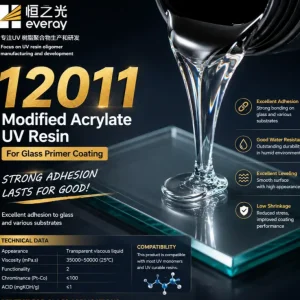
Specialty applications require low exotherm during polymerization and tailored flexibility. Our Low Heat Release Urethane Resins (e.g., Grade 72583) prevent thermal burning or nail plate discomfort in cosmetic nail gels while ensuring bubble-free curing. For glass container packaging and architectural glass, our modified acrylates (Grade 12011 & 17730A-2) form permanent water-resistant chemical bonds on smooth non-porous silica surfaces.
EVER RAY ensures all synthesized acrylate oligomers and modified monomers strictly adhere to global chemical inventory standards:
To accommodate diverse laboratory evaluations and industrial scale manufacturing operations, we offer flexible container configurations:
Leveraging major port access at Guangzhou, Shenzhen, and Hong Kong, our export shipping team guarantees sea, air, and multimodal logistics safety for non-hazardous and hazardous chemical shipments with full IMDG / IATA compliance.
As environmental targets tighten globally, EVER RAY's R&D center is leading three primary innovation fronts in synthetic radiation-curable materials.
Replacing petroleum-derived polyols with renewable carbon feedstocks (derived from soybean oil, castor oil, and cashew nut shell liquid). Our green synthesis platform achieves bio-content levels from 35% up to 70% while maintaining equivalent cross-linking speed and tensile strength.
Eliminating shadow-area uncured liquid in complex 3D automotive electronic modules and structural adhesives. Our dual-cure polyurethane acrylates combine rapid surface UV pinning with secondary moisture-curing or thermal-curing mechanisms for 100% deep-section conversion.
Combining the low-VOC zero-monomer diluent advantages of aqueous coatings with the high hardness and scratch resistance of traditional UV systems. UV-PUDs offer ultra-thin film deposition ideal for premium leather, flexible packaging, and luxury wood finishes.
Explore additional OEM/ODM formulations available for immediate global export and bulk order customization.
Addressing core questions regarding chemical formulation, batch consistency, sample requesting, and direct factory procurement.
Epoxy Acrylate is synthesized by reacting epoxy resins (typically Bisphenol-A diglycidyl ether) with acrylic acid. It offers ultra-fast UV cure speed, high pencil hardness (up to 5H–6H), superior scratch resistance, and lower raw material costs. However, it lacks flexibility and is prone to yellowing under outdoor UV light.
Polyurethane Acrylate (PUA) is produced by reacting diisocyanates (IPDI, HDI, or TDI) with polyols and hydroxyl-functional acrylates (such as HEA/HPA). Aliphatic PUA provides outstanding weatherability, non-yellowing clarity, high impact resistance, and excellent adhesion to plastics (PC, ABS, PET, TPU). Aromatic PUA offers balanced hardness and cost-efficiency for interior applications.
Our Yunfu production base operates under ISO9001 quality management control. Raw materials undergo rigorous incoming inspection (NCO content, hydroxyl value, purity testing). Synthesized batches are monitored in real-time for viscosity (Brookfield viscometer at 25°C), acid value (< 1.0 mg KOH/g), and Gardner color score (< 1.0 for clear grades). Final products are released only when specifications match within a strict ±5% tolerance band.
Yes. Our dedicated R&D synthesis team can modify oligomer backbone structures, degree of acrylation (functionality from 1 to 6+), glass transition temperature ($T_g$), and pre-dilution monomer ratios (e.g., diluting high-viscosity resins with HDDA, TPGDA, TMPTA, or IBOA) to suit your exact coating line viscosity window and substrate adhesion requirements.
All UV curable acrylate resins contain free-radical inhibitors (such as MEHQ) and must be stored in original sealed light-proof containers away from direct sunlight, UV rays, heat sources, and strong oxidizers. Recommended storage temperature is between 10°C and 30°C. Under these conditions, standard shelf life is 12 months from the date of manufacturing.
You can request 1kg sample pails for lab evaluation directly by contacting our international sales department via email ([email protected] or [email protected]) or WhatsApp (+86-18029628893 / +86-18033139299). Technical data sheets (TDS), Safety Data Sheets (SDS), and initial starting formulation recommendations are provided with all sample shipments.
Secure factory-direct pricing, custom formulation development, and dependable international chemical supply from Guangdong Ever Ray Environmental Material Co., Ltd.