Direct factory-grade oligomers engineered for extreme adhesion, micro-shrinkage, anti-fouling performance, and specialized industrial coatings.
Understanding the macromolecular structural modifications that solve the inherent physical limitations of conventional UV-curable resins.
In modern industrial radiation curing technology, standard commodity oligomers—such as conventional Bisphenol A epoxy acrylates, standard aromatic urethane acrylates, or unmodified polyester acrylates—frequently hit performance ceilings. When formulators attempt to balance opposing chemical physical properties, such as extreme surface hardness versus flexible impact resistance, or high crosslink density versus low volumetric polymerization shrinkage, standard chemistry fails. This technical bottleneck has driven the necessity for Special Functional Acrylate Oligomers (SFAOs).
As a premier Special Functional Acrylate Oligomer manufacturer and direct-factory supplier, our synthetic chemistry approach focuses on altering the macromolecular backbone, incorporating specialized hyperbranched architectures, fluorine/silicone hybrid modifications, acidic adhesion-promoting functional groups, and self-curing tertiary amine synergists directly into the polymer chain.
Polymerization shrinkage causes internal stress, warping, and adhesion loss on inert substrates. Our low-shrinkage modified acrylates (such as Grade 1290H and 17701) utilize sterically hindered alicyclic backbones and ring-opening/stretchable macromolecular segments, reducing linear shrinkage to below 1.2% while retaining rapid C=C double bond conversion rates.
Inert materials like glass, PET, untreated polypropylene (PP), and metallic alloys feature non-polar or smooth surfaces. By introducing carboxyl, phosphate ester, or hydroxyl-functionalized acrylate backbones (e.g., Grade 1100UV and 1200A), our resins chemically anchor to substrate oxides, guaranteeing 5B cross-hatch adhesion even after rigorous environmental exposure.
For anti-smudge, anti-graffiti, and low surface tension applications, special functional resins like 1291B-1 integrate low-energy perfluoroalkyl or polysiloxane terminal groups. During the liquid application stage, these functional groups migrate to the air-coating interface, creating a permanent hydrophobic and oleophobic barrier upon UV curing.
Macromolecular Insight for Formulators: The performance of a UV coating or printing ink is predominantly governed by the oligomer framework. While reactive diluents adjust viscosity and photoinitiators dictate speed, the Special Functional Acrylate Oligomer forms the 80%+ structural matrix that dictates hardness, chemical resistance, flexibility, glass transition temperature ($T_g$), and long-term durability.
How Tier-1 procurement teams in North America, Europe, and Asia-Pacific optimize total cost of ownership (TCO) through direct-factory sourcing.
The global demand for Special Functional Acrylate Oligomers is experiencing structural expansion driven by environmental mandates, regulatory tightening (REACH, TSCA, China GB standards), and the accelerated phase-out of solvent-borne systems. Enterprise procurement executives and technical directors face three core challenges:
Traders and regional re-packers often deliver inconsistent batch-to-batch viscosity and color variance. Formulators incur massive costs re-adjusting photoinitiator loading or diluent ratios line-by-line. Sourcing directly from an established manufacturing base with automated synthesis kettles eliminates batch drift.
Exporting finished consumer electronics, automotive components, and food packaging demands strict compliance regarding organotin catalysts, residual monomer content, heavy metals, and volatile organic compounds (VOCs). Modern factories must provide comprehensive SDS, RoHS, REACH SVHC, and Halogen-Free verification.
To assist chemical formulating teams in selecting the precise resin architecture, the matrix below outlines core industrial challenges and our corresponding factory-developed functional oligomeric solutions:
| Target Substrate / Application | Industrial Bottleneck | Functional Oligomer Solution | Key Chemical Property |
|---|---|---|---|
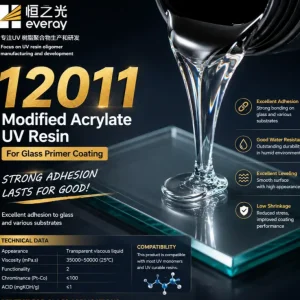
| Glass & Mirror Coatings | Loss of adhesion during boiling-water, dishwasher, or humidity chamber testing. | Grade 12011 / 1200A | Phosphate/Silane modified backbone delivering hydro-resistant covalent bonding to SiO₂ lattice. |
| LVT / PVC Resilient Flooring | High wear scratching, scuffing, and curling caused by cure shrinkage stress. | Grade 1262B / 1290H | Low-viscosity, micro-shrinkage modified oligomer enabling high line speed without tile curling. |
| Consumer Electronics (3C Plastic) | Fingerprint staining, sebum degradation, and yellowing under UV exposure. | Grade 1291B-1 / 6851A | Fluorine/silicone modified anti-fouling resin with non-yellowing aliphatic polyolefin structure. |
| High-Speed Offset & Film Inks | Poor pigment wetting, slow surface cure due to oxygen inhibition, film misting. | Grade 17701 / 1100UV | Hyperbranched acrylated structure with optimized rheology and instant surface tack-free response. |
How our laboratory is advancing special functional acrylate oligomers to align with global sustainability and LED-UV energy transition trends.
Mercury lamp phase-outs demand resins responsive to long-wavelength LED-UV curing (365nm, 385nm, 395nm). Our functional oligomers integrate active amine synergist chains and high-sensitivity acrylate groups to eliminate surface tackiness under low-energy LED lamps.
Addressing global scope-3 carbon reduction targets, our R&D synthesizes functional oligomers derived from plant-based polyols, modified bio-succinic acid, and cardanol chemistry without sacrificing chemical resistance or cure speed.
For complex 3D objects, automotive components, and electronic encapsulation with shadowed areas, our dual-cure oligomer series combines UV radiation curing with secondary moisture-cure or thermal-cure functional groups.
Operated under strict ISO9001 and ISO14001 management systems, our 40,000+ square meter production center houses multi-ton stainless steel synthesis reactors equipped with automated DCS system controls.
Select from our specialized polyurethane acrylates, high-hardness epoxy acrylates, and low-yellowing clear coating resins.
In-depth answers from our senior R&D photopolymer engineers regarding formulation, compatibility, and customization.
