Engineered for exceptional reactivity, physical durability, pigment dispersion, and precise viscosity control across specialized coating, printing, and industrial bonding substrates.
The radical shift toward zero-VOC industrial coatings, high-throughput digital fabrication, and sustainable radiation curing technologies.
The global market for UV curable resins and acrylate oligomers has evolved from a niche specialty sector into a cornerstone of modern eco-friendly industrial manufacturing. Driven by aggressive environmental mandates worldwide—such as the European Union's REACH and SVHC restrictions, the United States EPA Clean Air Act Title V, and China’s stringent VOC emission standards (GB38508-2020)—manufacturers across automotives, consumer electronics, graphic arts, and packaging are systematically replacing traditional solvent-borne systems with 100% solids, radiation-curable photopolymers.
Ultraviolet (UV) and Electron Beam (EB) curing systems operate through free-radical or cationic photo-polymerization mechanisms. Upon exposure to targeted light spectra (typically 200–400 nm for conventional mercury lamps and 365–395 nm for modern UV-LED systems), photoinitiators cleave to generate active radicals that rapidly crosslink liquid acrylate functional groups into highly durable, three-dimensional thermoset networks in fractions of a second. This instantaneous conversion delivers massive operational productivity gains: curing cycles drop from hours to milliseconds, footprint requirement shrinks by up to 80%, and operational thermal loads are virtually eliminated.
Fully compliant with global eco-mandates including TSCA, IECSC, REACH registration, and heavy-metal-free standards, allowing seamless integration into global supply chains.
Formulated specifically for narrow-band 365nm, 385nm, and 395nm UV-LED emission spectra, drastically cutting kilowatt-hour energy consumption versus traditional lamps.
Custom molecular weight distributions ensure ideal Newtonian or pseudoplastic flow, catering to high-speed flexo, offset, vacuum spray, or roll coating lines.
In-depth technical breakdown of backbone chemistry, crosslink density, functional group mechanics, and cured film characteristics.
| Oligomer Chemical Family | Backbone Structure Characteristics | Cure Speed / Reactivity | Glass Transition ($T_g$) | Key Strengths | Primary Industrial Applications |
|---|---|---|---|---|---|
| Bisphenol-A Epoxy Acrylates | Aromatic aromatic-ether backbone terminated with acrylate esters. | Ultra-Fast (<100 ms) | High (60°C – 95°C) | Extreme hardness, high tensile strength, economic efficiency, superior chemical resistance. | Wood primers, paper OPVs, metal decoration inks, rigid PCB solder masks. |
| Aliphatic Polyurethane Acrylates (PUA) | Cycloaliphatic or linear aliphatic diisocyanate (IPDI/HDI) with polyether/polyester soft blocks. | Moderate to Fast | Variable (-20°C to 70°C) | Zero yellowing, outdoor weatherability, exceptional flexibility, impact resistance. | Automotive clearcoats, 3C electronic housings, optical films, UV nail gel topcoats. |
| Aromatic Polyurethane Acrylates (PUA) | TDI/MDI based polyurethane chains coupled with hydroxy-functional acrylates. | Fast | Moderate (30°C – 65°C) | High toughness, excellent abrasion and scuff resistance, cost-balanced performance. | Floor coatings, plastic topcoats, industrial leather finishes, vacuum plating basecoats. |
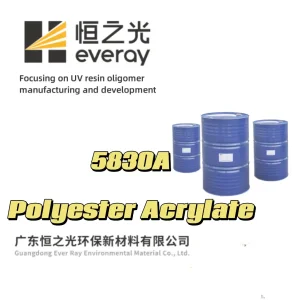
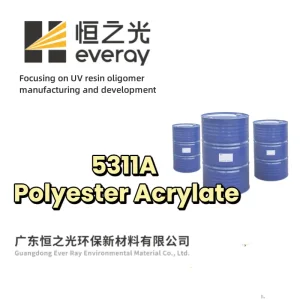
| Polyester Acrylates | Multifunctional polyester polyols reacted with acrylic acid. | Fast to Very Fast | Low to Moderate | Low viscosity, outstanding pigment wetting, minimal surface tension, flexo compatibility. | UV offset printing inks, lithographic varnishes, high-pigment screen inks. |
| Hyperbranched / Dendritic Acrylates | Highly branched globular molecular architecture with 6–16 acrylate functional terminals. | Ultra-Fast | High (>80°C) | Very low viscosity despite high molecular weight, low volume shrinkage, high crosslink density. | 3D printing photopolymers, micro-lens arrays, anti-scratch hardcoats. |
Free radical photopolymerization in ambient air suffers from atmospheric oxygen quenching active radical species at the film surface, resulting in tacky or under-cured surfaces. Formulators utilize amino-modified acrylates or active amine synergists (such as EVER RAY's specialty amine oligomers) to induce a chain-transfer reaction that consumes dissolved oxygen and generates reactive aminoalkyl radicals, thereby securing complete surface cure under low UV irradiation doses.
Integrating raw material supply networks with advanced chemical automation to deliver unmatched quality-to-cost ratios globally.
Situated within China's premier Guangdong petrochemical industrial belt, our manufacturing base leverages direct pipeline and bulk tank access to core chemical precursors including acrylic acid, acrylic esters, HDDA, TMPTA, IPDI, TDI, and specialized polyols. This hyper-dense supply chain integration eliminates intermediary logistics costs and guarantees chemical feedstock purity.
By operating high-capacity continuous stirred-tank reactors (CSTR) equipped with automated DCS (Distributed Control System) hardware, batch reaction parameters—including exothermic temperature spikes, acid value neutralizations, esterification ratios, and inhibitor ratios—are controlled to tolerances within ±0.5%. This level of process control ensures that buyers receive identical viscosity profiles, color indexes (APHA <50), and double-bond density across 200kg drum or 1000kg IBC tote shipments.
How customized UV curable resin grades solve specific production bottlenecks across key global market sectors.
Market Hub: East Asian Electronics Assemblies (China, Vietnam, South Korea)
Challenge: Mobile phone housings and laptop covers require intense metallic luster via Physical Vapor Deposition (PVD) vacuum electroplating, demanding extreme inter-layer adhesion between plastic (PC/ABS), UV basecoat, aluminum target layer, and UV topcoat.
Solution: Grade 7620 UV Resin provides exceptionally low shrinkage stress during crosslinking, preventing micro-cracking during vacuum thermal stress while maintaining high gloss (>95 GU at 60°) and pass of cross-hatch tape testing (ASTM D3359 5B).
Market Hub: North American & European Packaging Converters
Challenge: In-line printing presses operating at speeds exceeding 300 meters/min demand UV inks with immediate pigment wetting, minimal misting, low rheological thixotropy, and instant water-ink balance.
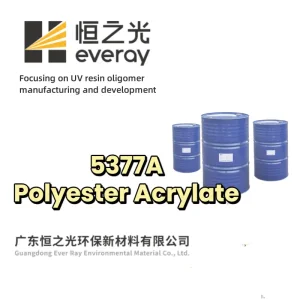
Solution: Polyester Acrylates 5320 and 5377A feature low hydroxyl numbers and optimized polarity, allowing organic pigments (Phthalo Blue, Rubine Red) to disperse effortlessly without agglomeration while keeping misting at near-zero levels under high shear forces.
Market Hub: Global Industrial Rapid Prototyping & Medical Manufacturing
Challenge: SLA/DLP 3D printed parts often suffer from brittleness, severe volumetric warp during tray peeling, and inadequate heat deflection temperatures (HDT).
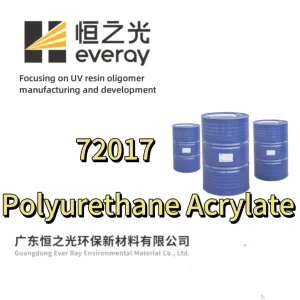
Solution: Photo-Thermal Dual-Curing Polyurethane Acrylate 72017 combines high-speed green state UV curing for crisp dimensional printing resolution with a secondary thermal cure phase, unlocking tensile strength >65 MPa and elongation at break up to 35%.
Navigating technical qualification, risk mitigation, containerized transport, and total cost of ownership (TCO).
Procuring chemical raw materials internationally requires balancing technical compliance, batch reliability, landed costs, and supply continuity. When evaluating UV curable resins and acrylate oligomers, procurement officers and principal formulators should execute a structured multi-stage qualification protocol:
Obtain grade-specific Technical Data Sheets (TDS), Safety Data Sheets (SDS complying with GHS Revision 8), and Certificate of Analysis (COA) templates. Confirm monomer content, residual solvent limits (<0.1% for low-odor grades), free radical inhibitor concentrations (e.g., MEHQ levels), and hazard classifications for transport.
Evaluate 1kg – 5kg lab samples in masterbatch formulations. Measure double bond conversion rate under target UV intensity (mJ/cm²), gloss, pendulum hardness (König/Persoz), MEK double-rub solvent resistance, and cross-hatch adhesion across targeted substrates (glass, aluminum, PET, ABS, wood primer).
Run 200kg drum pilot batches through full-scale industrial application equipment (e.g., roller coaters, high-speed offset presses, automated robotic sprayers) to verify misting, leveling, de-aeration, pot life, and oven stability under operational temperatures.
Establish standard packaging protocols—200kg steel drums or 1000kg UV-blocking IBC totes. Ensure temperature-controlled ocean freight options for heat-sensitive hyper-reactive oligomers during transit across equatorial shipping lanes.
Bio-based photopolymers, ultra-low energy LED systems, and self-healing functional coatings.
Synthesizing polyester and polyurethane acrylate oligomers utilizing bio-derived polyols sourced from castor oil, soybean oil, and succinic acid, elevating renewable carbon content to over 40–60% without compromising mechanical performance.
Emulsifying polyurethane acrylates into aqueous dispersions. Combining the ultra-low viscosity and zero VOCs of waterborne coatings with the instant cure speed and chemical resistance of traditional UV chemistries.
Incorporating dynamic reversible covalent bonds (e.g., Diels-Alder micro-domains) into urethane acrylate chains, enabling micro-scratches on automotive or electronic clearcoats to thermally seal under ambient sunlight exposure.
Detailed answers provided by our senior polymer application engineers and international trade specialists.
Epoxy acrylates offer ultra-fast curing, high pencil hardness (up to 3H-5H), extreme chemical resistance, and very high tensile strength at a competitive cost. However, they possess lower elongation flexibility and are prone to yellowing under prolonged outdoor UV exposure due to their aromatic ether backbone. Aliphatic polyurethane acrylates (PUA), conversely, feature non-yellowing aliphatic diisocyanate backbones, outstanding weatherability, superior impact resistance, and high flexural elasticity, making them ideal for exterior coatings and flexible plastic substrates.
Amine synergists operate via a rapid hydrogen-abstraction reaction with Type II photoinitiators (such as Benzophenone or ITX). Additionally, they react with dissolved atmospheric oxygen that would otherwise inhibit radical chain growth at the film surface. By scavenging oxygen radicals and generating active aminoalkyl radicals, amine synergists eliminate surface tackiness, accelerate linear curing speed, and lower the required overall photoinitiator concentration, reducing total formulation costs.
Adhesion on smooth, non-porous, or low-surface-energy substrates requires oligomers with low volumetric shrinkage during polymerization and incorporated functional groups (such as carboxyl, phosphate ester, or hydroxyl terminals) that form chemical bonds or strong hydrogen bonding with the substrate interface. Specialty modified acrylates (such as EVER RAY Grade 17730A-2 or 1200A) promote wetting and mechanical anchoring, routinely achieving 5B adhesion ratings in cross-hatch tape testing without requiring aggressive chemical primers.
UV curable resins must be stored in original sealed, light-proof containers (typically dark HDPE drums, lined steel drums, or black-shielded IBC totes) at temperatures between 5°C and 30°C. Storage away from direct sunlight, ambient UV sources, and localized heat sources (radiators/boilers) is critical. Under these recommended conditions, standard shelf life is a minimum of 12 months. Note that acrylic oligomers require oxygen present in the container head-space to allow radical inhibitors (like MEHQ) to function correctly; containers should never be nitrogen-blanketed or purged of oxygen.
Every export consignment includes a comprehensive documentation pack: Batch-specific Certificate of Analysis (COA), 16-section Safety Data Sheet (SDS) translated into target market languages, Commercial Invoice, Packing List, Certificate of Origin (COO), and Bill of Lading (BOL). For specialized destinations, REACH clearance compliance certificates and non-dangerous goods declaration certificates (if non-hazardous) are routinely provided.
Targeted oligomers for wood coatings, high-boiling-water resistant primers, flexographic printing inks, and low-shrinkage photo-thermal photopolymers.