High-yield engineered oligomers and reactive monomers tailored for UV curing, industrial coatings, wood varnishes, and precision electronics.
The modern global market for industrial coatings, advanced adhesives, and radiation-curable resins is undergoing a monumental chemical paradigm shift. Global manufacturing enterprises seeking to buy epoxy and paint from certified manufacturers and suppliers are no longer merely seeking bulk chemical commodities. Instead, tier-one formulators, OEM procurement executives, and chemical engineers require highly engineered, functionalized polymer matrices that combine instantaneous free-radical or cationic cure response with extreme chemical resistance, minimal cross-link volumetric shrinkage, and compliance with stringent environmental mandates.
As a leading China-based manufacturer headquartered in Jiangmen with large-scale production facilities in Yunfu, Guangdong, Guangdong Ever Ray Environmental Material Co., Ltd. (EVER RAY) provides tailored macro-level chemical solutions across six vital industrial verticals:
Epoxy acrylates (e.g., Grade 6100D-85, 6102) provide glass-like hardness (4H+ pencil hardness), scratch prevention, and solvent barrier properties over solid wood, engineered parquet, and SPC/LVT vinyl tiles.
Aliphatic polyurethane acrylates (PUA) engineered for mobile phone casings, laptop shells, and wearables demand zero yellowing, thermal shock endurance (-40°C to +85°C), and high flexibility.
Specialty low-shrinkage oligomers and ABS-like engineering resins (e.g., Grade 71209A-1) optimized for SLA, DLP, and LCD 3D printing platforms requiring dimensional fidelity and impact strength.
Fast-curing polyester acrylates and modified epoxy acrylates delivering fast pigment dispersion wetting, high gloss, and litho water-ink balance for UV offset, flexo, and screen printing.
Pure acrylates and modified oligomers designed for glass-to-metal, optical bonding, and electronic components encapsulating boiling water resistance and die-attach reliability.
Emulsifier-free waterborne polyurethane acrylate dispersions (WB UV) eliminating volatile organic solvents (Zero VOC) without sacrificing mechanical hardness or dry-to-touch speed.
The global demand for epoxy resins, acrylate oligomers, and protective paints is driven by key technological, regulatory, and economic macroeconomic factors. Understanding these structural shifts is essential for B2B procurement managers negotiating supply contracts.
Traditional two-component (2K) epoxy paints and solvent-borne polyurethane finishes demand thermal curing times ranging from several hours to multiple days. This creates severe floor-space bottlenecks, excessive energy consumption, and high greenhouse gas (GHG) emissions. Radiation curing—utilizing Ultraviolet (UV) light-emitting diodes (UV-LED operating at 365nm, 385nm, 395nm, or 405nm) or Medium-Pressure Mercury Vapour lamps—radically transforms factory economics:
Global regulatory enforcement is accelerating the phase-out of high-VOC, high-odor, and toxic chemical compounds. Enterprise buyers selecting resin suppliers must ensure strict adherence to international standard frameworks:
Selecting the precise polymer backbone is crucial to balance glass transition temperature ($T_g$), viscosity, tensile strength, elongation at break, and chemical resistance. Below is an engineering comparison matrix designed for R&D formulators.
| Resin Chemistry Class | Typical Viscosity (mPa.s @ 25°C) | Pencil Hardness | Elongation at Break (%) | Cure Speed Response | Yellowing Resistance | Primary Industrial Application |
|---|---|---|---|---|---|---|
| Bisphenol A Epoxy Acrylate (e.g., Grade 9105A-80) | 15,000 – 45,000 | 3H – 5H | 1% – 3% | Ultra-Fast (< 0.5s) | Fair (Interior Only) | Wood sealers, paper varnish, high-gloss OPV, metal inks |
| Modified Epoxy Acrylate (e.g., Grade 6231 / 6300) | 3,000 – 12,000 | 2H – 4H | 3% – 8% | Fast | Good | Plastic topcoats, screen inks, flexographic printing |
| Aliphatic Polyurethane Acrylate (e.g., Grade 7296-1) | 5,000 – 35,000 | H – 3H | 15% – 150% | Moderate to Fast | Exceptional (5+ Yrs Outdoor) | 3C electronics, automotive trim, nail gels, optical films |
| Aromatic Polyurethane Acrylate (e.g., Grade 7113A) | 8,000 – 25,000 | 2H – 4H | 5% – 25% | Fast | Moderate | Vacuum metallization primer, industrial flooring, PVC topcoats |
| Polyester Acrylate Oligomer (e.g., Grade 5103 / 5320) | 800 – 5,000 | HB – 2H | 10% – 45% | Fast | Good | Pigmented offset inks, plastic primers, flexible packaging |
| Waterborne UV Polyurethane (e.g., Grade 70601) | 50 – 500 | H – 3H | 20% – 100% | Fast (Post Water Evap) | Excellent | Zero-VOC wood finishes, leather topcoats, eco-packaging |
Real-world industrial deployment requires adapting chemical formulations to local climate conditions, substrate variations, and regional line speeds.
Challenge: A Munich-based Tier-1 automotive supplier required a scratch-resistant interior trim coating capable of passing rigorous heat-aging tests (100 hours @ 105°C) without micro-cracking or yellowing.
Solution: Implementation of EVER RAY’s Aliphatic Polyurethane Acrylate blended with functionalized reactive diluents. Yielded 3H pencil hardness while maintaining 25% elongation, fully passing BMW and VW climate chamber specs.
Challenge: High ambient humidity (85%+ RH) in Vietnam causing severe inter-coat delamination and surface oxygen inhibition in UV lacquer lines for smartphone housings.
Solution: Integration of EVER RAY Active Amine Synergist (Series 09) and Amino Acrylate (Series 08), eliminating surface tackiness under ambient LED lamps and elevating boiling water cross-hatch adhesion (ASTM D3359 5B) over polycarbonate substrates.
Challenge: A printing ink manufacturer in the Midwestern United States faced severe pigment flocculation and roller misting at line speeds exceeding 400 meters per minute.
Solution: Formulating with EVER RAY Low-Viscosity Polyester Acrylate Oligomer 5403-3F. Achieved superior pigment wetting, stable rheology, high gloss, and instant UV cure under 395nm LED arrays.
Procuring bulk chemical resins internationally requires strict batch-to-batch consistency, robust export packaging, and transparent technical documentation.
Every lot manufactured at our Yunfu chemical industrial base undergoes automated viscosity testing, GPC molecular weight distribution verification, color index evaluation (Gardner scale < 1), and gel time testing before dispatch.
We provide full UN-certified dangerous goods packaging (20KG steel pails, 200KG iron drums, and 1000KG IBC totes). Safe handling SDS (Safety Data Sheets available in 20+ languages) and COA (Certificate of Analysis) are included with every shipping dossier.
Our team of over 15 senior polymer engineers works directly with formulators to modify oligomer viscosity, adjust acrylic functionality (mono, di, tri, hexa-functional), or engineer hybrid dual-cure polymers tailored to unique process windows.
As chemical synthesis evolves, EVER RAY is actively pioneering four next-generation radiation-curable resin frontiers:
Synthesizing epoxy and urethane acrylates derived from plant-based polyols and cashew nut shell liquid (CNSL), achieving 30%–60% bio-based carbon content without compromising hardness.
Developing dual UV/Moisture and UV/Thermal curable oligomers designed to cure shadowed areas in complex 3D electronic sub-assemblies and automotive engine modules.
Expanding hyperbranched acrylate oligomers that maintain high acrylic functionality (> 6-functional) at ultra-low viscosities, minimizing or eliminating reactive diluent monomer use.
Engineering specialized oligomer structures optimized for long-wavelength UV-LED (395nm/405nm) and deep-cure electron beam (EB) sterilization processes.
Explore our complete technical catalog of epoxy acrylates, ABS-like engineering resins, and anti-fouling polyurethane acrylate polymers.
Direct responses from our chief R&D engineers addressing common chemical engineering, procurement, and application queries.
Bisphenol A Epoxy Acrylates feature rigid aromatic benzene rings along their polymer backbone, imparting exceptional surface hardness (up to 5H), ultra-fast free-radical conversion rates, high tensile strength, and chemical resistance at an economical cost. However, the aromatic backbone absorbs UV-A light over time, leading to yellowing. Aliphatic Polyurethane Acrylates utilize non-aromatic isocyanate structures (such as IPDI or HDI), providing superior exterior weatherability, long-term UV anti-yellowing performance, low temperature flexibility, and impact strength, making them ideal for automotive trim, 3C electronic housings, and optical films.
Oxygen inhibition occurs when atmospheric triplet oxygen ($^3\text{O}_2$) quenches free radicals during irradiation, forming unreactive peroxy radicals and leaving a tacky surface layer. Formulators can resolve this by: 1) Incorporating EVER RAY Amino Acrylate Oligomers or Active Amine Synergists (Series 08 & 09) which undergo hydrogen abstraction to regenerate active radicals; 2) Utilizing higher-functionality hyperbranched acrylates to accelerate gel point crosslinking; 3) Formulating with short-wavelength UV lamps or inert nitrogen blankets; 4) Blending low-viscosity reactive diluents such as TPGDA or TMPTA.
Free-radical acrylic polymerization typically incurs 5% to 15% volumetric shrinkage as van der Waals distances transition to covalent carbon-carbon bonds. To minimize internal stress, micro-cracking, and substrate warping: 1) Formulate with high-molecular-weight oligomers such as EVER RAY Low-Shrinkage Polyurethane Acrylate (Grade 73008); 2) Incorporate ring-opening specialty monomers or acrylic acid modified resins; 3) Utilize dual-cure systems (UV followed by secondary thermal post-cure); 4) Increase inorganic nano-silica loading to reduce active resin volume fraction.
Waterborne UV dispersions consist of polyurethane acrylate polymers emulsified or self-dispersed in water without organic solvents. Upon application, heat or forced air evaporates the water matrix, forming a physical dry-to-touch film before UV light exposure. Subsequent UV light exposure triggers radical crosslinking of the double bonds. WB UV eliminates VOC emissions, reduces flammability risks, enables easy viscosity adjustment with water, and delivers mechanical hardness comparable to conventional solvent-borne UV resins, making it the premier choice for zero-VOC wood and leather finishes.
UV-curable acrylate oligomers contain reactive double bonds that can thermally polymerize if exposed to light or excessive heat. Recommended storage conditions include: 1) Maintain ambient temperatures between 15°C and 25°C in original, unopened steel drums; 2) Store in total darkness away from direct sunlight, UV radiation, and strong oxidizing agents; 3) Retain dissolved air headspace inside containers, as dissolved molecular oxygen acts as a necessary radical stabilizer in combination with added inhibitors like MEHQ; 4) Under ideal sealed conditions, shelf life ranges from 12 to 18 months from the date of manufacture.
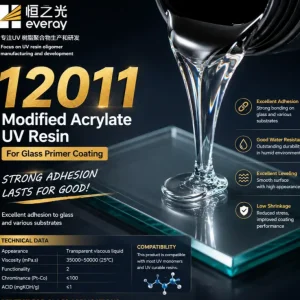
Yes. Adhesion to non-polar plastics (PP, PE, untreated PET) or inorganic glass substrates presents significant interfacial tension challenges. EVER RAY synthesizes specialized functionalized oligomers (e.g., Grade 12011 Modified Acrylate) incorporated with carboxyl, phosphate ester, or silane functional groups. These polar functionalities form chemical bonds and hydrogen bonds at the interface, yielding outstanding boiling water resistance and 5B tape adhesion performance without needing aggressive chemical pre-treatments.