Explore our factory-direct, high-purity epoxy acrylate and modified UV resin formulations engineered for superior adhesion, chemical resistance, and rapid photo-curing response across industrial applications.
The global market for epoxy resin materials and UV-curable oligomers is experiencing a transformative structural shift. Valued at over USD 12.8 Billion and expanding at a compound annual growth rate (CAGR) exceeding 6.4%, the industry is transitioning away from conventional solvent-borne thermal-cure resins toward eco-compliant, energy-efficient radiation-curable (UV/EB) resin formulations. Strategic B2B buyers—ranging from multi-national chemical formulators to precision electronics OEMs—are tasked with navigating volatile raw material supply chains, stringent decarbonization directives (such as EU REACH, TSCA, and China GB VOC standards), and demanding end-use performance criteria.
Modern procurement strategies mandate a granular understanding of upstream chemical precursors. Epoxy resin materials—primarily synthesized through the polycondensation of Bisphenol A (BPA) or Bisphenol F (BPF) with Epichlorohydrin (ECH)—serve as the foundational backbone for high-performance coatings, structural adhesives, electronic packaging, and composite matrices. When modified with acrylic acid to form epoxy acrylate oligomers, these resins gain ultra-fast photo-polymerization capabilities under ultraviolet irradiation, offering sub-second crosslinking, near-zero VOC emissions, and exceptional mechanical toughness.
To achieve optimal crosslinking density, tensile strength, and chemical inertness, formulation engineers must balance the structural characteristics of various epoxy derivative chemistries. Below is an engineering evaluation comparing primary UV-curable resin backbones:
| Resin Backbone Type | Cure Speed ($mJ/cm^2$) | Pencil Hardness | Adhesion Substrates | Key Chemical Advantage |
|---|---|---|---|---|
| Standard Bisphenol-A Epoxy Acrylate | Fast (< 150) | 3H – 5H | Paper, Wood, Metals, Rigid Plastics | Highest tensile strength, maximum gloss, economic cost efficiency. |
| Modified Epoxy Acrylate (Amine/Fatty Acid) | Ultra-Fast (< 100) | 2H – 4H | PVC, PET, Film Foils, Glass | Reduces oxygen inhibition, enhances flexibility, lowers volume shrinkage. |
| Epoxy Novolac Acrylate | Medium (< 200) | 5H – 6H | Glass, Ceramics, PCB Solder Mask | Exceptional thermal resistance ($T_g > 150^\circ\text{C}$), chemical immersion resistance. |
| Aliphatic Polyurethane Acrylate | Moderate (< 250) | H – 3H | PC, ABS, PMMA, TPU, Leather | Non-yellowing, weather-resistant, outstanding elongation & impact recovery. |
| Polyester Acrylate Oligomer | Fast (< 180) | HB – 2H | Paper Inks, Packaging Board, Offset | Superior pigment wetting, low viscosity, excellent ink-water balance. |
Achieving near-complete acrylation conversion is critical to eliminating residual monomer odor, preventing migration, and ensuring maximum film density. Modified epoxy acrylates supplied by tier-1 China manufacturers integrate proprietary active amine synergists to overcome atmospheric oxygen inhibition during free-radical photopolymerization.
High crosslink density often introduces internal cure stress leading to adhesion loss or film warping. Advanced oligomer synthesis employs hyperbranched geometry or flexibilized ring-opened segments to absorb volumetric shrinkage stress (< 3.5%), preserving intercoat adhesion on non-porous plastics like PET and glass.
For global procurement leaders, partnering directly with established Chinese epoxy resin manufacturers like Guangdong Ever Ray Environmental Material Co., Ltd. (EVER RAY) yields significant technical and commercial advantages. Situated within the heart of South China's chemical manufacturing hub in Guangdong, modern synthesis facilities deliver operational excellence through four strategic pillars:
China's chemical ecosystem dominates global production of basic epoxies, acrylic acid, and specialty diols. Direct pipeline access to bulk raw materials minimizes supply disruptions, stabilizes raw material hedging, and eliminates distributor markup—passing a 15% to 25% cost advantage directly to international formulators.
Utilizing multi-stage automated glass-lined reactors with precise DCS process monitoring, key parameters such as acid value (< 1 mg KOH/g), viscosity tolerance ($\pm 3\%$), color index (Gardner < 1), and inhibitor balance are strictly controlled. Every batch undergoes gel permeation chromatography (GPC) profiling before dispatch.
With over 10 national invention and utility patents, our doctorate-led chemical engineering team offers custom oligomeric synthesis. Whether modifying monomer viscosity, tuning refractive index for optical coatings, or synthesizing low-irritation monomers, prototype formulation turnaround is executed in under 10 business days.
All UV resin export products strictly comply with RoHS 2.0, REACH Pre-Registration, and halogen-free standards. Our logistics department coordinates UN-rated steel drum packaging, IBC tote shipping, full SDS documentation (in 16 languages), and seamless customs clearance worldwide.
Epoxy resin materials and acrylate oligomers are fundamental across high-value downstream manufacturing sectors. Understanding specific performance requirements ensures precise resin selection:
Smartphones, laptops, and automotive display panels require protective coatings that resist scratching, artificial sweat, and cosmic yellowing. Aliphatic polyurethane acrylate blended with modified epoxy acrylate delivers 4H pencil hardness while maintaining steel-wool abrasion resistance (> 2,500 cycles at 1kg load).
Modern SPC/LVT vinyl flooring and luxury hardwood panels rely on automated UV roller coating lines running at speeds exceeding 40 meters/minute. Fast-curing epoxy acrylates like grade 6100D provide immediate stacking hardness, stain resistance against household chemicals, and micro-scratch anti-fouling protection.
UV-curable printing inks demand low viscosity oligomers with exceptional pigment dispersion properties. Polyester acrylates (e.g., 5403DF) and amine-modified epoxy acrylates reduce photoinitiator dosage while providing high color strength, low misting on high-speed presses, and crisp print dot retention.
Precision assembly of glass-to-metal components, micro-lenses, and medical devices requires low-shrinkage pure acrylate and modified epoxy oligomers. These resins yield high optical clarity (> 98% transmittance), thermal shock tolerance (-40°C to +120°C), and boiling-water immersion resistance.
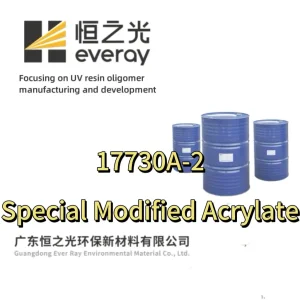
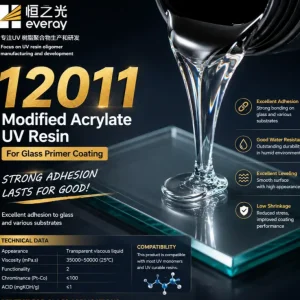
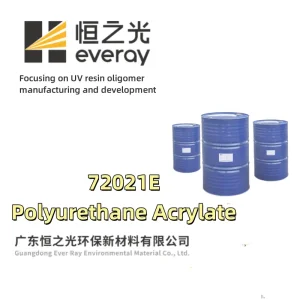
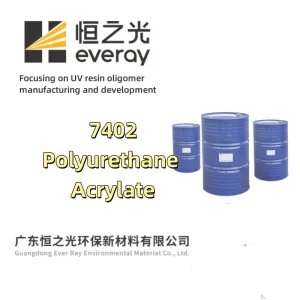
Discover our high-performance specialty resin series engineered for glass primers, flexible film varnishes, LED-UV packaging inks, and anti-yellowing optical coatings.
To safeguard production integrity and prevent batch failures, enterprise chemical procurement teams should execute a systematic 5-stage qualification audit when sourcing epoxy resins from overseas manufacturers:
Audit key physical parameters including monomer dilution ratio, viscosity at 25°C (mPa.s), functional group count (diquadrant vs. polyfunctional), density, and target curing energy ($mJ/cm^2$). Request viscosity-temperature rheology curves to anticipate pumping and coating dynamics.
Require batch-specific Certificates of Analysis (COA), Safety Data Sheets (GHS SDS compliant with localized REACH or OSHA regulations), and Fourier Transform Infrared Spectroscopy (FTIR) fingerprint charts to verify polymer identity.
Conduct laboratory drawdown tests on target production substrates. Evaluate pencil hardness (ASTM D3363), cross-hatch tape adhesion (ASTM D3359 Method B), gloss rating at 60°, and double-bond gel fraction via solvent extraction.
Verify annual plant tonnage capacity, automated DCS system integration, dangerous goods (DG) storage compliance, and ISO 9001 / ISO 14001 certifications. Confirm factory scale aligns with long-term order growth.
As global sustainability mandates tighten, the UV-curable material sector is undergoing continuous technological evolution. Manufacturers are investing heavily in three next-generation chemical vectors:
Replacing petroleum-derived bisphenol backbones with renewable plant-derived polyols (such as modified epoxidized soybean oil, cardanol derivatives, and bio-succinic acid) allows formulators to increase bio-carbon content to > 40% without compromising UV reaction kinetics or surface hardness.
Energy-saving LED-UV curing systems emit narrow spectral wavelengths. Novel modified epoxy oligomers incorporating built-in amine co-initiator structures maximize photon absorption at 385nm and 395nm, enabling rapid surface dryness without ozone generation or high electrical draw.
For 3D geometric parts with shaded regions unaffected by direct light irradiation, hybrid resin formulations combine free-radical UV crosslinking with secondary thermal cure or moisture-cure hydroxyl/isocyanate mechanisms, ensuring uniform structural integrity throughout complex assemblies.
Find authoritative, engineering-backed answers to the most frequent technical, logistical, and commercial inquiries submitted by chemical formulators and purchasing officers.
