The global market for High Gloss Polyurethane (PU) systems and ultraviolet (UV)-curable urethane acrylates is undergoing a structural transition driven by stringent environmental mandates (such as VOC limit policies under EU-REACH and China GB/T 38597-2020) and accelerating throughput demands across 3C consumer electronics, automotive OEM refinishes, rigid wood packaging, and additive manufacturing.
When sourcing from direct-synthesis chemical factories and specialized B2B suppliers, industrial formulators face complex procurement decisions. Evaluating high gloss polyurethane resins involves balancing molecular design parameters: balancing crosslink density against flexibility, managing refractive index mismatch to maintain >95 Gloss Units (GU) at 60°, and ensuring yellowing resistance under intense UV weathering.
Eliminate intermediary markup by connecting directly with synthesis reactors in Yunfu, Guangdong. Gain access to direct batch customization and competitive metric-ton pricing structures.
Oligomer backbones optimized for >92% acrylic double-bond conversion under LED-UV (365nm/395nm) and standard Mercury vapor light paths, mitigating residual monomer odor.
Engineered with IPDI (Isophorone Diisocyanate) and HDI (Hexamethylene Diisocyanate) adducts to guarantee UV weathering stability exceeding QUV 1000-hour standards.
To achieve specular gloss readings exceeding 95 GU at 60° without sacrificing impact toughness, resin synthesis engineers must balance molecular weight distribution ($M_w/M_n$) and polyurethane soft-to-hard segment ratios. Polyurethane acrylate (PUA) oligomers synthesised via polyether, polyester, or polycarbonate diols capped with hydroxyalkyl acrylates yield distinct physical properties:
| Chemical Class | Backbone Backbone Structure | Gloss Retainability (60°) | Pencil Hardness | Tensile Strength (MPa) | Primary Application Area |
|---|---|---|---|---|---|
| Aliphatic PUA (Di-functional) | IPDI / Polyester Polyol | 96 - 98 GU | H - 2H | 25 - 35 | 3C Plastic Coatings, Automotive Interior |
| Aliphatic PUA (Hexa-functional) | HDI Trimer / Polyether | 94 - 97 GU | 3H - 5H | 45 - 65 | High-Gloss Anti-Scratch Topcoats |
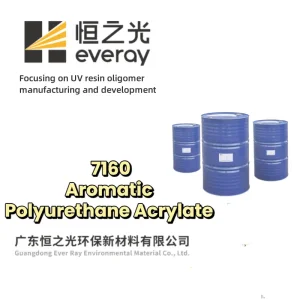
| Aromatic PUA (Tri-functional) | TDI / Polyether Polyol | 92 - 95 GU | 2H - 3H | 30 - 40 | Indoor Furniture, Parquet Wood Finishes |
| Waterborne PUA Dispersion | Anionic Hydrophilic PUA | 88 - 93 GU | HB - F | 18 - 28 | Eco-Friendly Leather & Film Varnishes |
A fundamental challenge in UV-curable high gloss coating production is atmospheric oxygen inhibition at the air-coating interface. Oxygen quenches free radical species, creating an under-cured, tacky surface layer that scatters light and reduces gloss.
Guangdong Ever Ray Environmental Material Co., Ltd. (EVER RAY) solves this by incorporating specialized amine synergists (such as our Active Amine series) into modified polyurethane acrylates. These amino-functional groups donate hydrogen atoms to peroxyl radicals, forming highly reactive aminoalkyl radicals that continue the polymerization chain even under ambient oxygen concentrations.
Operating out of Yunfu, Guangdong, EVER RAY combines nearly two decades of radiation-curing resin production with automated chemical reactors to guarantee strict lot-to-lot consistency.
High gloss polyurethane solutions must adapt to specific regional climates, substrates, and line speeds. Below are proven industrial formulation setups for global formulators:
Substrates: Polycarbonate (PC), ABS, PMMA, PET films.
Key Demand: High optical clarity, zero yellowing under sunlight, scratch resistance (Pencil Hardness ≥ 3H), and chemical resistance against alcohol and synthetic sweat.
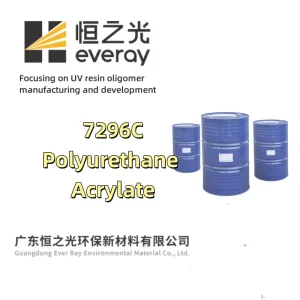
Recommended Grade: Aliphatic Polyurethane Acrylate (e.g., Grade 7296-1 / 7600 series).
Substrates: Veneer, solid oak, MDF, LVT/SPC flooring.
Key Demand: High build, fast sandability for basecoats, mirror-like topcoat gloss retention, and flexibility to withstand thermal expansion without micro-cracking.
Recommended Grade: Epoxy Acrylate & Aromatic PUA (e.g., Grade 7160 / 6100D-85).
Substrates: Coated paperboards, metallized films, flexible foil packaging.
Key Demand: Rapid curing at high line speeds (>150 m/min), low odor, excellent pigment wetting properties, and high gloss transfer.
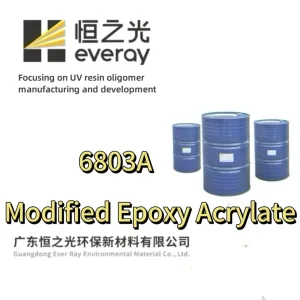
Recommended Grade: Polyester Acrylate & Amine Synergists (e.g., Grade 5320 / 6803A).
As industrial standards migrate toward eco-friendly and bio-based formulations, resin manufacturers must continuously innovate. EVER RAY's R&D roadmap focuses on three technological pillars:
Developing ultra-reactive polyurethane acrylate oligomers tailored for monochromatic LED curing systems. Reduces energy consumption by up to 60% compared to traditional mercury arc lamps while maintaining full surface cure and mirror gloss.
Expanding anionic and non-ionic polyurethane acrylate dispersions that utilize water as a diluent instead of monomeric reactive diluent. Achieves Zero-VOC classification without compromising hardness or chemical resistance.
Integrating renewable polyols derived from castor oil and bio-succinic acid into urethane acrylate chains. Developing moisture/UV dual-cure chemistry for shadowed electronic assemblies.
To facilitate seamless export across North America, Europe, and Asia-Pacific regions, EVER RAY maintains strict chemical compliance documentation:
Aliphatic Polyurethane Acrylates are synthesized using aliphatic diisocyanates (such as IPDI or HDI), which lack aromatic rings. This imparts superior UV weatherability, non-yellowing characteristics, and flexible gloss retention over long outdoor exposures. Aromatic Polyurethane Acrylates utilize aromatic diisocyanates (like TDI or MDI), which offer higher mechanical hardness, faster cure speeds, and cost efficiency, but tend to yellow over time, making them ideal primarily for interior applications.
Shrinkage wrinkles occur when there is an imbalance between surface cure rate and depth cure rate. To overcome this, formulators should combine hyperbranched high-functionality oligomers with low-shrinkage mono- or di-functional acrylate monomers (such as IBOA or HDDA), and calibrate photoinitiator absorption profiles (combining TPO for depth cure with 184 or TPO-L for surface clarity).
Every shipment is accompanied by a batch-specific Certificate of Analysis (COA) detailing viscosity (mPa.s at 25°C), color (Gardner scale), double-bond content, and acid value. Additionally, detailed Technical Data Sheets (TDS) and Safety Data Sheets (SDS) in accordance with GHS compliance are provided prior to sample dispatch.
Yes. As a direct synthetic manufacturer with 10+ automated reaction kettles in Yunfu, Guangdong, our chemical engineering team can tailor viscosity ranges, molecular weight distributions, and acrylation levels to fit roll coating, spray coating, slot-die, or flexo printing equipment.
Whether you are formulating zero-VOC waterborne UV wood coatings, scratch-resistant 3C electronics finishes, or high-speed flexographic UV inks, our application engineering team offers custom oligomer synthesis and technical starting formulations.
Headquarters Address: 12th Floor, Tower B, AOYUAN Plaza, Pengjiang District, Jiangmen City, Guangdong Province, China
Production Base: Dawan Industrial Park, Dawan Town, Yunan County, Yunfu City, Guangdong Province, China
Secondary Technical Contact: +86-18033139299 | Email: [email protected]
