Explore high-performance UV curable oligomers directly engineered for coatings, inks, adhesives, and specialty industrial applications.
Ultraviolet (UV) curable acrylates represent the cornerstone of sustainable, high-speed polymer synthesis across modern industrial chemical manufacturing. By leveraging free-radical radiation curing mechanisms, UV acrylate oligomers and monomers transform liquid coatings, inks, adhesives, and 3D photopolymers into ultra-durable solid films in fractions of a second. As global regulatory frameworks like EU REACH and US TSCA tighten controls over volatile organic compounds (VOCs) and hazardous air pollutants (HAPs), procurement teams and chemical formulation engineers actively look to buy UV acrylate products directly from verified manufacturers capable of guaranteeing consistent batch purity, controlled double-bond conversion, and custom viscosity profiles.
Guangdong Ever Ray Environmental Material Co., Ltd. (EVER RAY) stands at the forefront of this industrial transformation. Established in 2006, EVER RAY operates a state-of-the-art 40,000+ m² manufacturing complex in Yunfu, Guangdong, supported by technical sales headquarters in Jiangmen. Our engineering philosophy combines rigorous polymer synthesis with precise applications-level testing to deliver high-performance oligomers, including Epoxy Acrylates, Aliphatic and Aromatic Polyurethane Acrylates (PUA), Polyester Acrylates, Waterborne UV Resins, and Hyperbranched Acrylate structures.
Delivers exceptionally fast surface cure speeds, high surface hardness (pencil hardness up to 4H–5H), superior tensile strength, and exceptional gloss. Ideal for wood coatings, paper OPVs, and rigid plastic finishes.
Engineered for maximum flexural toughness, weatherability, and chemical durability. Aliphatic variants provide non-yellowing performance for 3C electronics and outdoor topcoats; aromatic variants yield cost-effective impact resistance.
Provides optimal pigment wetting dynamics, balanced rheological control, and low resin viscosity. Highly specified for offset, flexographic, and screen inks requiring precise ink-water balance.
Formulating high-efficiency UV curable systems requires matching oligomer structure to substrate chemistry and light source emissions. The primary functional backbone dictates film performance:
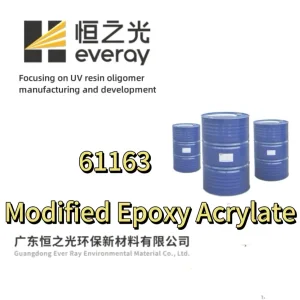
Formed through the esterification of bisphenol A epoxy resins with acrylic acid, standard Epoxy Acrylates (such as EVER RAY's 9105M-80 series) offer unparalleled double-bond reactivity and crosslinking density. The presence of aromatic rings and hydroxyl functional groups provides strong adhesion to polar substrates while establishing high chemical resistance to solvents, acids, and alkalis. To mitigate inherent brittleness, modified epoxy acrylates (e.g., Grade 61163 and Grade 6231) incorporate fatty acid or polyether chains, lowering resin viscosity and eliminating yellowing tendencies during thermal curing cycles.
Polyurethane Acrylates are synthesized by reacting aliphatic or aromatic diisocyanates with hydroxyl-terminated polyols and hydroxyl-functional acrylates (such as HEA or HPA). The urethane linkages (–NHCOO–) form intermolecular hydrogen bonds that dynamically absorb mechanical impact and thermal shock.
• Aliphatic Polyurethane Acrylates: Formulated using IPDI or HDI, these resins show zero UV absorption in the solar spectrum, rendering them immune to photo-oxidation and yellowing. They are essential for automotive interior displays, optical films, and high-end 3C electronic housings.
• Aromatic Polyurethane Acrylates: Utilizing TDI or MDI backbones, these oligomers offer cost-effective toughness and rapid response for wood floor topcoats and vacuum metallized primers on ABS/PC polymers.
Polyester Acrylates serve as multi-functional vehicles in high-speed printing inks and packaging varnishes. Their low intrinsic viscosity reduces the need for reactive diluents, minimizing skin irritation potential (PII) and odor emissions. For ultra-scratch-resistant clearcoats, EVER RAY's Hyperbranched Acrylic Resins (e.g., Grade 4600) utilize dendritic, highly branched molecular architectures containing 6 to 12 reactive acrylate groups per molecule. This yields dense 3D polymer networks without causing severe volumetric shrinkage.
| Oligomer Type | Cure Speed | Tensile Strength | Flexibility | Yellowing Resistance | Key Target Applications |
|---|---|---|---|---|---|
| Epoxy Acrylate (Bisphenol A) | Very High | High (70–90 MPa) | Low | Moderate | Wood primers, paper varnishes, rigid coatings |
| Modified Epoxy Acrylate | High | Medium (50–70 MPa) | Moderate | High | Anti-yellowing topcoats, flexo inks |
| Aliphatic Urethane Acrylate | Medium-High | High (40–80 MPa) | Excellent | Superior (Non-yellowing) | 3C electronics, outdoor plastics, nail gel |
| Aromatic Urethane Acrylate | High | High (50–75 MPa) | Good | Fair | Vacuum metallization, floor coatings |
| Polyester Acrylate | High | Medium (30–50 MPa) | Good | Good | Offset inks, screen inks, paper OPV |
| Hyperbranched Acrylate | Ultra High | Very High (>90 MPa) | Low-Moderate | High | Anti-scratch varnishes, 3D printing resins |
The global UV acrylate market is undergoing a major paradigm shift driven by technological innovations, environmental mandates, and operational efficiency goals:
Industrial lines are rapidly replacing traditional medium-pressure mercury vapor lamps with energy-efficient Light Emitting Diodes (LED-UV). Traditional mercury lamps emit a broad spectrum (200nm–400nm) generating intense heat, whereas LED-UV lamps output narrow monochromatic wavelengths (typically 365nm, 385nm, or 395nm). This transition requires oligomers with optimized spectral matching and higher surface reactivity to overcome deep-layer absorption issues and oxygen inhibition without requiring thermal infrared baking.
Waterborne Polyurethane Acrylate (WPUA) systems combine the low-VOC eco-compliance of water-based coatings with the instant cure performance of radiation chemistry. By dispersing acrylate-functionalized polyurethane chains in aqueous media, formulators achieve zero-solvent viscosity control, ideal for spray application on complex 3D wood profiles, luxury leather finishing, and porous substrates.
In automotive and electronics assembly, shadowed geometric areas fail to receive direct UV illumination. Next-generation UV acrylate resins integrate dual-cure mechanisms—combining UV radical polymerization with secondary moisture cure, thermal isocyanate reaction, or anaerobic epoxy reaction—guaranteeing 100% cure thoroughness throughout complex assemblies.
EVER RAY's acrylate formulations are specifically engineered to address real-world processing constraints across key international markets:
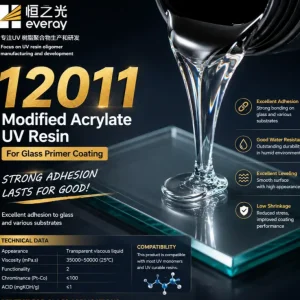
Requires high surface hardness, sweat resistance, steel wool scratch resistance (1000+ cycles), and adhesion to untreated PC, ABS, and glass. Aliphatic PUA oligomers combined with hyperbranched acrylates meet these stringent OEM standards.
Flexographic and offset packaging lines running at over 300 meters/minute demand rapid cure speeds, ultra-low misting, high pigment loading capacity, and zero solvent odor retention for food-contact outer packaging.
PVC flooring, SPC rigid tile, and natural hardwood require multi-layer UV coating systems: high-adhesion elastic primers, sanding sealers, and abrasion-resistant matte/gloss topcoats capable of enduring heavy foot traffic.
Sourcing UV acrylate oligomers directly from established Chinese chemical manufacturers provides global enterprise buyers with unprecedented strategic and financial advantages:
1. Complete Upstream Raw Material Integration: Guangdong EVER RAY's location within China's primary chemical manufacturing hub ensures direct access to core chemical feedstocks including Acrylic Acid, Epichlorohydrin, Isophorone Diisocyanate (IPDI), Polyols, and Photoinitiators. This vertical integration buffers our clients against global supply chain volatility and price fluctuations.
2. Advanced Mass-Scale Synthesizers & Automation: Operating over 10 automated reactor lines equipped with continuous temperature, pressure, and viscosity monitoring, EVER RAY delivers an annual production capacity exceeding 30,000 metric tons. High-volume synthesis directly lowers unit production costs while enabling tight batch-to-batch repeatability.
3. Rigorous Quality Control (QA/QC Standards): Every production batch undergoes comprehensive laboratory analysis using Gel Permeation Chromatography (GPC), Fourier Transform Infrared Spectroscopy (FTIR), rotational viscometers, and colorimeters. Samples are retained for 24 months to ensure complete traceability.
International procurement directors, EHS managers, and supply chain heads require strict regulatory compliance when qualifying overseas material suppliers. EVER RAY provides full international compliance guarantees for every product shipped:
Full compliance support for EU REACH, US TSCA, Korea K-REACH, and GB standards. Complete SDS (Safety Data Sheets) formatted according to GHS Revision 8 in multi-language editions.
Standardized packaging in 20kg plastic drums, 200kg steel drums, or 1000kg IBC totes. UN-certified dangerous goods (DG) packaging guarantees safe oceanic and intermodal transport.
Our in-house R&D team provides custom monomer/oligomer modification to match your exact viscosity, functionality, glass transition temperature (Tg), or refractive index specifications.
Select from our extensive portfolio of specialty oligomers designed for wood coatings, PVC flooring, screen varnishes, and 3D printing.
Find direct answers to key engineering, procurement, and formulation questions regarding UV acrylate oligomers and factory supply.
Partner directly with Guangdong Ever Ray Environmental Material Co., Ltd. Our application engineers are ready to assist with formulation guidance, resin samples, and competitive direct-factory pricing.
Contact Our Chemical Engineers