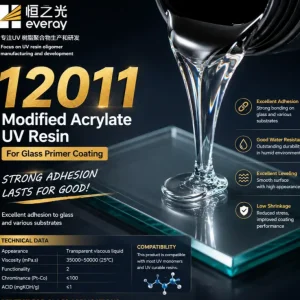
Explore our high-performance UV-curable monomers and resin oligomers optimized for glass primers, wood coatings, printing inks, and 3C electronic finishes.
The international radiation-curing (UV/EB) market is experiencing a profound paradigm shift. As industries transition from solvent-borne thermosetting chemical architectures toward instantaneous photo-curing, high-performance acrylic oligomers have become the bedrock of advanced surface technology.
As a premier direct-to-enterprise manufacturer based in Guangdong, China, EVER RAY operates at the nexus of raw material synthesis, chemical engineering, and global logistics. Modern commercial demand no longer seeks basic chemical commodities; rather, international enterprise buyers—spanning North America, Europe, East Asia, and Southeast Asia—require high-purity, batch-consistent oligomers capable of fulfilling stringent performance metrics.
Global regulatory bodies (REACH, EU-RoHS, US EPA TSCA) are enforcing stringent limits on volatile organic compounds. Acrylic oligomers form the reactive backbone of zero-VOC or near-zero-VOC UV formulations.
Industrial lines are rapidly converting from traditional medium-pressure mercury lamps to 365–395nm LED-UV systems. Formulators demand specialized oligomers engineered for ultra-fast surface and depth conversion.
End-use applications in 3C consumer electronics, automotive touchscreens, and optical films require hyper-dense crosslinking, scratch resistance (glass-like pencil hardness), and non-yellowing durability.
In photopolymer chemistry, the oligomer is the dominant determinant of physical, mechanical, and thermal properties in the final cured matrix. While reactive diluent monomers adjust application viscosity and photoinitiators dictate free-radical cleavage rates, the oligomer skeleton dictates tensile strength, elongation at break, glass transition temperature ($T_g$), substrate chemical bonding, and yellowing behavior under solar radiation.
Formulation Principle: Selecting the correct backbone (Epoxy, Polyurethane, Polyester, or Modified Acrylate) dictates the compromise between cure speed, mechanical flexibility, weatherability, and unit economic cost.
| Oligomer Category | Chemical Backbone Type | Key Performance Strengths | Target Technical Applications |
|---|---|---|---|
| Epoxy Acrylate (EA) | Bisphenol A Diglycidyl Ether (DGEBA) Acrylate | Ultra-fast cure speed, high pencil hardness (3H–5H), excellent chemical/solvent resistance. | Wood sealers, paper overprint varnishes (OPV), rigid plastic topcoats, potting formulations. |
| Aliphatic Polyurethane Acrylate (APUA) | Hexamethylene Diisocyanate (HDI) / IPDI + Polyester/Polyether Polyol | Zero-yellowing outdoor durability, high flexibility, impact resistance, weatherability. | 3C electronics, automotive interior trim, premium UV nail gels, optical film coatings. |
| Aromatic Polyurethane Acrylate (APUA-Ar) | Toluene Diisocyanate (TDI) / MDI + Polyol | Superior mechanical toughness, cost-effective abrasion resistance, fast gelation. | Industrial flooring, parquet wood coatings, heavy-duty mechanical wear layers. |
| Polyester Acrylate (PEA) | Hydroxyl-terminated Polyester Esterified with Acrylic Acid | Excellent pigment wetting, low intrinsic viscosity, low volatility, balanced flexibility. | UV offset printing inks, flexographic inks, high-pigment screen inks, plastic primers. |
| Waterborne UV Oligomer (WB-UV) | Polyurethane/Acrylate Dispersion with Ionic Self-Emulsifying Groups | Zero-VOC solvent-free dilution with water, low viscosity for spray coating, eco-compliant. | Eco-leather finishing, spray-applied wood coatings, porous substrate sealers. |
Achieving maximum double-bond conversion (C=C cleavage) is critical to prevent residual monomer migration, post-cure shrinkage stress, and edge curling. EVER RAY's hyperbranched and modified acrylic oligomers incorporate tailored steric hindrances and multi-functional acrylate sites. This structural optimization ensures rapid vitrification under standard UV dosage (200–500 mJ/cm²) while maintaining structural compliance on flexible polyolefin or rigid glass/metal substrates.
Our standardized and customized oligomers are deployed across global high-technology sectors requiring absolute material reliability.
Mobile phones, laptops, and smart wearables demand coatings resistant to artificial sweat, cosmetic oils, steel wool abrasion, and thermal cycle shocks. Our aliphatic urethane acrylates provide 4H pencil hardness without embrittlement on PC, ABS, and PMMA substrates.
Modern multi-color offset and flexographic printing presses operate at line speeds exceeding 300 meters per minute. Polyester acrylates (e.g., Polyester Acrylate 5336 & 5403-2F) deliver high ink lithographic stability, low fountain solution emulsification, and fast cure responsiveness.
Precision SLA, DLP, and LCD photopolymer resins require low-viscosity, low-shrinkage oligomers. Our engineered ABS-like and waterborne resins allow rapid layer-by-layer photo-curing with high dimensional accuracy and high tensile modulus for functional prototyping.
Procurement directors and chief technology officers operating chemical blending plants face escalating volatility in raw material supply, shipping lead times, and quality control. Partnering with a dedicated oligomer synthesis factory like EVER RAY provides structural procurement advantages:
We maintain direct long-term partnerships with tier-1 petrochemical suppliers for Acrylic Acid (AA), Isophorone Diisocyanate (IPDI), Epoxy Resins, and Polyols, ensuring continuous factory output even during regional chemical market fluctuations.
Every batch undergoes rigorous quality control testing via Gel Permeation Chromatography (GPC), rotational viscometers, and colorimeters. Parameters including Viscosity ($25^\circ\text{C}$), Acid Value ($\text{mg KOH/g}$), and Color (Gardner) are guaranteed within narrow standard deviation thresholds.
Exporting chemical raw materials globally demands comprehensive regulatory adherence. EVER RAY provides full technical compliance assistance for chemical compliance frameworks across continents:
Pre-registered and registered oligomer components complying with European Chemical Agency (ECHA) SVHC candidate lists.
Full inventory listing under the United States Toxic Substances Control Act for seamless customs clearance.
Certified zero heavy-metal content (Pb, Cd, Hg, Cr VI) and low halogen levels suitable for high-density electronic assemblies.
UN-rated standard 200kg steel drums, IBC totes, and ISO tanks accompanied by GHS SDS and Certificate of Analysis (COA) per shipment.
As green chemistry advances, EVER RAY's R&D center in Guangdong is actively developing next-generation photopolymer matrices designed for sustainable industrial growth:
Synthesizing oligomers utilizing plant-derived polyols (soybean oil, castor oil derivatives) to reduce carbon footprints without sacrificing pencil hardness or cure speed.
Engineering molecular structures with tailored absorption co-factors that overcome surface tackiness under lower energy LED UV lamps.
Integrating siloxane and fluorinated functional segments into polyurethane acrylate backbones for scratch self-repair and hydrophobic contact angles (>105°).
Detailed technical answers derived from our laboratory formulation team and quality control engineers.
Epoxy Acrylate delivers faster cure speeds, higher hardness, and lower unit cost, making it ideal for rigid indoor substrates. However, if your plastic substrate (e.g., PC, ABS, PET) requires high impact resistance, flexural recovery, non-yellowing performance, or outdoor UV exposure, Aliphatic Polyurethane Acrylate (APUA) is mandatory due to its flexible urethane linkages and UV-stable aliphatic backbone.
Atmospheric oxygen scavenges free radicals, creating soft, tacky surfaces in thin-film applications. To mitigate this, formulators can incorporate Amino Acrylate Oligomers or Active Amine Synergists. The tertiary amine groups undergo rapid hydrogen abstraction, consuming dissolved oxygen and forming peroxide radicals that re-initiate polymerization.
Yes. Our factory R&D team specializes in tailoring oligomer molecular weight distributions ($M_w/M_n$), monomer diluent ratios (e.g., cutting oligomers with TPGDA, HDDA, or TMPTA), and adjusting functional acrylate counts (from difunctional to hexafunctional) to match your exact spray, roller, or inkjet dispensing equipment.
When stored in original sealed containers away from direct sunlight, thermal sources, and moisture at temperatures between $5^\circ\text{C}$ and $30^\circ\text{C}$, our acrylic oligomers maintain a guaranteed shelf-life of 12 months. All products contain optimized free-radical inhibitors (such as MEHQ) to prevent premature gelation.
Select from our specialized series engineered for peelable adhesives, 3D printing engineering resins, LED wood coatings, and anti-yellowing adhesives.