Engineered for ultra-fast curing speed, superior film hardness, exceptional substrate adhesion, and controlled crosslinking density across demanding industrial coating applications.
An authoritative technical analysis of Bisphenol A Diglycidyl Ether (BADGE) esterification, crosslinking kinetic optimization, and residual monomer control in high-performance industrial clear coats.
In modern industrial chemistry, Epoxy Varnish formulations—specifically those derived from UV-curable epoxy acrylate oligomers—represent the pinnacle of mechanical durability, surface gloss, and chemical resistance. Standard Bisphenol A epoxy acrylates are synthesized via the catalyzed ring-opening esterification of Bisphenol A Diglycidyl Ether (BADGE) with acrylic acid. The resulting oligomer structure possesses terminal acrylate double bonds (C=C) combined with secondary hydroxyl groups (-OH) along the backbone.
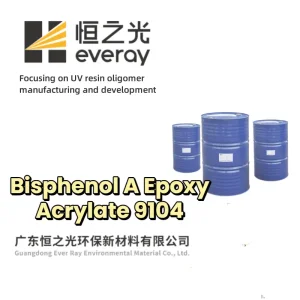
Unmodified Bisphenol A epoxy acrylate oligomers (such as standard Grade 9104 or 9105A-80) exhibit high reactivity and extreme film hardness. However, their high crosslink density can result in brittleness and limited outdoor weatherability due to UV-induced aromatic ring oxidation. To overcome these limitations, advanced chemical synthesis utilizes three primary modification routes:
| Oligomer Type | Typical Viscosity (mPa.s @ 25°C) | Tg (°C) | Double Bond Functionality | Core Industrial Strengths |
|---|---|---|---|---|
| Standard Bisphenol-A Epoxy Acrylate | 15,000 - 35,000 (diluted 20% TPGDA) | 55 - 75 | 2.0 | Ultra-fast cure, maximum hardness, high chemical & solvent resistance. |
| Modified Low-Shrinkage Epoxy Acrylate | 8,000 - 18,000 | 35 - 50 | 2.0 - 2.5 | Excellent flexibility, deep-layer cure, superior adhesion on ABS/PC & metals. |
| Urethane Modified Epoxy Acrylate | 12,000 - 25,000 | 45 - 65 | 2.5 - 3.5 | Balanced toughness, yellowing resistance, high scratch and abrasion recovery. |
| Waterborne UV-Curable Epoxy Dispersion | 100 - 800 (40% solid in water) | 30 - 45 | 2.0 | Zero-VOC compliance, excellent wood penetration, ultra-thin film application. |
How global original equipment manufacturers (OEMs) and formulators utilize custom epoxy varnish prepolymers to conquer rigorous end-use testing parameters.
Targeted for smartphone housings, laptop covers, and cosmetic caps. High-adhesion aromatic and aliphatic polyurethane acrylate blends serve as primer and topcoat resins for PVD vacuum aluminum coating on ABS, PC, and PMMA substrates. Resists 500+ cycles of RCA rubber friction and passes 100-grid cross-hatch adhesion tests.
Engineered for high-speed roll-coating production lines (SPC, LVT, luxury vinyl tiles, and solid hardwood parquet). Epoxy varnish formulations modified with low-viscosity acrylate oligomers provide high leveling, fast UV line speeds (>30 m/min), stain resistance (coffee, alcohol, iodine), and anti-scratch surface sealers.
Low-odor, low-migration polyester acrylate oligomers (such as 5403-2F and 5332F) formulated for offset, flexographic, and screen inks. Delivers superior pigment wetting, balanced ink-water equilibrium during continuous offset printing, and high gloss clarity on paperboard, flexible films, and metal cans.
Inside Guangdong Ever Ray Environmental Material Co., Ltd. — A state-of-the-art chemical manufacturing base situated in Dawan Industrial Park, Yunfu City, Guangdong Province.
Global procurement teams in the chemical sector face dual challenges: volatile raw material costs and batch-to-batch quality discrepancies. Guangdong Ever Ray Environmental Material Co., Ltd. addresses these challenges directly through intelligent factory automation and continuous manufacturing integration.
Our 40,000+ square meter production base operates over 10 fully automated synthesis lines controlled via Distributed Control Systems (DCS). Reaction temperatures, catalytic dosing rates, vacuum distillation, and esterification kinetics are monitored in real time, eliminating human error and maintaining a narrow molecular weight distribution.
By establishing long-term strategic supply agreements for core feedstocks (Bisphenol A, Epichlorohydrin, Acrylic Acid, Hydroxyethyl Acrylate) and maintaining large-capacity storage farms, Ever Ray mitigates global supply chain shocks, guaranteeing uninterrupted production schedules for tier-1 international clients.
Every single batch undergoes rigorous analytical testing before shipment. Quality control metrics include Gas Chromatography (GC) for residual monomer concentration, Gel Permeation Chromatography (GPC) for molecular weight distribution, rotational viscometry, and color index verification ($\le 1.0$ Gardner scale).
Seamless international chemical logistics, environmental compliance, and full technical documentation for seamless integration into global supply chains.
Enterprise chemical procurement requires total transparency and compliance with stringent international chemical safety regulations. Ever Ray maintains a dedicated regulatory compliance team providing global partners with comprehensive document packages:
Pioneering sustainable, energy-efficient, and bio-based photopolymer technologies for the next decade of manufacturing.
Replacing petroleum-derived Bisphenol A with renewable bio-based building blocks sourced from cashew nut shell liquid (CNSL), epoxidized soybean oil (ESO), and lignin. Target: Achieving >40% bio-based carbon content without compromising pencil hardness or cure speed.
Engineering specialized oligomer backbones optimized for long-wavelength LED-UV light sources. Eliminates high-energy mercury lamps, drastically reduces energy consumption by up to 70%, and prevents thermal substrate deformation during processing.
Pioneering dual-cure (UV radical + moisture or thermal cationic) formulations that incorporate dynamic supramolecular networks. Enables self-healing of micro-scratches under low thermal stimulus while maintaining permanent oleophobic surface characteristics.
High-solids, low-viscosity, and functionalized resins tailored for vacuum metallization, 3D printing, gel polishes, and specialized ink effect varnishes.
In-depth technical answers addressing polymer selection, dilution monomer choices, formulation tuning, and container supply logistics.
Standard Bisphenol A Epoxy Acrylates (e.g., Grade 9104) are formed by esterifying epoxy resins with acrylic acid. They offer the highest pencil hardness (up to 5H), fastest cure speeds, and lowest raw material cost, but are susceptible to outdoor yellowing and elevated brittleness. Polyurethane Acrylates (PUA)—especially aliphatic urethane acrylates like Grade 7200-1—utilize soft polyol backbones linked via polyisocyanates, providing extreme impact flexibility, non-yellowing weatherability ($\Delta E < 1.0$), and high abrasion resistance, making them suited for premium topcoats and 3C outdoor components.
In thin-film UV overprint varnishes and clear coats (<10 microns), atmospheric oxygen diffuses into the liquid film and quenches free radicals generated by photoinitiators, resulting in a sticky or tacky surface. Amino acrylates and active amine synergists contain alpha-amino hydrogen atoms. These hydrogens react rapidly with peroxyl radicals ($ROO^\bullet$) to form unreactive hydroperoxides while regenerating reactive alkylamino radicals that continue the polymerization chain, thereby achieving tack-free surface curing even under low-energy LED lamps.
Due to high prepolymer viscosity (often exceeding 100,000 mPa.s at 100% solid content), reactive diluent monomers are blended in proportions of 15% to 45%. Monofunctional monomers like IBOA (Isobornyl Acrylate) enhance Tg and water resistance while cutting viscosity. Difunctional monomers like TPGDA (Tripropylene Glycol Diacrylate) and HDDA (1,6-Hexanediol Diacrylate) balance viscosity reduction with rapid curing. Trifunctional monomers like TMPTA (Trimethylolpropane Triacrylate) maximize film crosslink density and surface scratch hardness.
Guangdong Ever Ray Environmental Material Co., Ltd. enforces strict batch QC under ISO 9001 certification. Key parameters tested for every production lot include: 1) Viscosity at 25°C via Brookfield rotational viscometer (tolerance $\pm 5\%$); 2) Acid value via potentiometric titration ($\le 1.0 \text{ mg KOH/g}$); 3) Gardner Color Scale ($\le 1.0$); 4) Curing energy density (mJ/cm²) measured under a standardized 365nm mercury UV lamp; 5) Monomer conversion efficiency verified by FT-IR spectroscopy.
Yes. Our in-house research laboratory and engineering team specialize in custom resin modification. We can synthesize custom epoxy acrylate backbones with tailored Tg values (ranging from $-10^\circ\text{C}$ to $+80^\circ\text{C}$), modify refractive indices for optical adhesives/films ($n_D > 1.55$), or integrate self-leveling silicone additives to achieve specific flow characteristics, static contact angles, or adhesion to fluoropolymer substrates.
For standard grades (including 9104, 6851A, 7200-1, and 5403-2F), standard factory stock lead time is 3 to 7 business days from order confirmation. Custom modified synthesis runs require 10 to 14 days. Minimum order quantity starts at 200kg (one standard steel drum) for sample evaluation, up to full-container loads (FCL, 16.0 to 18.0 metric tons) in 20-foot containers equipped with ISOTANK or palletized UN drums.
