Explore our flagship high-adhesion, low-shrinkage, and modified epoxy acrylates optimized for industrial coatings, flexible inks, wood varnishes, and electronic encapsulants.
Overcoming the historical dilemma between high surface hardness and brittle fracture in radical UV-curing systems through flexible segment insertion and backbone tailoring.
Standard Bisphenol-A epoxy acrylates (such as aromatic epoxy resins) are renowned across the UV curing industry for their exceptionally fast polymerization rate, superior surface hardness, elevated chemical resistance, and outstanding tensile strength. However, their rigid aromatic backbone structure creates an inherent technical limitation: severe brittleness, high shrinkage stress (>6%), and poor elongation. When applied to deformable substrates—such as thin plastic films, flexible printed circuit boards (FPC), or springy metallic foils—standard epoxy acrylates experience micro-cracking, film curling, and catastrophic delamination during mechanical flexure or thermal stress cycles.
To synthesize a true High-Quality Flexible Epoxy Resin, our chemical formulation team alters the rigid diglycidyl ether of bisphenol A (DGEBA) prepolymer. By introducing long-chain aliphatic polyethers, aliphatic polyester segments, or dimer acid modifications directly into the epoxy backbone prior to acrylation, we introduce internal plasticization at the molecular level. This modified molecular geometry decreases the glass transition temperature ($T_g$) of the cured matrix from >65°C down to custom ranges (-10°C to +35°C), dramatically raising elongation at break (from <3% up to 120%) while maintaining high reactivity under UV exposure.
In addition to linear chain flexibility, control over crosslink density is crucial. By adjusting oligomer functionality (difunctional vs. trifunctional flexibilized oligomers) and combining them with low-viscosity mono- or di-functional acrylate monomers, the network topology allows fast relaxation of volumetric shrinkage stresses during free-radical UV polymerization. This stress-dissipating mechanism guarantees flawless inter-coat adhesion, excellent 180° bendability, and zero post-curing embrittlement over long-term thermal aging.
Across North America, Europe, and Asia-Pacific, manufacturing sectors are transitioning toward eco-friendly, fast-curing UV photopolymers that replace solvent-borne coatings without compromising on physical toughness.
Modern consumer electronics require coatings capable of enduring repeated impact, folding, and thermal cycling. Flexible epoxy resins are heavily utilized in soft-touch coatings, protective clear coats, and electronic potting compounds for OLED displays, foldable smartphones, and wearable sensors. They provide anti-cracking barriers that shield delicate circuitry from moisture, chemical solvents, and physical shock.
In automotive assembly, flexible UV-cured formulations serve as primers and anti-corrosion topcoats for aluminum alloys, galvanized steel, and plastic trims. During post-coating metal forming operations (such as stamping, bending, and deep drawing), standard coatings crack. Our flexibilized epoxy acrylate technology stretches in unison with the metal substrate, ensuring flawless continuous protection.
Flexible packaging materials (BOPP, PET, PE films) demand UV inks and overprint varnishes (OPV) that cure instantaneously under LED-UV lamps while offering superior tape adhesion, boil-water resistance, and zero flaking upon pouch creasing. Flexibilized polyester and modified epoxy acrylates deliver optimal wetting and elastic deformation across high-speed printing presses.
Comparative physical property evaluation highlighting key parameters crucial for formulation scientists, polymer engineers, and procurement specialists.
| Performance Metrics | Standard Bisphenol-A Epoxy Acrylate | Elastomer-Modified Flexible Epoxy Resin | Aliphatic Polyurethane Acrylate (PUA) |
|---|---|---|---|
| Tensile Elongation at Break (%) | 1.5% – 3.5% (Brittle) | 25% – 120% (High Flexibility) | 40% – 250% (Elastomeric) |
| Cure Speed (m/min @ 80W/cm) | 35 – 50 m/min (Ultra-Fast) | 30 – 45 m/min (Fast) | 15 – 30 m/min (Moderate) |
| Volumetric Shrinkage (%) | 6.0% – 8.5% (High Stress) | 2.1% – 3.8% (Low Stress) | 1.5% – 3.2% (Very Low) |
| Glass Transition Temp ($T_g$) | +65°C to +85°C | -10°C to +30°C | -25°C to +40°C |
| Adhesion to Metals & Plastic Films | Poor (Prone to Peeling) | Outstanding (Grade 0 / 5B Cross-Hatch) | Excellent |
| Chemical & Solvent Resistance | Superior (High Crosslink) | Excellent (Balanced Resistance) | Good to Moderate |
| Cost-to-Performance Ratio | Economical Baseline | High Commercial Efficiency | Premium Investment |
Real-world integration examples demonstrating how flexible epoxy oligomers resolve severe formulation bottlenecks across diverse operational environments.
Problem: A global food packaging converter experienced severe flaking and ink delamination during pouch folding and freezing tests when printing on untreated PET/BOPP films using standard epoxy inks.
Solution: Replacing 35% of rigid epoxy oligomers with our modified flexible epoxy resin (such as Grade 6106) provided high elongation and polar bonding groups. The finished ink achieved 5B tape cross-hatch adhesion, zero cracking upon 180° sharp creasing, and withstood pasteurization boiling tests for 30 minutes.
Problem: Electronic control units (ECU) potted with rigid UV potting resins cracked during thermal shock testing (-40°C to +125°C) due to severe thermal expansion mismatch between the metal casing and PCB components.
Solution: Formulating with low-shrinkage flexible polyurethane acrylate and modified epoxy acrylates (Grade 73008 & 61003A) cushioned thermal contraction stresses. The cured encapsulant exhibited zero micro-fractures over 1,000 thermal shock cycles while keeping moisture ingress below 0.05%.
Problem: Engineered hardwood flooring subjected to heavy foot traffic and dropped object impacts showed micro-cracking and whitening in the primer layer under hard UV topcoats.
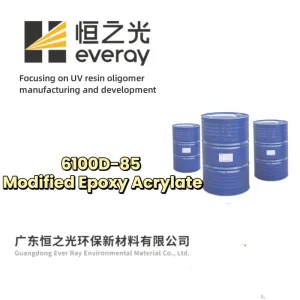
Solution: Integrating 6100D-85 high-adhesion flexible epoxy acrylate into the UV sanding sealer layer created an elastic stress-absorbing zone. Impact resistance improved from 25 kg·cm to >50 kg·cm without sacrificing sanding line speed.
Ensuring full international regulatory safety standards, strict lot-to-lot manufacturing reproducibility, and responsive customer-centric customization.
All flexible epoxy products synthesized at our Yunfu chemical manufacturing plant strictly comply with international environmental directives, including EU REACH registration, RoHS 3.0 (Directive 2015/863/EU), US TSCA inventory, halogen-free requirements (IEC 61249-2-21), and volatile organic compound (VOC) emissions restrictions.
We maintain end-to-end quality control across raw material sourcing, reaction vessel parameters, and final batch testing. Every drum delivered comes with a comprehensive Certificate of Analysis (COA) specifying viscosity (Brookfield @ 25°C), color (Gardner), acid value (mg KOH/g), density, and refractive index to guarantee zero line disruption.
Recognizing that standard products cannot fulfill every niche requirement, our dedicated R&D team offers custom oligomer modification. Whether you require adjusted monomer diluents, lowered viscosity for inkjet delivery, heightened thermal endurance, or specific photoinitiator responsiveness (LED 365nm / 395nm), we deliver tailored sample batches within 5–7 working days.
Pioneering next-generation radiation-curable chemistry to meet stringent eco-sustainability, ultra-fast LED curing, and hybrid dual-cure mechanisms.
To reduce corporate carbon footprint and decrease dependence on petrochemical feedstocks, our synthetic research is incorporating up to 45% renewable bio-based raw materials (derived from modified vegetable oils, cardanol, and bio-succinic acid). These bio-flexible epoxies match petroleum-derived performance in flexibility and adhesion while significantly cutting Scope 3 supply chain emissions.
As conventional medium-pressure mercury lamps are phased out globally due to energy consumption and environmental regulations, our chemical synthesis focuses on optimizing photo-response at long-wave UV-A wavelengths (365nm, 385nm, 395nm, 405nm). Additionally, hybrid dual-cure systems (UV free-radical / thermal or UV / moisture cure) are being developed to ensure complete curing in shadowed 3D geometries.
Emerging applications in smart electronics, automotive interiors, and protective coatings demand dynamic chemical networks. Our future product pipeline includes smart flexibilized oligomers containing reversible hydrogen bonding or dynamic covalent bonds, allowing surface micro-scratches to self-heal upon mild thermal activation.
In-depth responses from our senior application engineers addressing technical, chemical, and manufacturing inquiries.
Standard bisphenol-A epoxy acrylate is produced by reacting bisphenol-A diglycidyl ether (DGEBA) directly with acrylic acid. It features a rigid aromatic ring backbone that delivers high hardness ($Tg > 65^\circ\text{C}$) but results in extreme brittleness and low elongation (<3%). In contrast, flexible epoxy resin incorporates extended aliphatic polyether, polyester, or long-chain alkane segments into the resin backbone. This molecular alteration lowers the glass transition temperature ($Tg$), decreases crosslink density, releases internal cure stress, and boosts elongation at break up to 25%–120% while preserving the fast curing speed and chemical durability characteristic of epoxy chemistry.
Flexible plastic substrates such as PET, PC, PVC, and PE undergo dimensional flexing, thermal expansion, and mechanical deformation. Rigid epoxy acrylates shrink significantly during UV polymerization (6%–8%), building severe internal interfacial stress that causes cracking or film peeling. Flexible epoxy acrylates reduce cure shrinkage down to 2%–3% and feature active polar hydroxyl groups that bond tightly with plastic surfaces. The cured film flexes, bends, and stretches in unison with the underlying substrate, eliminating delamination even during 180° folding or die-cutting.
Yes. All of our modified epoxy acrylate resins and flexible oligomer series are fully compatible with both traditional medium-pressure mercury lamps and modern 365nm / 385nm / 395nm / 405nm LED-UV curing systems. When combined with appropriate long-wavelength photoinitiators (such as TPO, TPO-L, or DETX amine synergists), our flexibilized resins exhibit high reactivity, rapid surface dry, and zero surface tackiness at energy dosages as low as 100–250 mJ/cm².
Flexible epoxy oligomers usually exhibit medium-to-high viscosity (5,000 to 45,000 cP at 25°C). To reduce viscosity for spray, roller, or flexo application, formulators should use mono- or di-functional flexibilizing reactive diluents such as IBOA (Isobornyl Acrylate), TPGDA (Tripropylene Glycol Diacrylate), HDDA (1,6-Hexanediol Diacrylate), or PPGDA (Polypropylene Glycol Diacrylate). Avoid excessive use of trifunctional monomers (like TMPTA) as high-functionality monomers increase crosslink density and negate the flexibilizing benefits of the resin.
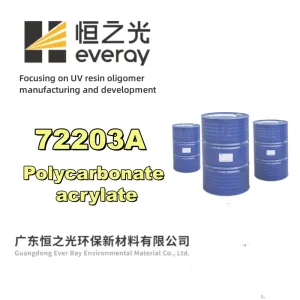
Aromatic epoxy resins inherently contain bisphenol-A aromatic rings that undergo photo-oxidation when exposed to prolonged outdoor UV radiation, causing mild yellowing. For indoor wood, paper, electronic potting, and flexo ink applications, this is negligible. However, if extreme non-yellowing and weather resistance are mandatory for outdoor clear coats, we recommend utilizing our Aliphatic Polyurethane Acrylate (PUA) oligomers or Polycarbonate Acrylate series (such as Grade 72203A and 72923), which contain zero aromatic rings and offer superior weatherability.
When stored in original sealed, light-proof containers at temperatures between 5°C and 30°C away from direct sunlight, heat sources, and strong oxidizers, our flexible epoxy acrylate resins remain stable with a guaranteed shelf life of 12 months. Ensure containers are sealed properly after sampling to prevent moisture contamination or airborne free-radical polymerization triggers.
Free-radical UV polymerization can suffer from oxygen inhibition at the air-coating interface, leading to surface tackiness. To overcome oxygen inhibition in flexible epoxy coatings, formulators can introduce amine synergists or amino acrylate oligomers (such as our Amino Acrylate Series), increase photoinitiator concentration, utilize higher UV peak intensity LED lamps, or incorporate active amine additives that scavenge dissolved oxygen radicals during cure.
Absolutely. We supply 1kg and 5kg trial sample kits complete with Technical Data Sheets (TDS), Safety Data Sheets (SDS), Certificate of Analysis (COA), and starting formulation guidance to help chemical formulators and R&D engineers optimize their coatings, inks, or adhesives quickly.
Complete your chemical formulation requirements with our specialized tough, yellowing-resistant, non-yellowing, and low-viscosity UV-curable oligomers.