Precision-synthesized urethane acrylates engineered for rapid crosslinking, non-yellowing durability, and superior interfacial adhesion.
Decoding structure-property relationships, functional acrylate backbone dynamics, and double-bond conversion efficiencies in modern industrial resins.
In high-demand industrial coating, ink, and photo-fabrication sectors, Polyurethane Acrylates (PUA) represent the pinnacle of radiation-curable polymer chemistry. By combining the intrinsic mechanical toughness, abrasion resistance, and chemical durability of polyurethane backbones with the instantaneous free-radical polymerizability of acrylate functional groups, high-performance urethane resins serve as the bedrock for modern surface engineering.
The primary differentiator of high-performance urethane oligomers lies in the chemical nature of the precursor diisocyanates used during reaction synthesis:
Synthesized utilizing cycloaliphatic or linear aliphatic diisocyanates such as Isophorone Diisocyanate (IPDI), Hexamethylene Diisocyanate (HDI), or Dicyclohexylmethane 4,4'-Diisocyanate (H12MDI). Lacking conjugated aromatic rings, APUA oligomers exhibit exceptional QUV weatherability, resistance to solar yellowing, high optical clarity, and sustained elongation at break. They are irreplaceable in 3C electronic clear coats, outdoor automotive topcoats, and optical adhesives.
Formulated using Toluene Diisocyanate (TDI) or Methylene Diphenyl Diisocyanate (MDI). Aromatic ring structures deliver dense pi-electron stacking, yielding remarkable tensile strength, high glass transition temperatures ($T_g$), extreme scratch hardness, and rapid surface curing speeds at lower raw material costs. Ideal for interior wood flooring, vacuum metallization basecoats, and industrial paper varnishes.
| Polymer Grade | Backbone Type | Viscosity (cP @ 25°C) | Functionality | Glass Transition ($T_g$) | Primary Industrial Utility |
|---|---|---|---|---|---|
| 70601 Waterborne | Aliphatic PUA Dispersion | 100 – 500 | Multi-functional | 35 °C | Eco-friendly 3D printing & zero-VOC wood coatings |
| 7113A Aromatic | TDI-Based Urethane | 15,000 – 25,000 | 3-Functionality | 68 °C | UV Vacuum metallization & plastic hardness primers |
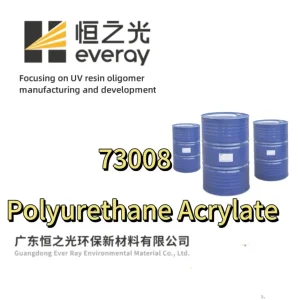
| 73008 Low Shrink | Aliphatic Polyether PUA | 8,000 – 12,000 | 2-Functionality | -15 °C | Electronic potting encapsulation & metal adhesion |
| 7600 Multifunctional | Modified Aliphatic PUA | 35,000 – 50,000 | 6-Functionality | 85 °C | High scratch-resistant consumer electronics (3C) topcoat |
| 53036 Skin-Feel | Polyester-Urethane Hybrid | 4,000 – 7,000 | 2-Functionality | 12 °C | Excimer 172nm laser matte soft-touch coatings |
The superior physical performance of urethane acrylates compared to simple epoxy or polyester acrylates stems from secondary inter-chain physical crosslinking. The carbamate (NH-CO-O) groups form dynamic hydrogen bonds across the polymer matrix. Upon mechanical stress, these hydrogen bonds act as "sacrificial bonds," breaking reversibly to dissipate impact energy before reforming—giving high-performance urethane coatings their unmatched combination of extreme hardness and flexural toughness.
How integrated petrochemical ecosystems, precision DCS synthesis, and agile custom modification deliver strategic competitive edges to global buyers.
China hosts the world's most concentrated chemical supply chain for acrylic acid, HEA/HPMA functional monomers, and diisocyanates (IPDI, HDI, TDI). China-based factories operate with direct raw material pipeline access, insulating international buyers from global supply disruptions while delivering unbeatable cost-per-kilogram value.
Modern South China synthesis plants utilize Distributed Control Systems (DCS) for exothermic temperature control down to ±0.5°C during polyaddition reactions. This guarantees extremely tight molecular weight distribution (MWD) and narrow polydispersity indices, eliminating batch-to-batch viscosity fluctuations.
Unlike legacy Western chemical conglomerates bound by rigid product catalogs, top China high-performance urethane manufacturers offer agile molecular tailoring. Application engineers can adjust oligomer functionality, backbone flexibilization, or bio-based content within 14 working days for OEM pilot testing.
Navigating the global shift toward low-VOC waterborne systems, energy-efficient LED-UV curing, and 172nm excimer laser matte finishing.
Environmental regulations (such as REACH, US EPA VOC caps, and China's GB38508-2020) are accelerating the phase-out of traditional solvent-borne resins. Waterborne UV Polyurethane Dispersions, exemplified by grade 70601, embed hydrophilic carboxylate groups into the PUA backbone. Upon water evaporation, UV irradiation triggers rapid crosslinking, delivering solvent-free coatings with zero odor and zero hazardous air pollutants (HAPs).
Industrial coating lines are rapidly replacing high-power medium-pressure mercury lamps with energy-efficient 365nm to 405nm UV-LED curing arrays. High-performance urethane suppliers are re-engineering oligomer structures to enhance double-bond reactivity and reduce oxygen inhibition, ensuring thorough surface and deep-section cure under narrow LED wavelengths.
To achieve luxurious, anti-fingerprint, ultra-matte finishes without matting agents (which compromise clarity and scratch resistance), specialty polyester-urethane acrylates like grade 53036 are exposed to 172nm excimer radiation. This induces micro-folding on the surface layer prior to full bulk UV curing, producing a silky "skin-feel" touch for luxury automotive interiors and premium consumer electronics.
Addressing supply chain security, regulatory frameworks, and rigorous multi-stage quality control for global enterprise buyers.
Every production lot undergoes comprehensive analytical verification: Viscosity testing (Brookfield DV2T), Color (Gardner Scale), Acid Value titration, Double-Bond Conversion Rate via FTIR spectroscopy, and Free Monomer Residual Gas Chromatography. Certificates of Analysis (COA) are provided for every batch.
Our manufacturing processes comply fully with EU REACH registration requirements, RoHS 3.0 (Directive 2015/863), SVHC screening, US TSCA inventory standards, and Halogen-Free guidelines (IEC 61249-2-21), ensuring smooth global export and seamless compliance for multinational brands.
We partner with international chemical distributors, formulators, and original equipment manufacturers (OEMs) to offer customized monomer dilution ratios, viscosity modifications, specific packaging (20kg pails, 200kg steel drums, 1000kg IBC totes), and confidential private-label supply contracts.
Advanced formulations targeting matte coatings, flexo inks, optical adhesives, and extreme anti-yellowing applications.
Direct technical answers regarding polymer selection, yellowing prevention, glass adhesion chemistry, and factory supply logistics.