Explore our high-performance portfolio engineered for demanding UV/EB coatings, graphic inks, industrial adhesives, and additive manufacturing. Formulated for ultra-fast surface cure, low pigment inhibition, and high scratch resistance.
In the realm of radiation-curable chemistry (UV and Electron Beam curing), polyester acrylate oligomers occupy a foundational position. Synthesized through the esterification of polycarboxylic acids (or their corresponding anhydrides) with polyhydric alcohols, followed by capping with acrylic acid, polyester acrylates represent a versatile class of reactive resin backbones. Their molecular design allows synthetic chemists to tailor crucial performance metrics—including glass transition temperature (Tg), viscosity, crosslink density, pigment wetting capability, and mechanical flexibility.
The general chemical architecture of a polyester acrylate involves an ester-linked backbone ($[-R_1-O-CO-R_2-CO-O-]_n$) terminated with reactive acrylate esters ($CH_2=CH-COO-$). The choice of diols (such as neopentyl glycol, ethylene glycol, 1,6-hexanediol, or tripropylene glycol) and dicarboxylic acids (such as phthalic anhydride, adipic acid, or isophthalic acid) dictates the structural stiffness and intermolecular forces. For instance, aliphatic saturated polyester backbones provide excellent color stability and flexibility, whereas aromatic polyester structures impart high hardness, chemical resistance, and thermal resistance.
Key Chemistry Insight: Unlike epoxy acrylates, which exhibit inherently high viscosity and rigid structures due to bisphenol-A aromatic rings, polyester acrylates can be engineered across a wider viscosity spectrum (from 500 mPa·s to over 100,000 mPa·s at 25°C) and functionality range (2-functional linear to 6-functional hyperbranched structures) without requiring excessive monomer diluents.
Difunctional grades offer extreme elongation and flexural strength for plastic and leather coatings, whereas tetra- and hexa-functional grades yield ultra-fast UV curing response, high crosslinking density, and scratch resistance.
Due to the abundance of ester carbonyl ($C=O$) and ester oxygen groups along the polymer chain, polyester acrylates exhibit low interfacial tension with organic and inorganic pigments, preventing pigment flocculation in inks.
In lithographic UV offset printing, specific polyester acrylate oligomers (such as Grade 5335F and 5403DF) provide a balanced hydrophilicity/hydrophobicity ratio, resisting emulsification under high-speed printing conditions.
When chemical formulators select oligomers for UV coatings, offset inks, or 3D printing resins, choosing the correct resin family is critical. Below is a multi-parameter comparison matrix demonstrating how polyester acrylates fit within industrial radiation-curable systems:
| Performance Property | Polyester Acrylate | Epoxy Acrylate | Urethane Acrylate (PUA) | Pure / Acrylic Acrylate |
|---|---|---|---|---|
| Cure Speed / Reactivity | Very High (4/5) | Extreme (5/5) | Moderate to High (3-4/5) | Moderate (3/5) |
| Viscosity (mPa·s @ 25°C) | Low to Medium (500 – 15,000) | High (20,000 – 200,000) | Medium to High (5,000 – 80,000) | Low to Medium (1,000 – 20,000) |
| Flexibility & Toughness | High (Tunable diol/acid) | Low (Brittle, high shrinkage) | Exceptional (High impact resistance) | High (Elastomeric potential) |
| Pigment Wetting & Dispersion | Outstanding (Industry Standard) | Fair to Moderate | Moderate | Fair |
| Weatherability & Yellowing | Good (Aliphatic saturated) | Poor (Aromatic Bisphenol-A) | Outstanding (Aliphatic PUA) | Excellent |
| Substrate Adhesion (Plastics/Metal) | Good to Excellent | Excellent (Rigid metals/glass) | Excellent (Wide substrate range) | Outstanding (Polyolefins/PET) |
| Cost / Performance Ratio | Optimal (Highly Commercial) | Economical | Premium | Moderate to High |
The global market for radiation-curable coatings and inks is undergoing a major structural shift. Valued at over USD 5.8 Billion in 2024, the market for UV/EB curable resins is projected to expand at a CAGR of 6.8% through 2032. Procurement heads, chemical sourcing directors, and technical R&D managers across Europe, North America, and Asia-Pacific face evolving challenges driven by regulatory frameworks, sustainable manufacturing mandates, and supply chain volatility.
China's specialty chemical manufacturing sector has evolved beyond simple high-volume production into an advanced, automated Industry 4.0 ecosystem. Advanced production bases—such as Guangdong Ever Ray Environmental Material Co., Ltd. (operating a 40,000+ m² facility in Yunfu, Guangdong)—represent the modern pinnacle of polymer synthesis resilience and quality control.
Distributed Control Systems (DCS) monitor chemical reaction kinetics, temperature vectors, and vacuum stripping pressures in real time. This guarantees ultra-consistent molecular weight distribution (Mw/Mn < 1.45) and eliminates batch-to-batch viscosity variances.
Located within major South China chemical clusters, manufacturing facilities benefit from direct pipeline access to purified acrylic acid, diols, and anhydrides. Strategic raw material integration hedges against price fluctuations and ensures uninterrupted global supply.
Advanced catalyst technology and high-vacuum deodorization yield polyester acrylates with Pt-Co color ratings under 50 (APHA), preventing color distortion in optical clear coats, white printing inks, and wood varnishes.
Supply Chain Security Guarantee: Modern Chinese manufacturers provide full trace-batch documentation—including Certificate of Analysis (COA) per drum, REACH registration Dossiers, SDS, and GHS-compliant dangerous goods packaging—enabling seamless customs clearance across European, North American, and Southeast Asian ports.
Polyester acrylate oligomers are utilized across diverse industrial applications. Selecting the optimal grade requires aligning polymer architecture with end-use performance specifications.
In offset inks, the resin must disperse pigment particles efficiently while maintaining a strict water-ink balance. Polyester Acrylate Model 5335F and Model 5403DF are specifically synthesized with controlled acid numbers (typically < 5 mg KOH/g) and balanced polar ester linkages. This prevents ink emulsification on high-speed dampening rollers, eliminating ink fly, ghosting, and misting at press speeds exceeding 15,000 sheets per hour.
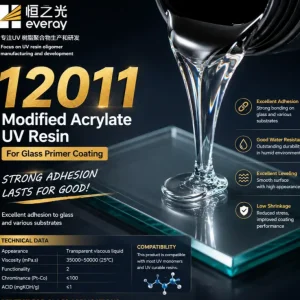
Glass and metallic substrates present significant adhesion challenges due to high surface energy and smooth topographies. Modified Acrylate UV Resin Model 12011 incorporates carboxyl and hydroxyl functional modifiers directly onto the ester backbone. When exposed to UV radiation, the resin forms chemical hydrogen bonding with silanol ($Si-OH$) groups on glass surfaces. Formulations containing Model 12011 withstand demanding 100°C boiling water immersion testing for over 2 hours without peeling or cross-hatch loss.
Rigid coatings crack when applied to flexible substrates like leather, luxury vinyl tile (LVT), or natural wood flooring subjected to thermal expansion. Pure Acrylate and Polyester Acrylate blends (such as Model 7296C) utilize long-chain aliphatic diol backbones. This lowers the crosslink density while maintaining tough surface scratch resistance, delivering high flexibility (1/8-inch conical mandrel pass) without sacrificing solvent resistance against alcohol, MEK, and household cleaners.
In SLA/DLP/LCD 3D printing, volumetric shrinkage causes part warping, curling, and internal residual stress. Photo-Thermal Dual-Curing Polyurethane / Polyester Acrylate resins (such as Model 72017) deliver low linear shrinkage (< 1.2%), high green strength upon light exposure, and enhanced mechanical toughness upon thermal post-curing.
Even high-grade oligomers require balanced formulating. Below, our technical application team addresses four common formulation defects and provides polyester acrylate adjustment strategies:
Cause: Atmospheric oxygen scavenges free radicals generated during photo-initiation, creating a tacky surface layer.
Solution: Incorporate 10–20% Amine-Modified Polyester Acrylate or Active Amine Synergist. The tertiary amine groups undergo rapid hydrogen abstraction, consuming oxygen molecules and restoring surface cure.
Cause: High acrylate double-bond density creates extreme volumetric contraction during polymerization.
Solution: Blending higher molecular weight difunctional polyester acrylates or pure acrylates (such as Model 72027) lowers double bond density, relieves internal stress, and restores cross-hatch adhesion to 5B standards.
Cause: Dark polymerization caused by trace metallic impurities or improper storage temperatures.
Solution: Ensure polyester acrylates are stabilized with 200–500 ppm MEHQ inhibitor and stored in oxygen-permeable HDPE containers below 30°C away from direct UV exposure.
Key answers to technical, commercial, and logistical questions frequently asked by overseas procurement managers and R&D chemists.
Discover additional specialized acrylate resins designed for industrial UV wood coatings, 3C electronics topcoats, vacuum plating, and high-reactivity specialty inks.