Explore our high-performance UV-curable oligomers and specialty resins engineered for superior chemical, mechanical, and optical properties.
An in-depth analysis of urethane linkages, radical photopolymerization kinetics, and molecular structural engineering for high-performance coatings.
Polyurethane (PU) coatings represent the pinnacle of modern protective polymer technology, offering an extraordinary synthesis of mechanical toughness, elastomeric flexibility, chemical inertness, and optical clarity. As a leading polyurethane coating manufacturer and factory, Guangdong Ever Ray Environmental Material Co., Ltd. (operating advanced production hubs in Yunfu and Jiangmen, China) specializes in synthesizing targeted Polyurethane Acrylate (PUA) oligomers, waterborne polyurethane dispersions (PUD), and multi-functional acrylate prepolymers engineered specifically for ultra-violet (UV) and electron-beam (EB) radiation-curing matrices.
The core chemistry of polyurethane coatings relies upon the reaction between polyfunctional isocyanates (\(-\text{NCO}\) groups) and hydroxyl-terminated polyols (\(-\text{OH}\) groups) to yield stable urethane linkages (\(-\text{NH--COO}--\)). In radiation-curable polyurethane acrylates, acrylated end-groups (typically via reactions with hydroxyalkyl acrylates such as 2-hydroxyethyl acrylate, HEA, or hydroxypropyl acrylate, HPA) are grafted onto the urethane backbone. This hybrid architectural design establishes two distinct structural zones within the crosslinked film:
Formed by aromatic (TDI, MDI) or aliphatic (IPDI, HDI, H12MDI) isocyanates coupled with short-chain diols. These domains form hydrogen-bonded physical crosslinks, conferring extreme pencil hardness (up to 4H–6H), abrasion resistance, and chemical barrier properties.
Composed of flexible polyether, polyester, polycarbonate, or polybutadiene chains. The soft segment provides elastomeric elongation, impact dissipation, low-temperature flexibility, and substrate stress relief during radical polymerization shrinkage.
Terminal vinyl groups undergo near-instantaneous free-radical polymerization under UV light (365–405 nm wavelengths), constructing a robust 3D network with adjustable double-bond conversion rates exceeding 92% in optimized formulations.
Formulators often face trade-offs between UV resistance and cost. Aliphatic Polyurethane Acrylates (APUA) synthesized via Isophorone Diisocyanate (IPDI) or Hexamethylene Diisocyanate (HDI) offer zero quinoid structure formation, guaranteeing non-yellowing performance under QUV accelerated weathering (>2,000 hours, \(\Delta E < 1.5\)). Conversely, Aromatic Polyurethane Acrylates (ARPUA) utilizing TDI/MDI provide cost-effective hardness and tensile strength for interior wood coatings, flexographic inks, and heavy-duty floor lacquers where UV-driven discoloration is non-critical.
| Resin Chemistry Type | Viscosity Range (mPa·s @ 25°C) | Pencil Hardness | Elongation at Break (%) | QUV Weatherability | Primary Industrial Focus |
|---|---|---|---|---|---|
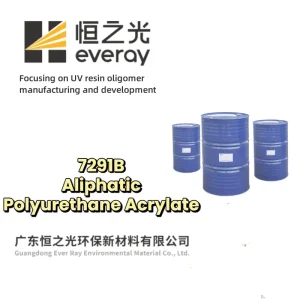
| Aliphatic PUA (e.g., PUA 7291B) | 15,000 – 45,000 | 3H – 5H | 15% – 85% | Superior (>2000 hrs) | Automotive OEM, 3C Electronics, Solar Topcoats |
| Aromatic PUA (e.g., Grade 7600) | 20,000 – 60,000 | 2H – 4H | 10% – 50% | Moderate (Yellowing risk) | Interior Wood Flooring, Paper Varnishes, Industrial Machinery |
| Epoxy Acrylate (e.g., 6100D-85) | 40,000 – 100,000 | 4H – 6H | 2% – 8% | Poor (Chalking risk) | High-Gloss OPV, Metal Primers, PCB Solder Masks |
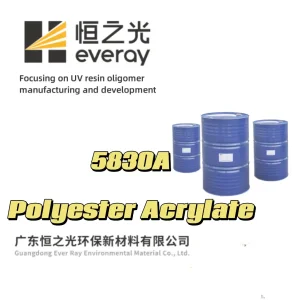
| Polyester Acrylate (e.g., 5830A) | 1,500 – 12,000 | H – 3H | 20% – 120% | Good to Excellent | Flexo Inks, Excimer Soft-Touch, Leather Finishing |
Tracking the shift toward low-VOC, high-solids, LED-UV curable polyurethane systems across key international commercial sectors.
The global industrial coatings sector is currently navigating an unprecedented structural transition driven by stringent environmental regulations (such as REACH in Europe, GB38507 VOC thresholds in China, and EPA Rule 1113 in North America). Traditional solvent-borne two-component (2K) polyurethane coatings—long favored for high-build automotive clearcoats and structural steel anti-corrosion—are rapidly giving way to Energy-Curable Polyurethane Systems and Waterborne Polyurethane Dispersions (PUD).
EV lightweighting relies heavily on composite substrates (CFRP, Polycarbonate, ABS blends). Polyurethane acrylates engineered by Ever Ray deliver high-adhesion clearcoats that cure under LED-UV wavelengths (395nm), eliminating thermal warping of sensitive plastic components.
Mobile phone housings, laptop enclosures, and wearable tech require anti-fingerprint (AF), scratch-resistant (5H pencil hardness), and chemical-resistant (10,000+ alcohol rub cycles) topcoats fulfilled by hyperbranched polyurethane acrylates.
Luxury Vinyl Tile (LVT), Stone Plastic Composite (SPC), and engineered hardwood manufacturing lines demand ultra-fast line speeds (>60 m/min) with zero VOC emissions. PUA resins provide instantaneous mechanical strength for immediate stacking and packing.
Furthermore, the global shift from mercury lamp curing to energy-efficient LED-UV curing systems requires polyurethane acrylates with optimized surface-cure response. Standard acrylate oligomers often suffer from oxygen inhibition at surface interfaces when exposed to long-wave LED light. Ever Ray solves this via chemical incorporation of tertiary amine synergists into the polyurethane backbone or pairing with amine-modified acrylates, accelerating surface tack-free times to milliseconds.
How Ever Ray leverages upstream integration, advanced reactor automation, and stringent QC protocols to supply global markets seamlessly.
Evaluating a industrial supplier requires looking beyond laboratory-scale formulations to assess raw material security, manufacturing infrastructure, quality control systems, and international compliance. As an established enterprise with roots dating back to 2006, Guangdong Ever Ray Environmental Material Co., Ltd. operates a sprawling production plant spanning over 40,000 square meters in Yunfu, Guangdong, equipped with more than 10 fully automated synthesis lines.
Located in Southern China’s prime chemical industrial belt, Ever Ray benefits from direct pipeline access to key monomer feeds (Acrylic Acid, HEA, IPDI, TDI, Polyether polyols). This eliminates supply bottlenecks and insulates international partners from global pricing volatility.
Every synthetic lot undergoes comprehensive analytical validation via Gas Chromatography (GC), Gel Permeation Chromatography (GPC for molecular weight distribution), Rotational Rheometry, and QUV testing, guaranteeing strict drum-to-drum batch repeatability.
Equipped with dangerous goods packaging compliance (UN drums, ISO tanks, Flexibags), export licensing, and rapid dispatch capabilities via major maritime hubs (Shenzhen, Guangzhou, Hong Kong), supplying over 50 countries worldwide.
Ever Ray holds over 10 utility and invention patents covering hyperbranched polyurethane acrylate synthesis, excimer laser matte-surface resins, and bio-based UV monomers. Our in-house technical team of PhD polymer chemists continuously pushes performance boundaries for specialized industrial requirements.
Next-generation polymer architectures shaping the future of radiation-cured and sustainable functional polyurethane coatings.
The polyurethane coating landscape is evolving beyond traditional physical protection toward dynamic, smart, and ultra-sustainable functional surfaces. Ever Ray’s R&D division has established a clear technical roadmap prioritizing three breakthrough resin platforms:
Conventional matting requires silica additives that increase viscosity and reduce clarity. Advanced PUA oligomers (such as Grade 53036) undergo micro-folding under 172nm excimer UV radiation, creating a super-matte finish (gloss < 2° at 60°) with soft-touch skin feel and self-healing micro-scratches.
For complex 3D industrial parts with shaded cavities where UV light cannot penetrate, dual-cure polyurethane acrylates combine UV radical curing for rapid surface handling with secondary moisture curing (silane or residual isocyanates) for complete dark-cure shadow conversion.
Incorporating up to 45% bio-based carbon content derived from castor oil, succinic acid, and renewable polyols without sacrificing hardness or solvent resistance. Aligns with corporate Scope 3 decarbonization goals for global tier-1 brand owners.
Practical formulation recommendations for demanding industrial processing lines.
Challenge: Vacuum plating (aluminum deposition) on ABS plastic containers often suffers from poor inter-coat adhesion, thermal cracking, and loss of mirror gloss under perfume spray exposure.
Ever Ray Engineering Solution: Utilizing PUA 7230E paired with reactive monomer HDDA and photoinitiator 184. 7230E provides controlled shrinkage and high flexibility, preventing micro-cracking over metalized films, while delivering 100% cross-hatch adhesion (ASTM D3359 5B) after 48-hour humidity chamber testing.
Challenge: UV coatings on glass bottles or architectural glass panels detach rapidly when subjected to pasteurization or boiling water immersion tests due to moisture migration at the inorganic interface.
Ever Ray Engineering Solution: Formulating with Polyester Acrylate 5830A combined with 1.5% silane coupling agent (EO-EO glycidoxypropyltrimethoxysilane). The high hydroxyl concentration of 5830A bonds chemically with hydrolyzable silanes, passing 2-hour boiling water immersion without blistering or tape-off detachment.
Ensuring full regulatory compliance across international jurisdictions for frictionless import and application.
Navigating global chemical regulations requires comprehensive analytical and regulatory support. Ever Ray supports overseas formulators and OEM procurement teams by providing fully certified documentation packages:
Precise specification ranges for viscosity, color (Gardner/APHA), acid value, refractive index, and solids content provided for every commercial shipment.
Safety Data Sheets updated to GHS Rev 8 in multi-language formats (English, Spanish, German, French, Japanese). Full REACH compliance for European market access.
Our application laboratory assists with line optimization, photoinitiator blending, monomer selection, and substrate troubleshooting to shorten product development cycles.
Expert solutions to common formulation and application challenges in polyurethane and UV coating technology.
Discover high-adhesion, low-odor, and excimer-compatible resin systems engineered for high-performance UV formulations.