The global printing ink manufacturing sector is undergoing an unprecedented technological paradigm shift driven by stringent VOC environmental regulations, hyper-speed automation, and the demand for enhanced chemical resistance across complex substrates. As a specialized High-Quality printing ink Manufacturer, our engineering framework integrates molecular resin design, precise rheological control, and photo-initiator synergy to deliver high-performance oligomers and ink vehicles engineered for maximum throughput.
Modern industrial printing demands extend far beyond visual color density. Industrial packaging, 3C electronic housings, flexible barrier films, and automotive components mandate ink formulations capable of instant polymerization under UV LED wavelengths, robust boiling-water resistance, ultra-low migration profile for food-contact compliance, and zero yellowing over extended product lifecycles.
The commercial printing ink sector is categorized primarily into flexographic, lithographic offset, gravure, screen, and digital inkjet processes. While conventional solvent-borne inks continue to experience regulatory headwinds under global chemical safety directives (such as EU REACH, TSCA, and China GB/T standards), energy-curable (UV/EB) ink chemistry has surged ahead with a CAGR exceeding 6.8%.
Rapid growth in flexible food packaging, shrink sleeves, and narrow-web label printing requiring low-odor, low-viscosity polyester acrylates with instant UV LED cure speed.
Demands immaculate lithographic water-ink balance, high pigment loading capacity, and high shear stability to prevent ink misting and emulsification at high press speeds.
Covers high-build tactile effects, snowflake/wrinkle textured finishes, glass ceramic printing, and high-resolution digital inkjet UV inks for industrial direct-to-shape printing.
Achieving optimal printing ink performance requires balancing contradictory chemical properties. High functionality increases cure speed and scratch resistance but induces volumetric shrinkage and compromises substrate adhesion. To overcome these barriers, our chemical formulation team focuses on three key technical frontiers:
By synthesizing hyperbranched polyol core acrylates, formulators achieve functionality up to 6 or 8 double bonds with surprisingly low Newtonian viscosity. This reduces reactive diluent usage while enhancing surface scratch hardness (up to 4H-5H pencil hardness).
Atmospheric oxygen quenches free radicals during atmospheric UV curing, causing sticky surface layers. Incorporating tertiary amine-modified acrylates (Active Amines) acts as an oxygen scavenger, accelerating surface cure speeds by 40-60% even under low-energy LED lamps.
In UV lithographic offset inks, resins must maintain zero breakdown under fountain solution emulsification stress. Our modified polyester acrylates balance polar carboxylic hydroxyl groups with non-polar aliphatic chains to guarantee stable ink transfers across 15,000 sheets/hour.
Every substrate presents unique surface energy challenges. Standard UV resins often fail on low-surface-energy plastics (such as untreated PP, PE, or PET) or non-porous inorganic surfaces like tempered glass and aluminum alloys.
| Application Scenario | Target Substrates | Key Performance Challenges | Recommended Oligomer Solution |
|---|---|---|---|
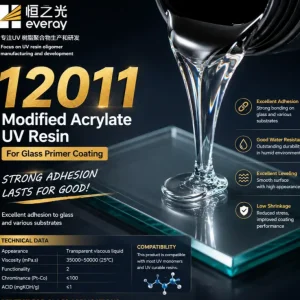
| Glass & Cosmetic Containers | Inorganic Glass, Ceramic Tiles | Boiling water resistance, inter-coat adhesion, alkali washing stability | 17730A-2 / 12011 Modified Acrylate Resin |
| UV Litho Packaging | Cardboard, Coated Paper, Folding Cartons | Water-ink balance, low odor, fast speed, high gloss OPV | 5403-3F Polyester Acrylate / 6805A-1 Resin |
| Plastic & 3C Electronics | PC, ABS, PMMA, Treated PET | Abrasion resistance, anti-yellowing, alcohol wipe resistance | 7913 Polyurethane Acrylate / 5103 Polyester Resin |
| Tactile & Decorative Printing | Specialty Labels, Paper Varnish | Wrinkle effect, snowflake texture, screen creeping control | 7317 Wrinkle UV Resin / 5450 Screen Varnish Resin |
| Additive Manufacturing / 3D | Photopolymer Resins | Tensile strength, high impact resistance, dual-curing low shrink | 71209A-1 ABS-Like / 72017 Dual-Cure PUA |
Integration of renewable plant-derived polyols (castor oil, modified soybean oil) into acrylate backbones to achieve >40% bio-based carbon content while maintaining ultra-fast cure kinetics.
Eliminating shadow-area uncured zones in 3D structures and opaque thick-film printing inks via dual-stage mechanisms: initial UV pin-curing followed by thermal moisture crosslinking.
Deploying machine learning models to predict ink transfer dynamics, surface tension wetting, and pigment dispersion stability, cutting formula development cycles by over 70%.
As a global tier-one synthetic material partner, our company provides end-to-end industrial solutions tailored for printing ink manufacturers, masterbatch compounders, and high-tech coating formulators. From custom oligomer synthesis to strict regulatory compliance, we safeguard your supply chain reliability.
Every batch undergoes rigorous quality testing including Gel Permeation Chromatography (GPC) molecular weight profiling, Brookfield cone-plate viscosity measurement, acid value titration, and APHA color index verification.
Fully compliant with EU REACH, RoHS 2.0, China GB9685 food-contact standards, and Nestlé Guidance Note on Packaging Inks. Free of organotin compounds, heavy metals, and banned photoinitiator contaminants.
Whether your press lines operate under 365nm UV LED, 395nm UV LED, or traditional Medium Pressure Mercury Vapour lamps, our chemical engineers adjust double-bond density and oligomer molecular weights to match your exact processing window.
