Select from our benchmarked formulations engineered for maximum crosslink density, rapid curing response, and exceptional substrate binding strength.
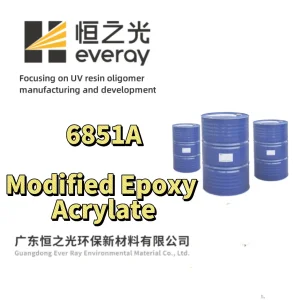
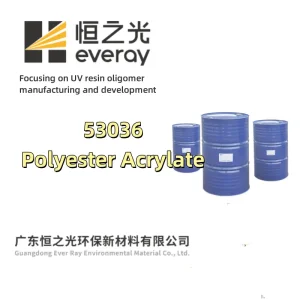
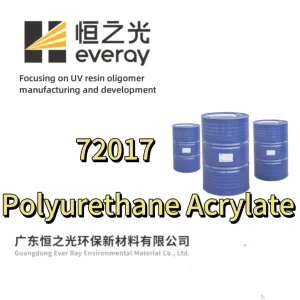
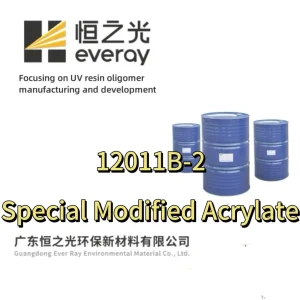
Screen printing remains a bedrock foundation of global industrial manufacturing, enabling functional, decorative, and electronic ink deposition across diverse polymers, glass, metals, and textiles. However, modern environmental directives and high-speed automated production lines require a radical transition from volatile organic compound (VOC) solvent systems toward high-solid UV/LED radiation-curable resin chemistry.
As an industry leader in photo-curable oligomers and special functional resins, Guangdong Ever Ray Environmental Material Co., Ltd. (operating from our 40,000 m² state-of-the-art facility in Yunfu, Guangdong, with global sales based in Jiangmen) manufactures raw materials that redefine the physical limitations of screen printing inks, overprint varnishes (OPVs), and functional coatings. By engineering precise oligomeric backbones—ranging from epoxy acrylates and polyurethane acrylates (PUA) to hyperbranched structures—we provide chemical formulators and tier-1 printing factories with the ultimate competitive advantage: elevated information gain, reproducible viscosity control, and unparalleled adhesion on problematic substrates.
Traditional medium-pressure mercury lamps generate excessive infrared heat, distorting heat-sensitive plastic film substrates like PET, PVC, and Polycarbonate. The global screen printing market is rapidly converting to LED curing sources operating at 365nm, 385nm, and 395nm. This shift necessitates oligomers with heightened photo-reactivity and photoinitiator compatibility to counteract narrow-spectrum UV absorption.
Stringent EU REACH, RoHS 2.0, TSCA, and domestic Chinese VOC standards have virtually eliminated solvent-borne screen printing inks from top-tier supply chains. Modern screen printing factories must utilize 100% solid systems or low-VOC waterborne UV dispersions that comply with zero-emission factory directives without sacrificing chemical rub resistance.
Screen printing is no longer restricted to graphic art. The market for printed touch panels, membrane switches, automotive display bezels, RFID tags, and flexible printed circuits (FPC) is accelerating. Resin systems must exhibit zero volumetric shrinkage, low dielectric constant, high optical transparency, and extreme flexural fatigue resistance.
Screen printing requires unique fluid dynamics compared to flexographic, offset, or digital inkjet systems. The ink must exhibit pronounced thixotropy: low viscosity under high shear rate (when pushed by the squeegee through screen mesh counts ranging from 100 to 180 threads/cm), followed by rapid structural recovery (high zero-shear viscosity) once deposited to prevent dot gain and sagging.
| Oligomer Chemical Class | Primary Physical Traits | Key Performance Metrics | Optimal Substrate & Application |
|---|---|---|---|
| Bisphenol A Epoxy Acrylate (e.g., Ever Ray 6851A, 6100D) |
Fast cure rate, high glass transition temperature (Tg), high tensile strength | Hardness >3H, excellent surface gloss, MEK double rubs >200 cycles | Glass primers, wood sealers, paper overprint varnishes, rigid plastics |
| Aliphatic Polyurethane Acrylate (e.g., Ever Ray 7296-1, 7200F) |
Superior flexibility, non-yellowing, exterior weatherability, toughness | Elongation 20%–150%, non-yellowing ΔE < 1.0 after 1000h QUV, impact resistant | 3C electronics housings, automotive interior displays, membrane switches |
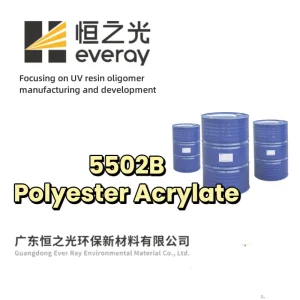
| Polyester Acrylate (e.g., Ever Ray 5502B, 5403-2F) |
Low viscosity, excellent pigment wetting capability, fast reactivity | High color density, low ink tack, excellent flow through fine screen mesh | High-speed graphic screen inks, container decoration, packaging print |
| Photo-Thermal Dual-Cure Resin (e.g., Ever Ray 72017) |
Dual polymerizing mechanism (UV exposure + thermal post-bake) | Complete shadow curing, zero unreacted monomer residue, low volumetric shrinkage | Optically clear adhesive (OCA), complex 3D screen printing, deep cavity inks |
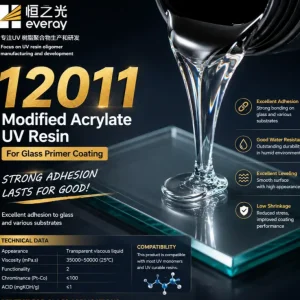
Glass is inherently non-porous and hydrophilic, causing standard UV inks to delaminate when exposed to humidity or thermal shock.
Solution: Formulating with Ever Ray 12011 Modified Acrylate introduces polar functional groups and silane-coupling compatibility. Achieves 100% cross-hatch tape adhesion (ASTM D3359 5B) even after 2 hours of boiling water immersion testing.
Screen-printed ink layers on Polycarbonate (PC) or PMMA sheets undergo severe thermoforming stretching without cracking or loss of opacity.
Solution: Utilizing high-elongation Aliphatic Polyurethane Acrylates paired with special modified monomers yields flexible crosslinked networks capable of enduring deep-draw thermoforming pressures exceeding 50 Bar.
Creating braille lettering, 3D textured graphics, or luxury velvet-touch cosmetics packaging via heavy deposit rotary screen screens.
Solution: Ever Ray 53036 Polyester Acrylate combined with excimer laser surface matting creates extreme low-gloss, velvety tactile finishes with scratch resistance up to 4H pencil hardness.
Formulators frequently encounter chemical and physical challenges during screen printing ink development. Below is our direct technical troubleshooting matrix for ink engineers:
Free radical photopolymerization is scavenged by atmospheric oxygen at the top surface, resulting in tacky, unreacted screen printing surface films under low UV dose.
When multi-color screen prints are layered, high crosslinking density in the primary color layer creates a inert glass-like surface, causing subsequent white or clear trap passes to flake off.
Dark ambient room light or stray UV equipment radiation initiates premature crosslinking inside mesh openings, causing catastrophic screen blockage during production halts.
Procurement heads and R&D managers must enforce stringent audit metrics when selecting raw chemical vendors. Unstable monomer viscosity or trace moisture contamination can compromise an entire printing run.
Every batch produced at Ever Ray's Yunfu facility undergoes Brookfield rotational viscometer checks at 25°C, Gardner color scale measurements, and gel permeation chromatography (GPC) to guarantee exact molecular weight distribution.
Full documentation suites—including Technical Data Sheets (TDS), Safety Data Sheets (SDS compliant with GHS Revision 8), Certificates of Analysis (COA), REACH registration dossiers, and SVHC non-containment declarations—are instantly available per lot.
With 10+ scalable automated synthesis reactors operating simultaneously, Ever Ray maintains long-term raw material buffer stocks, insulating international procurement programs from spot market price spikes and supply disruptions.
Explore our expanded series of specialty acrylates designed for vacuum plating, high wear resistance, rapid curing, and high-strength bonding.
In-depth technical responses addressing common engineering and sourcing queries.
Work directly with our chemical synthesis engineers to evaluate resin samples, optimize screen ink formulations, or request custom oligomer manufacturing.
Specify your resin chemistry target (Epoxy Acrylate, Polyurethane Acrylate, Polyester Acrylate, Monomer), substrate layer, and curing lamp system to receive tailored sample drums.
Request Technical Data & Samples