Explore our primary selection of certified UV-curable raw materials engineered for professional nail polish, protective coatings, and industrial applications.
The global cosmetic and professional nail care sectors are undergoing a profound technological shift. Historically reliant on traditional, solvent-based nitrocellulose lacquers that air-dry through volatile solvent evaporation, modern consumer expectations and stringent occupational health standards have accelerated the adoption of ultraviolet (UV) and UV-LED curable gel systems. As modern formulations demand instantaneous drying times, non-chip wear durations exceeding 21 days, and high-mirror optical clarity, the selection of raw materials—specifically aliphatic polyurethane acrylates, epoxy acrylates, and photoinitiator complexes—has become the central pillar of brand differentiation.
The global market is bifurcated into high-volume consumer retail channels and premium salon-grade systems. Salon systems demand ultra-precise physical properties: an equilibrium between high tensile modulus (scratch resistance) and elasticity (prevention of edge chipping under impact). Furthermore, industrial nail art printing technologies—utilizing specialized UV inkjet droplets directly onto synthetic substrates or natural keratin—require oligomers with controlled rheology, ultra-low shear viscosity, and rapid radical propagation rates under low-energy LED lamps.
Understanding the photopolymerization dynamics of ultraviolet nail polish requires examining the core resin architecture. The backbone of every high-performance gel system comprises three main functional chemical elements: Oligomers (providing mechanical backbone and flexibility), Reactive Diluents/Monomers (controlling viscosity and crosslink density), and Photoinitiators (absorbing UV photons to generate free radicals).
Selection of the urethane acrylate backbone governs weatherability, color stability, and mechanical strength. Aliphatic Polyurethane Acrylates (APUAs), synthesized from hexamethylene diisocyanate (HDI) or isophorone diisocyanate (IPDI), feature saturated molecular structures that exhibit superior UV stability. They guarantee zero yellowing under continuous daylight or lamp exposure, making them the absolute industry standard for clear top coats and vibrant white/pastel color gels. Conversely, Aromatic Polyurethane Acrylates (derived from TDI or MDI) provide economic cost advantages and elevated hardness, rendering them highly effective for dark-pigmented base layers or industrial wood/plastic topcoats (such as specialized grades like 7296C and 7160).
Transitioning from traditional high-pressure mercury lamps (emitting at broad 254–365nm spectral peaks) to energy-efficient UV-LED curing lamps (emitting narrow spectral bands concentrated at 365nm, 385nm, or 395nm) has fundamentally changed photoinitiator chemistry. Type I photoinitiators (such as Hydroxycyclohexyl phenyl ketone - 184) remain highly favored for non-yellowing surface cures. However, deep-layer curing of heavily pigmented black, red, or titanium dioxide-filled white gels requires Type I acylphosphine oxide derivatives (e.g., TPO or TPO-L) and Bis-acylphosphine oxides (BAPO - 819) due to their long-wave absorption tails extending beyond 400nm.
| Chemical Class | Typical Viscosity (cPs @ 25°C) | Cure Speed (LED 395nm) | Yellowing Index (ΔYI) | Primary Application in Gel Polish |
|---|---|---|---|---|
| Aliphatic Urethane Diacrylate | 15,000 – 45,000 | High (< 20 sec) | Ultra-Low (< 0.5) | High-Gloss Non-Wipe Top Coats, Clear Builders |
| Aromatic Urethane Acrylate | 8,000 – 25,000 | Very High (< 15 sec) | Moderate (Slight yellowing) | High-Adhesion Primer Gels, Dark Pigment Layers |
| Modified Epoxy Acrylate | 3,000 – 12,000 | Ultra-Fast (< 10 sec) | High (Unsuitable for light colors) | Sanding Sealers, Outer Scratch-Resistant Shells |
| Polyester Acrylate Oligomer | 1,500 – 6,000 | Moderate | Low-Moderate | Pigment Wetting Dispersants, Viscosity Modifiers |
Matching specialized resin chemistries to localized mechanical and aesthetic requirements across diverse professional nail environments.
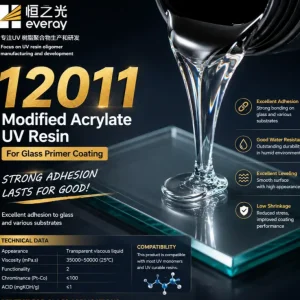
The foundational layer requires maximum chemical affinity to natural human keratin. Formulations leverage low-shrinkage functional monomers and modified phosphate-containing oligomers (such as 12011 Glass/Substrate Adhesion resins) to form dual hydrogen-covalent bonding, preventing premature lifting even in hot, humid salon environments.
Color coats require oligomers with outstanding pigment-wetting capabilities. Incorporating hyperbranched acrylate oligomers or specialized polyester acrylates (e.g., 5312-A and 5336B) guarantees uniform dispersion of inorganic pigments (Iron Oxides, TiO2) and organic mica pearls, preventing pigment settling during long shelf-life storage.
Top coats must cure fully without an oxygen-inhibited sticky surface layer. Utilizing aliphatic urethane acrylates paired with active amine synergists (or amino acrylates) forces rapid surface radical recombination, yielding a hydrophobic, mirror-like finish resistant to ethanol, acetone, and household detergents.
Building gels used for nail extensions require thixotropic, high-viscosity resins that hold shape prior to cure. Low-shrinkage modified acrylates (such as 17701 and 1290H) eliminate volume contraction during polymer network crosslinking, preventing physical stress on the underlying natural nail matrix.
Specialty 3D artistic finishes—including velvet cat-eye, micro-snowflake, and tactile wrinkle effects—depend on phase-separating functional resins (such as 7317 Specialty Oligomers). These induce controlled micro-surface wrinkles via surface differential curing under targeted LED wavelengths.
Beyond cosmetics, specialized UV resins provide protective topcoats over vacuum-metallized synthetic nail tips made of ABS/PC. Resins like Aromatic Polyurethane Acrylates deliver extreme inter-coat adhesion and thermal barrier properties during aluminum vapor deposition processes.
As the epicenter of global chemical synthesis and fine chemical processing, Guangdong Province in China represents the highest concentration of chemical engineering infrastructure for radiation-curable materials. Chinese chemical manufacturing hubs deliver unmatched vertical integration: synthesizing raw acrylic acid, polyols, and diisocyanates locally, converting them into specialized oligomers, and formulating finished bulk gels under strict, standardized industrial controls.
Our advanced manufacturing facility operates under automated glass-lined chemical reactors with continuous temperature monitoring (controlling exothermic peaks to within ±0.5°C during acrylic functionalization). This eliminates batch-to-batch variations in molecular weight distribution (Mw/Mn dispersity), ensuring predictable UV curing speeds and zero color shifting across multi-ton production lots.
Navigating international cosmetics safety compliance is paramount for brands exporting across North America, the European Union, and the Asia-Pacific region. UV nail polish ingredients are categorized under strict chemical inventories and cosmetic safety directives:
In-depth answers from our senior R&D chemists resolving common technical challenges in UV nail polish formulation.
Answer: Exothermic heat spikes occur when high-functionality acrylate monomers polymerize rapidly, generating rapid localized thermal kinetic energy. To suppress heat spikes: (1) Replace high-reactivity tri- or tetra-functional monomer diluents with higher molecular weight di-functional aliphatic urethane acrylates; (2) Decrease the weight percentage of high-extinction photoinitiators like TPO; (3) Incorporate moderate molecular weight polyester acrylate oligomers (such as 5312-A) to act as internal thermal heat sinks during rapid double-bond conversion.
Answer: Yellowing is caused by degradation products of aromatic rings under UV exposure or decomposition by-products of amine co-initiators and Type I photoinitiators. To guarantee zero yellowing (ΔYI < 0.5): utilize 100% Aliphatic Polyurethane Acrylates derived exclusively from IPDI or HDI backbones, select non-yellowing photoinitiators (such as 184 or 1173), and add primary hindred amine light stabilizers (HALS) alongside UV absorbers.
Answer: Edge peeling stems from high polymerization volumetric shrinkage creating mechanical internal stress at the nail interface, compounded by insufficient lipid/moisture wetting. Resolving this requires incorporating low-shrinkage functional monomers and specialized adhesion promoters like 12011 Modified Acrylate UV Resin, which contains carboxyl or phosphate groups that form strong hydrogen bonds with nail keratin.
Answer: High crosslink density resins are required. Modified Bisphenol A Epoxy Acrylates (such as Grade 9104) or high-functionality urethane acrylates provide tight polymeric networks that prevent solvent molecules from swelling the cured polymer matrix, making them ideal for protective industrial outer shells and chemical-resistant topcoats.
Answer: Atmospheric oxygen diffuses into the surface layer during curing, reacting with free radicals to form unreactive peroxy radicals, leaving a sticky, under-cured film. Formulators eliminate this sticky layer by blending Amino Acrylate Oligomers or Active Amine synergists with hyperbranched acrylates. The amine group undergoes fast hydrogen abstraction to scavenge oxygen, enabling complete surface curing under ambient air.
Specialized UV resins engineered for rapid curing lines, flexible plastic coatings, substrate primers, and functional art effects.