Engineered for high reactivity, superior clarity, controlled shrinkage, and exceptional adhesion across glass, metal, and engineered plastics.
Buy Polyester Acrylate 5335F A High-Performance Solution for Offset Inks Supplier, Factory
Wholesale 6116 UV-resin in most substrate coating and UV-printing ink Suppliers, Products
Buy Low viscosity 6300 modified epoxy acrylate UV resin for UV paper varnish Manufacturers, Supplier
Wholesale 6200D UV-resin in shadowless glue systems Suppliers, Products
Wholesale 5650F UV resin for UV varnish and printing ink Manufacturer, Manufacturers
Understanding molecular architecture, free-radical polymerization dynamics, and interfacial bonding physics in high-reliability industrial adhesives.
UV acrylic adhesives rely on instant photochemical crosslinking triggered by ultraviolet irradiation (typically 365nm to 405nm). Upon absorbing photons, photoinitiators undergo Norrish Type I homolytic cleavage or Norrish Type II hydrogen abstraction, generating reactive free radicals.
These radicals attack the double bonds of acrylate functional groups ($\text{C}=\text{C}$), initiating rapid chain-growth polymerization. Modern formulations integrate amine synergists to overcome ambient oxygen inhibition at the surface layer.
The core structural backbone dictates mechanical performance. Urethane Acrylates (PUA) impart elastic flexibility, impact toughness, and non-yellowing weatherability. Epoxy Acrylates (EA) yield extreme glass transition temperatures ($T_g$), pencil hardness, and chemical resistance.
Polyester Acrylates (PEA) offer low formulation viscosity and pigment wetting. Tailoring functional acrylate monomers allows precise control over crosslink density and shrinkage stress.
Achieving structural adhesion across heterogeneous substrates (such as glass to aluminum, or polycarbonate to stainless steel) requires optimized thermodynamic surface wetting and chemical bonding.
Incorporating functional monomers containing carboxyl ($-\text{COOH}$), phosphate esters ($-\text{PO}_3\text{H}_2$), or silane coupling groups allows the adhesive matrix to form ionic and covalent bonds with inorganic surface hydroxyls, preventing interfacial delamination under hydrothermal aging.
During radical polymerization, van der Waals distances between liquid monomer molecules transform into covalent bond lengths within the polymer network, leading to volumetric shrinkage (typically 3% to 8%). High-end industrial UV acrylic adhesives utilize hyperbranched oligomers, high-molecular-weight polyurethane acrylates, and inorganic nanofillers (silica) to reduce volumetric shrinkage below 1.2%, minimizing residual internal stress and optical birefringence.
The global shift toward energy-efficient manufacturing, eco-friendly chemical regulations, and high-precision micro-assembly is redefining photopolymer standards.
Traditional high-pressure mercury vapor lamps emit broad-spectrum UV light alongside excessive infrared heat. Industrial assembly lines are rapidly converting to UV-LED lamps (365nm, 385nm, 395nm, 405nm) due to 70% lower energy consumption, instant on/off cycling, and cold-light curing suitable for heat-sensitive plastic substrates.
This shift requires resin formulators to redesign photoinitiator systems—utilizing acylphosphine oxides like TPO, TPO-L, and BAPO—to ensure deep-section curing under monochromatic LED wavelengths.
Global environmental mandates including EU REACH, RoHS 2.0, TSCA, and China's strict GB/T VOC regulations are driving the phase-out of solvent-borne adhesives and toxic reactive diluent monomers like Isobornyl Acrylate (IBOA) elevated-odor grades.
Modern UV acrylic adhesives are formulated as 100% solids, solvent-free, halogen-free, and low-skin-irritation systems, meeting stringent outgassing requirements for automotive and consumer electronics.
A major historical limitation of light-curing adhesives is shadow zones—areas blocked from direct UV light exposure by opaque components. Next-generation UV acrylic adhesives incorporate Dual-Curing Mechanisms:
With the expansion of wearable health monitors, single-use diagnostic microfluidics, and surgical instruments, UV acrylic adhesives must increasingly comply with ISO 10993 (Part 5 Cytotoxicity, Part 10 Sensitization) and USP Class VI standards.
These specialized medical-grade adhesives withstand aggressive sterilization techniques, including ethylene oxide (EtO), gamma radiation, and autoclave steam cycles, without yellowing or losing bond strength.
Custom-synthesized UV acrylic resins tailored for micro-assembly tolerances, optical transparency, and extreme thermal shock endurance.
Used extensively in camera module assembly (Compact Camera Modules - CCM), Active Alignment (AA) lens bonding, wafer dicing tape formulations, and BGA underfill protection.
Key parameters include low coefficient of thermal expansion (CTE < 50 ppm/°C), glass transition temperature ($T_g > 110^\circ\text{C}$), and ultra-low ion content ($\text{Na}^+, \text{Cl}^- < 5\text{ ppm}$) to prevent galvanic corrosion.
Liquid Optical Clear Adhesives (LOCA) bond display cover glass, touch sensors, and OLED/LCD panels. Requirements include refractive index matching ($n_D \approx 1.49 - 1.51$) to eliminate reflections and boost outdoor readability.
Formulations exhibit optical clarity (>99% light transmittance), zero turbidity, and resistance to yellowing ($\Delta YI < 1.0$) after 1,000 hours of QUV accelerated weathering.
Modern vehicles feature dozens of optical sensors, radar units, and HUD displays that must withstand extreme operating thermal range (-40°C to +125°C), high vibration, and moisture ingress.
Low-stress urethane acrylate UV adhesives ensure that delicate lens alignment is permanently locked without drift over the vehicle's lifespan.
A whitepaper comparison of fundamental oligomer classes used in industrial UV acrylic adhesive formulations.
| Oligomer Chemical Class | Primary Physical Strengths | Cure Speed | Shrinkage % | Adhesion Profile | Target Industrial Use |
|---|---|---|---|---|---|
| Bisphenol A Epoxy Acrylate | Extreme hardness, high tensile strength, excellent chemical resistance | Ultra-Fast (< 2s) | 3.5% - 5.5% | Glass, Metals, Rigid Plastics | Glass varnishes, structural bonding, shadowless adhesives |
| Aliphatic Urethane Acrylate (2-Func) | High flexibility, non-yellowing, weatherable, shock absorption | Moderate (3-5s) | 1.0% - 2.0% | PET, PC, PMMA, TPU, Metals | Optical LOCA adhesives, flexible display bonding, medical tubing |
| Aliphatic Urethane Acrylate (6-Func) | High scratch resistance, extreme crosslink density, surface hardness | Fast (1-2s) | 4.0% - 6.5% | PC, ABS, Treated Glass | Hardcoat protective lacquers, 3C electronic housing adhesives |
| Polyester Acrylate Oligomer | Low viscosity, excellent pigment wetting, cost balance | Fast (2-3s) | 3.0% - 4.5% | Paper, Cardboard, Selected Plastics | UV offset inks, overprint varnishes, pressure-sensitive UV glues |
| Specialty Phosphate Modified Acrylate | Direct chemical bonding to metals and un-treated glass, corrosion resistance | Moderate (3s) | 2.0% - 3.5% | Aluminum, Stainless Steel, Copper, Glass | Metal primers, optical frame bonding, structural hybrid glues |
Why leading multinational chemical distributors and OEM adhesive formulators partner with Guangdong Ever Ray Environmental Material Co., Ltd.
Our 40,000+ m² modern production facility in Yunfu, Guangdong, synthesizes core acrylic oligomers from raw precursor monomers (acrylic acid, epoxy resins, aliphatic diisocyanates, polyols).
This vertical integration eliminates third-party trader margins, guarantees pure raw chemical inputs, and ensures uncompromised cost-competitiveness for high-volume procurement.
Every industrial production batch undergoes strict quality control testing using state-of-the-art analytical equipment:
With over 10 active invention patents and an experienced in-house R&D chemistry team, we customize oligomers for targeted technical criteria—adjusting refractive index, color ($b^*$), viscosity, cure speed, or glass transition temperature within 2 to 3 weeks.
We provide full TDS, SDS (GHS compliant), COA documentation, and international sample air-freight logistics.
A systematic technical evaluation framework for chemical sourcing managers and adhesive formulation engineers.
Before submitting an RFQ, engineering procurement teams should define five core operational parameters:
UV acrylic resins and photopolymer adhesives are light-sensitive and moisture-sensitive chemicals. Our export packaging protocol ensures maximum stability during transoceanic shipping:
Expert engineering answers to common technical queries regarding UV acrylic adhesives and oligomer selection.
UV acrylic adhesives undergo free-radical polymerization, achieving full curing within seconds under UV light exposure, making them ideal for high-speed automated production lines. They offer exceptional optical clarity, wide flexibility tuning, and superior adhesion to plastics. In contrast, UV cationic epoxies cure slower and exhibit lower shrinkage, but can be sensitive to ambient humidity and are generally more brittle unless modified with polyols.
Oxygen inhibition occurs when atmospheric oxygen reacts with free radicals to form inactive peroxyl radicals, slowing down surface curing. To eliminate tackiness: (1) Add amino acrylate oligomers or active amine synergists which act as oxygen scavengers; (2) Increase photoinitiator concentration or switch to higher surface-cure photoinitiators like Type I alpha-hydroxyketones; (3) Increase UV light intensity; or (4) Formulate with higher-functionality acrylate resins.
Aliphatic polyurethane acrylate (PUA) oligomers are the industry gold standard for non-yellowing outdoor applications. Unlike aromatic urethane acrylates or standard epoxy acrylates—which contain benzene rings that degrade and turn yellow under solar UV radiation—aliphatic PUA structures maintain ultra-high transparency ($\text{Transmittance} > 99\%$) and yellowing index $\Delta YI < 1.0$ even under prolonged outdoor UV exposure.
Direct light-curing requires at least one substrate to be transparent to UV wavelengths. For bonding two completely opaque substrates (e.g., metal to metal, or black PBT plastic), you must select a Dual-Cure UV Acrylic System. These adhesives undergo initial UV fixture at exposed fillets, followed by secondary thermal curing (e.g., $100^\circ\text{C}$ for 15 minutes) or ambient moisture curing to complete polymerization in shadowed regions.
Key parameters include ambient temperature, dissolved oxygen content, light exposure, and metal contaminant levels. UV acrylic formulations require trace dissolved oxygen to maintain the effectiveness of radical inhibitors (such as MEHQ or BHT). Store resins in light-blocking black HDPE containers at temperatures between $15^\circ\text{C}$ and $25^\circ\text{C}$. Avoid heating above $40^\circ\text{C}$ or storing in airtight glass containers under pure nitrogen blanketing.
We implement a strict ISO 9001 certified Quality Management System. Raw materials are sampled and verified by FTIR fingerprinting before reactor loading. Every finished synthesis batch is evaluated for viscosity (rotational viscometer), color (Gardner scale), acid value, monomer conversion %, and curing reactivity (UV radiometer) against a master standard. COAs are generated for every drum prior to dispatch.
Standard laboratory evaluation samples (100g to 1kg) are dispatched via international express air freight within 3 to 5 working days. For standard commercial production grades, our typical MOQ is 200kg (one standard steel drum). Custom synthesis and viscosity modifications can be accommodated with commercial trial volumes starting at 1,000kg.
Explore our specialized range of high-adhesion, low-shrinkage, and abrasion-resistant acrylated resins for industrial formulations.
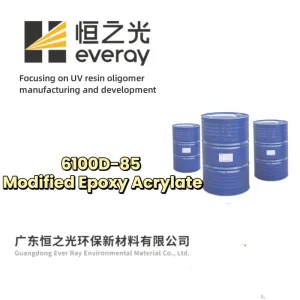
Buy High adhesion 6100D-85 epoxy acrylate for UV wood coating applications, etc. Suppliers, Factory