
Engineered to deliver exceptional curing speed, superior film hardness, chemical durability, and substrate adhesion across demanding industrial coating processes.
Analyzing the macro-economic transformation, environmental mandates, and technical breakthroughs reshaping high-performance surface finishing.
The global shift toward zero-VOC (Volatile Organic Compound) manufacturing has placed Ultra-Violet (UV) and Electron Beam (EB) curing solutions at the forefront of industrial coatings. Modern regulatory frameworks such as REACH in Europe and stringent EPA regulations in the United States are compelling manufacturing OEMs to replace thermal-cured solvent-borne paints with rapid photochemical radiation systems.
Unlike thermal drying ovens that require 20 to 45 minutes of flash-off and heat-soak time, UV curing paints crosslink instantaneously upon exposure to specific ultraviolet wavelengths (254nm to 405nm). This near-zero cure latency enables high-speed automation lines to operate at line speeds exceeding 100 meters per minute, drastically shrinking floor space footprints.
By leveraging three-dimensional polymer networks formed through radical or cationic polymerization, UV curable paints deliver superior mechanical scratch resistance, chemical inertness to solvents, high gloss retention, and thermal stability. Formulators can precise-tune glass transition temperatures ($T_g$) from soft-touch elastomeric films to glass-hard 9H pencil hardness coatings.
How Guangdong Ever Ray Environmental Material Co., Ltd. integrates advanced synthetic chemistry with high-throughput manufacturing infrastructure.
Situated in Guangdong’s industrial heartland (with corporate headquarters in Jiangmen and a state-of-the-art chemical synthesizing production plant in Yunfu Dawan Industrial Park spanning over 40,000 square meters), EVER RAY leverages direct supply integration of acrylic acid, polyols, isocyanates, and epoxy resins. This chemical cluster density reduces precursor logistics costs by up to 18% compared to Western counterparts.
Unlike off-the-shelf chemical distributors, EVER RAY operates an in-house R&D laboratory equipped with Gel Permeation Chromatography (GPC), Fourier-Transform Infrared Spectroscopy (FTIR), and rheology profiling equipment. Our synthetic experts modify acrylation degrees, branching structures, and amine functional synergy to match precise customer viscosity targets and lamp spectrum profiles (Traditional Mercury Arc vs 365nm/395nm UV LED).
Every batch produced across our 10+ automated synthesis lines undergoes stringent testing for acid value, color scale (Gardner/APHA), viscosity stability, double bond conversion rate, and monomer residue. Products are packaged in anti-actinic light-shielded steel drums and certified for international maritime transport under dangerous goods and non-hazardous chemical protocols.
Understanding the molecular dynamics, chemical bonds, and functional performance profiles of primary radiation-curable resins.
| Resin Chemistry Class | Key Molecular Attributes | Primary Strengths | Typical Industrial Target Applications |
|---|---|---|---|
| Epoxy Acrylate Oligomers | Bisphenol A backbone esterified with acrylic acid. High double bond density. | Ultrafast cure response, extreme film hardness (5H-9H), high gloss, low cost. | Wood sealers, paper overprint varnishes (OPV), rigid plastic coatings, metal cans. |
| Aliphatic Polyurethane Acrylates (Aliphatic PUA) | Aliphatic diisocyanate (IPDI/HDI) reacted with polyester/polyether polyols & hydroxy acrylates. | Zero yellowing upon QUV aging, superior weatherability, high flexibility, impact resistance. | Automotive clear coats, 3C electronic housings, smartphone finishes, outdoor films. |
| Aromatic Polyurethane Acrylates (Aromatic PUA) | TDI/MDI aromatic structure integrated with acrylate functional end-groups. | Balanced tough-hardness, high tensile strength, outstanding abrasion resistance. | Parquet wood flooring, resilient PVC tile coatings, industrial floor finishes. |
| Polyester Acrylate Oligomers | Multi-functional polyester backbone terminated with acrylate esters. | Excellent pigment wetting capability, low viscosity, excellent ink-water balance. | UV offset inks, UV flexographic inks, screen printing inks, pigmented topcoats. |
| Waterborne Polyurethane Acrylates (WB UV PUA) | Self-emulsifying polyurethane acrylate dispersed in aqueous medium. | Zero organic solvent emission, low film buildup, low viscosity sprayability. | Eco-friendly wood furniture finishes, leather coatings, plastic spray paint. |
| Specialty Functional & Hyperbranched Acrylates | Dendritic or highly branched core structures with multi-acrylate functionality. | Ultra-low viscosity, high crosslinking density, minimal curing shrinkage stress. | 3D printing photopolymers (SLA/DLP), optical adhesive formulations, hardcoats. |
Precision formulated UV curing paint systems tailored for specific substrate properties and application technologies.
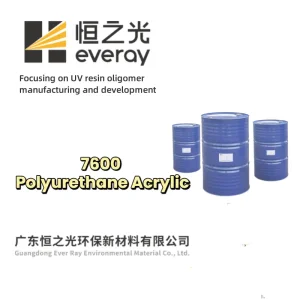
Electronic housings made of PC, ABS, and PMMA require protective coatings that resist finger oils, sweat, cosmetic chemicals, and accidental drops. Formulations utilizing aliphatic polyurethane acrylates (such as EVER RAY 7600 and 7402 series) offer non-yellowing protection with exceptional steel wool scratch resistance (over 2,000 cycles under 1kg load).
Automotive specifications demand extreme thermal cycle resistance (-40°C to +85°C) and resistance to chemical sunscreens. Utilizing specialized modified epoxy acrylates and hyperbranched resins ensures superior adhesion to low-surface-energy automotive polypropylene (PP) and thermoplastic olefins (TPO) with minimal priming.
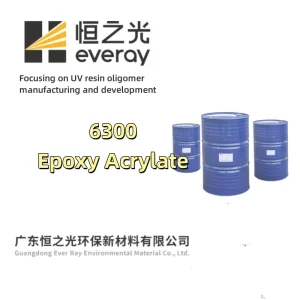
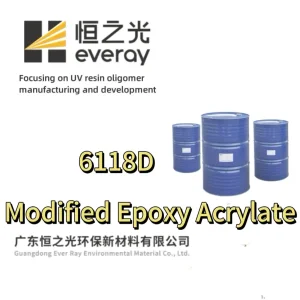
High-speed roller coating lines for hardwood parquet and Luxury Vinyl Tile (LVT) floor finishing depend on rapid surface cure to prevent blocking during automated stacking. Epoxy acrylates combined with active amine synergists (like EVER RAY 6118 and 6300) deliver high sandability sealers and high-abrasion topcoats.
High-speed offset and flexographic printing on paperboards and metallic foils requires oligomers with excellent pigment dispersion properties and low odor. Polyester acrylate oligomers (such as 5502B and 5335F) ensure vibrant ink dispersion, clean water-ink balance, and instant UV LED curing.
Precision stereolithography (SLA), Digital Light Processing (DLP), and LCD 3D printers require liquid photopolymer resins with minimal volumetric shrinkage during polymerization. Custom modified pure acrylates provide sharp dimensional accuracy, high heat deflection temperatures (HDT), and balanced toughness for functional prototype engineering.
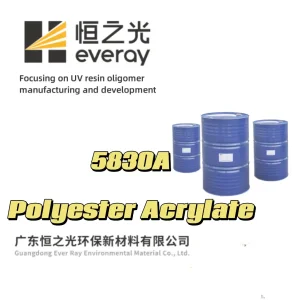
In challenging substrates such as glass containers, optical lenses, and unprimed aluminum alloys, standard resins suffer from interfacial delamination when exposed to moisture. EVER RAY's high-hydroxyl polyester acrylates (such as 5830A) deliver exceptional water-boiling resistance and intercoat adhesion.
Pioneering sustainable chemistry, high-efficiency photonics, and advanced functional oligomers for tomorrow's manufacturing needs.
Industrial lines are transitioning rapidly from traditional high-pressure mercury vapor lamps to narrow-band UV LED curing systems to cut electricity consumption by up to 70%. EVER RAY's newest oligomers are molecularly engineered to absorb peak energy in the long-wavelength UV-A spectrum, overcoming surface tackiness caused by atmospheric oxygen inhibition without requiring nitrogen inerting chambers.
Aligned with carbon-neutrality mandates, our chemical synthesis research team is replacing petroleum-derived polyols with renewable bio-based feedstocks derived from soybean oil, cardanol, and bio-succinic acid. These green oligomers deliver high double-bond reactivity while reducing the carbon footprint of the synthesized coating resin by up to 35%.
For complex 3D components with shadow areas unexposed to direct UV light, EVER RAY is expanding dual-cure chemistry portfolios (UV / Thermal Dual Cure and UV / Moisture Dual Cure). Initial UV exposure sets the structural geometry instantly, while secondary ambient moisture or mild thermal bake ensures complete polymer conversion throughout unexposed shaded geometries.
A systematic operational protocol for formulation chemical engineers and procurement directors evaluating supplier capabilities.
Identify substrate chemistry (e.g., untreated PP vs corona-treated PET vs cold-rolled steel). Match surface tension values: UV coating liquid surface tension must be at least 5-10 mN/m lower than substrate surface energy to ensure total wetting and micro-interlocking anchorage.
Different line application machinery demands strict rheology windows:
Correlate photoinitiator absorption spectra with factory curing lamp outputs (Medium Pressure Mercury Lamp vs 365/395nm LED). Ensure double bond density yields target pencil hardness without inducing excess film brittleness or curl deformation.
In-depth answers to critical chemical, operational, and supply questions from global paint formulators and sourcing managers.
Epoxy Acrylates are synthesized from bisphenol A diglycidyl ether and acrylic acid. They provide extremely high cure speed, exceptional surface hardness (often 4H-6H), high chemical resistance, and lower raw material cost. However, they possess limited flexibility and tend to yellow under outdoor UV exposure.
Polyurethane Acrylates (PUA) incorporate aliphatic or aromatic isocyanates. Aliphatic PUAs offer superior outdoor weatherability, zero yellowing, extreme impact flexibility, and high elongation at break, making them ideal for automotive and premium electronic finishes, though at a higher relative cost.
Atmospheric oxygen quenches free radicals generated during photo-polymerization, resulting in surface tackiness, especially in thin coatings (<10 µm). EVER RAY mitigates this by synthesizing Amino Acrylate Oligomers and Active Amine Synergists (such as our Active Amine series). The tertiary amine groups undergo hydrogen abstraction with oxygen-quenched radicals, regenerating active radical species to ensure complete surface tack-free cure even under ambient air conditions.
Every industrial customer receives comprehensive technical compliance documentation for each chemical batch, including:
Yes. With over 10 invention and utility patents and a dedicated R&D technical team, EVER RAY routinely modifies acrylate oligomers to match client-specific process parameters. We can adjust monomer dilution ratios (TPGDA, TMPTA, DPHA, IBOA), alter functionality from 2-functional to 6-functional branches, or tune the glass transition temperature ($T_g$) to optimize film flexibility or hardness for your target application.
All UV curable acrylate resins must be stored in original, unopened, light-shielded containers (high-density polyethylene or coated steel drums) away from direct sunlight and artificial UV sources. Recommended storage temperatures are between 10°C and 30°C. When kept under these controlled chemical warehouse conditions, our oligomers maintain a shelf life stability of 12 to 18 months from the manufacture date without premature gelation or viscosity degradation.
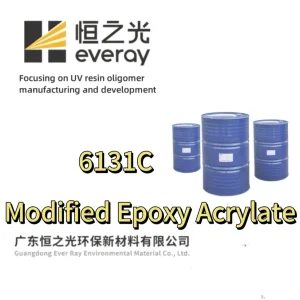
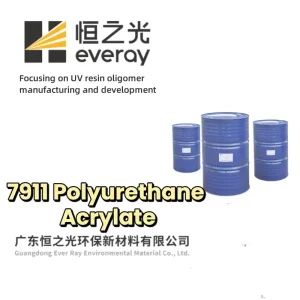
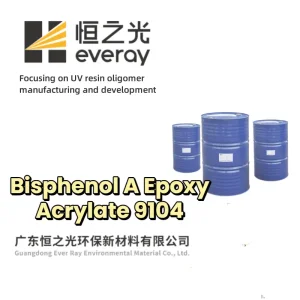
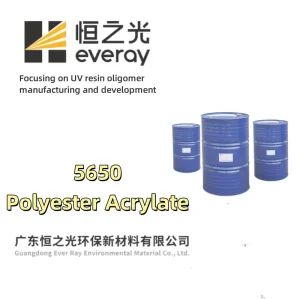
Discover additional high-reactivity oligomers designed for furniture finishes, offset printing inks, rigid plastic coatings, and thermal-resistant applications.
Contact Guangdong Ever Ray Environmental Material Co., Ltd. today to request technical samples, customized polymer synthesis, or complete formulation TDS & SDS packages.