Engineered for High-Speed Offset, Flexographic, Screen, and Digital UV Printing Inks
The Paradigmatic Shift from Thermal-Cured Solvents to 100% Solid Photopolymer Networks
The global printing ink and industrial coating landscape is undergoing an unprecedented technological transition. Modern manufacturing demands rapid processing speeds, zero volatile organic compound (VOC) emissions, low energy consumption, and high mechanical performance. As global regulatory bodies enforce stricter limits on solvent vapor evaporation—such as the EU REACH annexes, US EPA Title V regulations, and China's GB/T environmental directives—UV curable ink manufacturers and raw material factories stand at the center of green chemistry innovation.
Ultraviolet (UV) and Electron Beam (EB) curing technologies utilize electromagnetic radiation rather than thermal energy to induce instantaneous free-radical or cationic polymerization. Converting liquid oligomers, monomers, and photoinitiators into three-dimensionally crosslinked polymer matrices within milliseconds eliminates the need for drying ovens, reduces manufacturing footprints by up to 70%, and minimizes operational energy costs by up to 80% compared to conventional thermal-drying systems.
Accelerating demand in flexible packaging, 3C electronics (computers, communications, consumer electronics), automotive interiors, and additive manufacturing (3D printing photopolymers) is propelling compound annual growth rates (CAGR) for UV ink raw materials above 7.8% globally.
Successful ink manufacturing requires strict harmonization between the oligomer backbone (epoxy, polyurethane, or polyester acrylates), reactive diluents, pigment dispersants, and photoinitiator packages matched to lamp spectra (Mercury vs LED 365/385/395nm).
Leading global buyers prioritize chemical synthesis factories with direct control over primary acrylic acid esterification, batch-to-batch molecular weight distribution, and pure oligomer purification systems to prevent line downtime.
Deciphering the Performance Vectors of Industrial UV-Curable Oligomers
The physical properties of a cured UV ink film—ranging from pencil hardness, flexibility, and scratch resistance to substrate adhesion and chemical resistance—are directly dictated by the chemical structure of its constituent oligomers. As an industry-leading manufacturer, Guangdong Ever Ray Environmental Material Co., Ltd. custom-engineers fundamental chemical classes to solve complex formulation barriers:
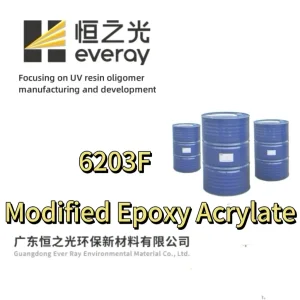
Epoxy acrylates represent the workhorse of the UV ink industry. Characterized by high double-bond reactivity, elevated glass transition temperatures (Tg), exceptional surface hardness, and brilliant gloss, products such as 6100D Epoxy Acrylate UV Resin and 6203F Low-Shrinkage Modified Epoxy Acrylate provide unmatched cost-to-performance efficiency. Modifications diminish the inherent brittleness and volumetric shrinkage associated with pure Bisphenol-A diglycidyl ether diacrylate (BADGE-DA), granting superior adhesion to metallic foils, non-porous plastics, and paperboards.
Polyurethane acrylates bridges high tensile strength with remarkable elasticity and impact tolerance.
Conventional linear or branched oligomers face a fundamental trade-off: increasing functionality to boost cure speed and scratch resistance simultaneously elevates resin viscosity, requiring excess diluents. Modern synthesis breakthroughs—exemplified by 4600 Hyperbranched Acrylic UV Resin—utilize globular, highly branched macromolecular structures. This architecture provides high acryloyl double-bond density (high functionality) alongside low intrinsic viscosity, empowering formulators to produce low-VOC, ultra-scratch-resistant screen, flexo, and 3D printing inks with minimal curing energy requirements.
Surface cure inhibition caused by atmospheric oxygen remains a critical bottleneck in thin-film UV printing. Integrating amino-modified acrylate oligomers and active amine synergists (such as UV Resin 5017 and amine accelerators) donates hydrogen atoms to peroxyl radicals, effectively scavenging oxygen at the ink-air interface, eliminating surface tackiness, and reducing dependence on expensive photoinitiators.
Tailoring Resin Reactivity to Substrate Dynamics and High-Speed Converting Lines
Challenge: Modern lithographic offset presses operate at speeds exceeding 15,000 sheets per hour, requiring inks with precise rheological water-ink balance, zero emulsification, and instant cure under low-energy UV or LED lamps.
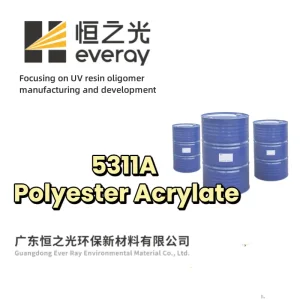
Solution: Formulations incorporating polyester acrylates (such as 5202B and 5311A) provide low viscosity, superior pigment wetting, and balanced lipophilicity, ensuring sharp dot reproduction without misting or lithographic scumming.
Challenge: Mobile device housings, touchscreens, and automotive displays made of Polycarbonate (PC), PMMA, and treated PET demand 4H+ pencil hardness, alcohol rub resistance, and zero thermal distortion.
Solution: Blending hyperbranched acrylates (4600 series) with high-adhesion PUA (7291B) creates highly crosslinked clearcoats that pass 500+ MEK rub cycles, cross-hatch tape tests (5B), and thermal shock cycling from -40°C to +85°C.
Challenge: Non-polar substrates like tempered glass, ceramic tiles, and untreated aluminum alloys present severe interfacial energy barriers, often causing film delamination upon boiling water immersion.
Solution: Utilizing special modified acrylates featuring carboxyl, phosphate, or silane-functional moieties (e.g., Special Modified Acrylate Resin for Water Transfer) establishes chemical covalent bonding across inorganic-organic interfaces, surviving 2-hour boiling water testing.
Pioneering the Next Horizon of Sustainable, High-Efficiency Radiation Curing
Transitioning standard broad-spectrum mercury curing to energy-efficient 365nm, 385nm, and 395nm LED wavelengths through custom-tuned photo-response oligomers.
Integrating bio-succinic acid, soybean oil epoxides, and plant-derived polyols into polyurethane and polyester acrylates to achieve >40% renewable carbon metrics.
Developing polymeric photoinitiators and self-initiating oligomers compliant with Swiss Ordinance and Nestlé Guidance for primary food packaging.
Combining UV free-radical curing with moisture or thermal secondary mechanisms for shaded areas in 3D-printed automotive components.
Empowering International Formulators with Rigorous QA Frameworks and Documentation
Navigating global chemical regulation requires absolute transparency and comprehensive technical backup. As a certified manufacturer operating out of Jiangmen Headquarters and the Yunfu Dawan Industrial Park Production Base (spanning over 40,000 square meters with 10+ automated synthesis lines), EVER RAY ensures total chemical traceability:
Full support for EU REACH registration, RoHS 2.0 restriction compliance, SVHC screening, and SVHC-free verification. GHS-compliant Safety Data Sheets (SDS) and Certificate of Analysis (COA) are provided for every batch.
Every resin batch undergoes rigorous QC: Brookfield viscosity profiling at 25°C, Gardner color index determination, residual monomer gas chromatography (GC-MS), and Fourier-Transform Infrared (FTIR) double-bond conversion tracking.
Standard export packaging includes 200kg steel drums, 1000kg IBC totes, and ISO tanks with full Dangerous Goods (DG) compliance for ocean, air, and multimodal international logistics.
Factory-Direct Portfolio for High-Performance UV/EB Formulations
Addressing Formulator Challenges, Chemistries, and OEM/ODM Manufacturing Procedures
