Direct factory-grade resins synthesized for industrial wood coatings, high-speed flatline coating processes, vacuum coating, UV offset printing inks, and protective clearcoats.
The global wood furniture, architectural flooring, and millwork coating industries are undergoing a massive regulatory and operational transition. Traditional solvent-borne nitrocellulose (NC) and polyurethane (PU) wood finishes are being aggressively phased out across North America, the European Union, and East Asia due to stringent Volatile Organic Compound (VOC) limits set by environmental protection agencies (such as EU REACH Annex XVII, US EPA Method 24, and China GB 30981-2020).
In response, automated manufacturing facilities have adopted 100% solid UV-curable epoxy acrylates and waterborne polyurethane acrylate (WBPUA) dispersions. As a premier wood epoxy manufacturer and chemical synthesizer, our factory engineers materials that address the fundamental physical challenge of wood finishing: balancing ultra-fast ultraviolet cure rates with low polymerization shrinkage, deep substrate penetration, and permanent structural adhesion.
Modern industrial wood coating lines operate at throughput velocities ranging from 15 to 60 meters per minute. Thermal drying ovens for traditional wood epoxies require immense footprint lengths (up to 100 meters) and colossal energy consumption. Radiation-curable epoxy acrylates require less than 5 seconds under mercury vapor or 365nm/395nm LED-UV curing lamps to achieve complete crosslinking density.
By transitioning from two-component (2K) thermal-cure amine epoxies to modified single-component UV epoxy acrylates (such as our 6100D-85 and 6106 grades), industrial furniture plants reduce factory floor space requirements by up to 70%, eliminate pot-life waste entirely, and cut energy expenses per square meter of coated wood by more than 55%.
Understanding the precise molecular architecture required to maximize mechanical toughness, clarity, and wood pore wetting.
Standard epoxy acrylates are synthesized via the ring-opening addition reaction of Bisphenol A Diglycidyl Ether (DGEBA) with acrylic acid in the presence of a tertiary amine catalyst. The resulting backbone retains rich aromatic rings providing exceptionally high Glass Transition Temperature ($T_g > 65^\circ\text{C}$), high pencil hardness (3H–5H), and chemical resistance against water, alcohol, and house cleaning fluids.
Traditional epoxy acrylates suffer from volumetric shrinkage during free-radical polymerization ($3\% - 6\%$), causing internal stress, micro-cracking, and wood adhesion failure. Our chemical factory modifies the backbone with internal aliphatic polyester segments and flexibilizing ether chains (e.g., Grade 6102), reducing volumetric shrinkage to under 1.5% while maintaining surface hardness.
Unmodified aromatic bisphenol structures undergo quinone-type photo-oxidation when exposed to solar UV spectrum, leading to film yellowing ($\Delta E > 3.0$). Our non-yellowing modified epoxy acrylate solutions (e.g., Grade 67283) incorporate steric hindered amine light stabilizers (HALS) and cycloaliphatic structures to ensure long-term color neutrality on natural white oak, maple, and birch veneers.
| Oligomer Grade Series | Viscosity (mPa.s @ 25°C) | Functionality | Cure Speed (m/min) | Key Performance Attribute | Primary Industrial Application |
|---|---|---|---|---|---|
| 6100D-85 Epoxy Acrylate | 15,000 – 25,000 | 2 | 25 – 45 | Extreme adhesion to oily woods, high gloss | Wood sealers, roller coat primers |
| 6102 Low-Shrinkage Epoxy | 8,000 – 14,000 | 2 | 20 – 35 | Volumetric shrinkage < 1.2%, anti-warping | Thick wood topcoats, edge bandings |
| 67283 Anti-Yellowing Epoxy | 5,000 – 10,000 | 2.2 | 30 – 50 | $\Delta E < 0.8$ after 500h QUV test | Clear architectural veneer finishes |
| 5202B Polyester Acrylate | 1,200 – 2,500 | 4 | 40 – 60 | Superior pigment wetting, fast surface cure | Wood grain printing inks, colored OPV |
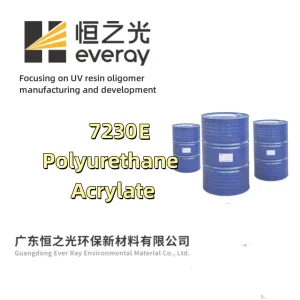
| 7230E Polyurethane Acrylate | 3,000 – 6,000 | 3 | 15 – 30 | Impact resistance, flexibility, non-cracking | High-end solid wood furniture & tables |
On modern continuous flatline finishing systems (such as Barberán, Cefla, or Giardina coater setups), resin viscosity stability and rheology control are paramount. Our factory synthesizes epoxy acrylates optimized for double-roller and reverse-roller applicators. They offer ideal shear-thinning characteristics under doctor blades, ensuring pore-filling levelling without air entrapment or micro-foaming on MDF, particleboard, or natural timber panels.
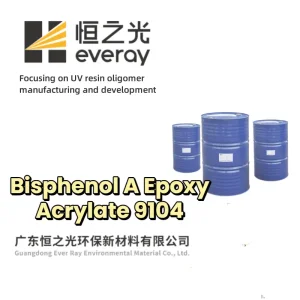
Engineered hardwood flooring faces extreme mechanical stress, shoe heel impacts, and scratch threats. By blending our high-hardness Bisphenol A Epoxy Acrylate (e.g., Grade 9104) with tough multifunctional urethane acrylates, formulators achieve Taber abrasion resistance ratings exceeding 1,000 cycles (CS-10 wheel, 1000g load) with zero film delamination under cross-hatch tape testing (ASTM D3359 Class 5B).
In artisanal and commercial live-edge slab furniture manufacturing, deep-pour 2K casting epoxies are required to encapsulate thick timber sections (5cm–10cm depth). Our high-purity, low-exotherm thermosetting casting epoxies ensure ultra-clear air release, near-zero peak exotherm temperatures to prevent wood burning/charring, and Shore D hardness ratings > 85 for crystal-clear, glass-like table surfaces.
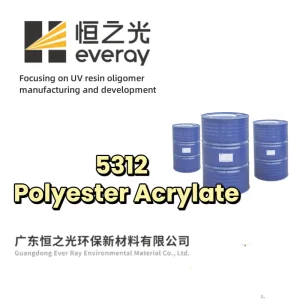
Decorative wood grain printing on PVC sheets, paper foils, or directly onto pre-sealed wood board surfaces demands oligomers with high pigment wetting capability. Our hyperbranched polyester acrylates (such as Grade 5332F and 5312) allow high loading of organic/inorganic pigments without viscosity spikes, maintaining sharp printing dot definition on high-speed flexo and offset presses.
Every manufacturing batch undergoes rigorous analytical testing: Brookfield viscosity checks, acid value titration, color index (Gardner Scale < 1.0), and photo-curing kinetics via Fourier-Transform Infrared Spectroscopy (FTIR) to ensure identical performance drum after drum.
Fully compliant with EU REACH registration, RoHS 3.0, and TSCA inventory requirements. Detailed Safety Data Sheets (SDS in GHS format) and Certificates of Analysis (COA) accompany every shipment, guaranteeing low monomer residual odor and low toxicity.
Factory-direct export capabilities utilizing 200kg steel drums, 1000kg IBC totes, and ISO tanks. Formulated with temperature-stable polymerization inhibitors ensuring a minimum guaranteed shelf life of 12 months under ambient storage conditions.
Pioneering eco-friendly bio-based materials, dual-cure mechanism resins, and LED-UV optimized photo-polymers.
Integrating plant-based cardanol, soybean oil, and glycerol derivatives to achieve >40% renewable carbon content without compromising hardness.
Eliminating surface tackiness caused by oxygen inhibition under pure LED 395nm energy sources using novel amine synergist oligomer backbones.
Resin systems that instantly cure on UV light exposure and continue secondary moisture-curing inside deep wood pores and shadow areas.
Self-repairing oligomeric networks capable of healing micro-scratches on high-gloss luxury wood surfaces under ambient sunlight or heat.
Select from our extended series of multifunctional UV resins, modified epoxy acrylates, high-adhesion primers, and temperature-resistant oligomers.