Engineered for SLA, DLP, and LCD 3D printing systems alongside industrial UV coatings and adhesive applications.
Analyzing the shift from additive prototyping to high-volume polymer manufacturing across tier-1 global supply chains.
The additive manufacturing sector has matured beyond rapidly visual prototyping into full-scale industrial production. Photopolymer resins utilized in StereoLithography (SLA), Digital Light Processing (DLP), and Masked Liquid Crystal Display (mLCD) 3D printers now demand rigorous chemical standards: isotropic mechanical strength, thermal deflection stability (>150°C), minimal volumetric shrinkage (<1.2%), and repeatable viscosity kinetics.
Industrial users and OEM hardware integrators are increasingly replacing expensive brand-locked resin cartridges with high-grade wholesale photopolymer raw materials. Purchasing bulk oligomers and custom-formulated resins direct from specialized chemical manufacturers yields cost savings exceeding 40% to 60%, drastically expanding profit margins for contract manufacturers.
Modern industrial applications require resin systems tailored for extreme operational environments. Demand has surged for high-temperature resistant resins, elastic TPU-like elastomers, biocompatible dental resins, flame-retardant electronics enclosures, and tough ABS-like polymers capable of enduring continuous mechanical shock without structural fracture.
In high-speed mLCD and DLP 3D printing systems operating at 385nm to 405nm wavelengths, the chemical balance between photoinitiator concentration (e.g., TPO, BAPO) and oligomer reactivity directly dictates print speed and green-state mechanical integrity. Formulations must suppress oxygen inhibition without compromising pot life or inducing thermal deformation during layer curing.
Understanding the molecular foundation of photopolymers: Urethane Acrylates, Epoxy Acrylates, Polyester Acrylates, and Reactive Monomeric Diluents.
To produce high-yield 3D printing resins, formulators synthesize specific functional backbone polymers. Guangdong Ever Ray Environmental Material Co., Ltd. customizes cross-linking density, glass transition temperature ($T_g$), tensile modulus, and elongation at break through rigorous molecular tailoring of acrylate oligomers.
| Resin Chemistry Class | Primary Oligomer Backbone | Key Mechanical Properties | Viscosity Range (mPa.s @ 25°C) | Optimal 3D Application |
|---|---|---|---|---|
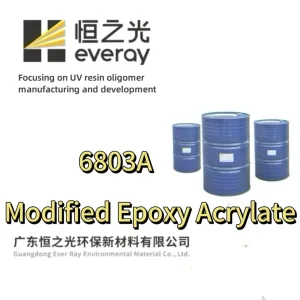
| Standard Rigid Resins | Bisphenol A Epoxy Acrylate / Polyether Acrylate | High Hardness (85-90D), High Tensile Strength (50-65 MPa) | 300 - 600 | Desktop Prototyping, Architectural Models, Miniatures |
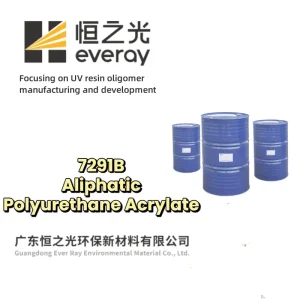
| Tough ABS-Like Resins | Modified Aliphatic Urethane Acrylate (PUA) | High Impact Resistance, Balanced Elongation (20-35%) | 400 - 850 | Functional Snap-Fits, Electronic Housings, Jigs & Fixtures |
| Flexible / TPU-Like Resins | Long-Chain Polyether Polyurethane Acrylate | High Elongation (>150%), Low Hardness (60-75A), Tear Strength | 800 - 2,500 | Gaskets, Footwear Midsoles, Wearable Dampeners |
| High-Temp Resistant Resins | Multifunctional Novel Epoxy Acrylate & Hyperbranched Oligomers | HDT > 180°C, Minimal Thermal Creep, Flame Retardant | 500 - 1,200 | Injection Mold Inserts, Hot Fluid Manifolds, Automotive Engine Components |
| Water-Washable Resins | Waterborne Polyurethane Acrylate / Ethoxylated Acrylates | Easy Water Cleanup, Low Odor, Rapid Curing | 250 - 450 | Educational Use, Consumer DIY, Low-VOC Cleanroom Prototyping |
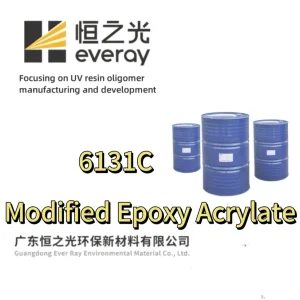
Oligomers form the structural backbone (60-80% of matrix). Aliphatic polyurethane acrylates impart weatherability and yellowing resistance, while epoxy acrylates deliver maximum surface hardness and rapid polymerization rates.
Monomers like IBOA (Isobornyl Acrylate), HDDA (Hexanediol Diacrylate), and TPGDA regulate liquid viscosity, decrease surface tension, improve layer wetting, and tune the final polymer crosslink density.
Selecting optimized photoinitiators (TPO, BAPO, 184) ensures deep light penetration under 365nm, 385nm, and 405nm UV-LED sources, ensuring thorough bottom-up or top-down vat polymerization.
Vertical integration, raw material control, and massive production capacity from Guangdong's premier chemical industrial base.
Guangdong Ever Ray Environmental Material Co., Ltd. operates as a key backbone manufacturer in China's advanced chemical material landscape. By controlling syntheses from raw monomer refinement to finished photopolymer blending, Ever Ray ensures unmatched batch-to-batch stability and cost competitiveness for global importers.
Strategically situated in Dawan Industrial Park, Yunfu, Guangdong, Ever Ray enjoys direct access to domestic basic petrochemical refiners and premium imported specialty reagents. This guarantees uninterrupted production even during global raw material shortfalls.
Every single drum undergoes Gel Permeation Chromatography (GPC), Gas Chromatography-Mass Spectrometry (GC-MS), viscometer verification, and real-world 3D printing test runs on industrial LCD and DLP printers prior to release.
With corporate sales headquartered in Jiangmen City and close proximity to major port hubs in Shenzhen and Guangzhou, Ever Ray ships dangerous-goods certified chemical drums, IBC containers, and custom OEM bottled packaging seamlessly worldwide.
How customized 3D photopolymer resins are deployed across diverse regional manufacturing hubs globally.
In electronics manufacturing corridors in Shenzhen, Dongguan, and South Korea, low-shrinkage high-hardness resins are used for micro-encapsulation, rapid structural housing iteration, and protective UV coatings on PMMA, PC, and ABS substrates.
Tier-1 automotive parts factories in Germany and the United States utilize high-temperature resistant, flame-retardant resins for functional wind tunnel models, customized assembly jigs, and low-volume interior ductwork components.
Dental labs across North America, Europe, and Japan rely on biocompatible, ultra-low distortion resins for 3D printing surgical guides, thermoforming aligner models, indirect bonding trays, and castable crown patterns.
Jewelry artisans in Dubai, India, and Guangzhou utilize zero-ash burn-out castable photopolymer resins designed with high wax content for direct investment casting of precious metals like gold, platinum, and silver.
Footwear manufacturing hubs in Vietnam, Indonesia, and Fujian leverage highly resilient, fatigue-resistant elastomeric polyurethane acrylate (PUA) resins for direct additive production of lattice midsoles and shoe uppers.
Manufacturing facilities in Mexico and Brazil use reinforced rigid resins for short-run injection molding tools, vacuum forming masters, and custom silicone mold patterns, dramatically accelerating product launches.
Strategic directions in dual-cure chemistry, eco-friendly bio-based acrylates, and high-speed multi-material 3D resins.
Future industrial photopolymers incorporate secondary thermal or moisture-curing reaction mechanisms. Initial UV exposure rapidly sets the geometry (green state), followed by thermal post-baking that activates secondary epoxy or polyurethane reactions for unprecedented mechanical strength and temperature resistance.
Guangdong Ever Ray is leading research into bio-derived acrylate oligomers sourced from plant oils and renewable feedstocks. Replacing petroleum-based precursors reduces carbon footprints without sacrificing UV curing speed or polymer toughness.
Eliminating volatile organic compounds (VOCs) and harsh isopropyl alcohol (IPA) washing steps. Advanced water-washable oligomers allow 3D printed parts to be cleansed in tap water while maintaining high mechanical properties post-curing.
Ensuring full documentation, chemical safety, and custom formulation services for international chemical distributors and OEMs.
All wholesale photopolymer resins and oligomer batches supplied by Ever Ray come with comprehensive Safety Data Sheets (SDS) matching GHS standards, Technical Data Sheets (TDS), Certificate of Analysis (COA), and REACH / RoHS / SVHC compliance certification.
In-house chemical R&D teams customize liquid resin viscosity, color pigment stability, light curing reactivity, mechanical elasticity, or Shore hardness to match specific 3D printer hardware specs and LED wavelengths.
We provide flexible industrial packaging solutions ranging from 1kg / 5kg bottles for private label retail, to 20kg plastic pails, 200kg steel drums, and 1,000kg IBC totes for large-scale chemical compounders.
Explore specialized epoxy acrylates, polyurethane acrylates, and high-performance modified resin solutions.
In-depth technical answers addressing polymer selection, custom OEM blending, volume procurement, and logistics.
For standardized oligomers and stock photopolymer resins, our standard MOQ starts at 200kg (one drum). For custom-synthesized oligomers or tailored private label formulas, the minimum order typically starts at 1,000kg to ensure batch-to-batch synthesis consistency and optimal factory pricing.
Volumetric shrinkage is mitigated by incorporating hyperbranched acrylate oligomers, high-molecular-weight polyurethane acrylates, and special ring-opening monomers. By balancing ester group density, we reduce shrinkage stress to under 1.2%, preventing part warping during print curing.
Yes. Our chemical application engineers adjust photoinitiator spectral absorption curves and co-initiator active amine synergists to match your hardware's exact UV-LED or laser light source wavelength, maximizing cure speed while preventing over-exposure blooming.
When stored in original sealed light-proof drums between 15°C and 28°C away from direct sunlight and heat sources, our photopolymer resins retain full chemical stability and viscosity specs for 12 to 18 months from the date of manufacture.
Modern waterborne polyurethane acrylate chemistry (such as Grade 70251) achieves tensile strength (45-55 MPa) and Shore D hardness (80-85D) comparable to standard rigid resins, provided parts are properly dried before post-curing.
We supply full GHS-compliant Safety Data Sheets (SDS), Technical Data Sheets (TDS), Certificate of Analysis (COA) per batch, REACH registration numbers, RoHS compliance statements, and non-dangerous goods export documentation where applicable.
Request technical datasheets, order evaluation samples, or schedule a technical consultation with our polymer chemists today.
Request Full Catalog & Sample Kit