Engineered for high-speed curing, exceptional adhesion, and precise viscoelastic properties. Direct supply from Guangdong Ever Ray Environmental Material Co., Ltd.
Understanding the molecular dynamics of free-radical photo-polymerization, acrylate oligomer synthesis, and crosslinking kinetics in industrial UV adhesives.
In modern manufacturing, traditional thermal-cured adhesives and solvent-based contact glues are rapidly being phased out due to stringent environmental regulations (VOC limits), energy consumption metrics, and throughput constraints. A professional Wholesale Adhesive UV Factory serves as the technological backbone for high-tech sectors, providing photopolymer formulations that cure within milliseconds upon exposure to ultraviolet radiation (specifically 365nm to 405nm spectral bands).
UV adhesive formulations are complex, multi-component chemical matrixes containing oligomers (50-80%), reactive diluent monomers (10-40%), photoinitiators (1-5%), and specialized performance additives (adhesion promoters, stabilizers, silane coupling agents). The choice of oligomer backbone dictates the mechanical properties, thermal stability, Tg (glass transition temperature), and chemical resistance of the cured network.
Technical Information Gain: Acrylic oligomers synthesized at Ever Ray undergo precise molecular weight distribution control (MWD). By maintaining polydispersity index (PDI) within narrow margins, our wholesale UV resins deliver predictable rheological behavior, zero shear-thinning variance, and ultra-low shrinkage rates (< 2.5%) crucial for optical and microelectronic bonding.
| Oligomer Chemical Architecture | Primary Mechanical Trait | Cure Speed Kinetic | Typical Industrial Application |
|---|---|---|---|
| Epoxy Acrylate (e.g., 9105A-80) | High Hardness (4H-6H), High Tensile Strength | Ultra-Fast (< 0.5 sec) | Glass Primers, Heavy-Duty Wood Coatings, PCB Solder Mask |
| Aliphatic Polyurethane Acrylate (PUA) | Non-Yellowing, Superior Flexibility & Elongation | Moderate to Fast | 3C Electronics, Optical Bonding, Nail Gels, Automotive Trim |
| Aromatic Polyurethane Acrylate | Cost-Effective Toughness, Abrasion Resistance | Fast | SPC/LVT Flooring Topcoats, Plastic Structural Adhesives |
| Polyester Acrylate (e.g., 5336B) | Low Viscosity, High Pigment Compatibility | Rapid Surface Cure | UV Offset & Flexo Inks, Overprint Varnishes (OPV) |
Analyzing global demand shifts across Europe, North America, Southeast Asia, and Eastern Europe for UV-curable oligomers and industrial adhesives.
The global miniaturization of smartphones, wearables, and display panels demands shadowless UV adhesives capable of zero optical distortion, low outgassing, and thermal shock resistance (-40°C to 125°C). Industrial UV factories are supplying modified aliphatic urethane acrylates to meet stringent consumer electronics specs.
With smart cockpits adopting large curved OLED/LCD displays, auto tier-1 suppliers utilize dual-cure UV resins (UV + atmospheric moisture cure) to eliminate shadow areas behind bezels, preventing delamination and yellowing over 10-year vehicle lifecycles.
Desktop and industrial SLA/DLP/LCD 3D printing requires custom oligomer blends balancing cure speed, tensile modulus, and low volumetric shrinkage. High-impact ABS-like resins (such as 71209A-1) bridge the gap between prototyping and direct digital manufacturing.
Headquartered in Jiangmen with a 40,000+ m² modern production facility in Dawan Industrial Park, Yunfu, Guangdong. Operating 10+ automated chemical synthesis lines since 2006.
Every batch of resin produced at our factory undergoes rigorous quality control protocols. We utilize Gas Chromatography (GC), Gel Permeation Chromatography (GPC), Rheometers, and Karl Fischer Titrators to monitor:
Backed by over 10 invention and utility patents, our in-house synthesis team works directly with global B2B clients to tailor resin properties:
Case breakdowns on resolving real-world formulation challenges: adhesion failure, surface oxygen inhibition, yellowing under UV exposure, and thermal contraction stress.
Challenge: Bonding tempered glass to polycarbonate (PC) frames in optical display assemblies. Standard UV glues suffer from high volumetric shrinkage, leading to internal stress, optical birefringence, and eventual delamination after boiling water immersion testing.
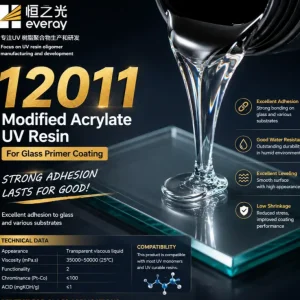
Formulation Strategy: Incorporating 12011 Modified Acrylate UV Resin as a glass primer and 6200D UV-resin in shadowless glue formulations. The carboxyl-modified functional groups interact with hydroxy groups on the glass surface via hydrogen bonding and siloxane coupling, while the flexible urethane backbone absorbs mechanical shear stress.
Result: 100% adhesion retention after 2 hours of boiling water testing (100°C), zero delamination, and cross-hatch tape test (ASTM D3359) achieving 5B rating.
Challenge: On high-speed printing lines (> 100 meters/min), UV paper varnishes often suffer from surface tackiness caused by atmospheric oxygen inhibition, as well as "screen creeping" during flexographic application.
Formulation Strategy: Deploying 5450 UV Resin combined with amine synergists (Active Amines). The amine groups scavenge peroxyl radicals formed by atmospheric oxygen, transferring electrons back to the growing acrylate radical chain and securing instant tack-free surface curing.
Ensuring seamless chemical import, environmental safety, and regulatory peace of mind for B2B purchasers worldwide.
Our resin series comply with European Union REACH registration protocols, SVHC (Substances of Very High Concern) screening, and RoHS directive standards. Free from heavy metals, halogenated solvents, and banned phthalates.
UV resins and acrylate monomers require specialized UN-approved packaging (steel drums, IBC totes, HD-PE pails) and temperature-controlled freight logistics to prevent premature polymerization during tropical transit.
Every commercial order is accompanied by a batch-specific Certificate of Analysis (COA), Technical Data Sheet (TDS), and 16-section Safety Data Sheet (SDS) compliant with GHS standards in English, Spanish, German, and French.
Emerging trends shaping the chemical formulation landscape: Bio-based monomers, LED-UV long-wave curing, and self-healing photopolymers.
Transitioning from traditional high-pressure mercury lamps to energy-efficient LED-UV curing systems requires oligomers with high quantum yield absorption when paired with phosphine oxide photoinitiators (TPO, BAPO).
Developing bio-based polyols derived from soybean oil, castor oil, and lignin to replace petroleum-derived polyester and polyether backbones, reducing carbon footprints without compromising physical properties.
Integrating secondary curing mechanisms (UV + thermal shadow cure or UV + moisture cure) for complex 3D assemblies with zero light line-of-sight.
Explore our specialized resin portfolio formulated for high yellowing resistance, fast cure speed, and targeted substrate adhesion.
Addressing core queries regarding factory capacity, custom synthesis, resin substitution, shelf life, and safety handling.