Precision-formulated for rapid UV photo-curing, superior surface hardness, and immediate industrial line efficiency.
In modern industrial manufacturing, time-to-cure is directly correlated with plant throughput, working-capital efficiency, and overall operational profitability. Traditional epoxy resins—long celebrated for their unyielding mechanical adhesion, thermal endurance, and chemical inertness—have historically suffered from lengthy curing cycles ranging from hours to days. As global supply chains accelerate toward just-in-time (JIT) manufacturing and Industry 4.0 automation, the global market for fast drying epoxy systems and modified epoxy acrylate oligomers has experienced an unprecedented surge.
Modern fast-drying epoxy solutions bridge the performance gap between classic bisphenol-A chemistry and ultra-rapid radiation curing (UV/EB). By synthetically grafting acrylic functional groups onto epoxide backbones or utilizing advanced latent amine hardeners, chemical synthesis manufacturers now offer liquid resins capable of achieving full structural integrity within seconds under UV irradiation or minutes at ambient temperatures. This advancement eliminates production bottlenecks across automotive assembly lines, high-speed overprint varnish (OPV) converting, 3C electronics potting, and industrial wood processing.
For chemical procurement specialists and formulators, sourcing wholesale fast-drying epoxy resins requires balancing rapid crosslinking kinetics against internal stress accumulation. Uncontrolled curing contraction can yield brittle polymer matrices, interfacial delamination, or micro-fracturing. Consequently, leading synthesis manufacturers like Guangdong Ever Ray Environmental Material Co., Ltd. (EVER RAY) focus on molecular modifications—incorporating flexible polyether linkages, hyperbranched structures, and polyurethane acrylates—to maintain high surface hardness while mitigating volumetric shrinkage.
Understanding the difference between traditional thermal amine-cured epoxies, cationic UV epoxies, and free-radical epoxy acrylates is critical for correct product selection. Below is a detailed technical comparative analysis designed for resin formulators and chemical R&D engineers:
| Resin Chemistry Class | Primary Curing Mechanism | Typical Gelation Time | Surface Hardness | Volumetric Shrinkage | Primary Industrial Use |
|---|---|---|---|---|---|
| Standard Bisphenol-A Epoxy | Nucleophilic Ring-Opening (Amine/Anhydride) | 20 Mins – 4 Hours | Shore D 80 - 85 | Very Low (< 1.5%) | Structural Composites, Civil Potting |
| Epoxy Acrylate Oligomer (UV) | Free-Radical Acrylic Double-Bond Polymerization | 1 – 3 Seconds | Pencil Hardness 2H - 5H | Moderate (3.0% - 5.5%) | Overprint Varnishes, 3C Electronic Coatings |
| Modified Epoxy Acrylate Solution | Hybrid Free-Radical / Thermal Latent Cure | 2 – 8 Seconds | Pencil Hardness 3H - 6H | Low to Moderate (2.0% - 3.5%) | High-Speed Wood Sealers, Solder Masks |
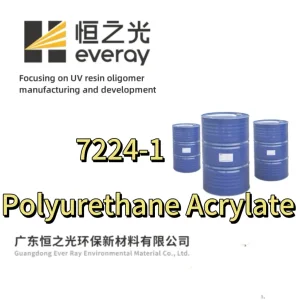
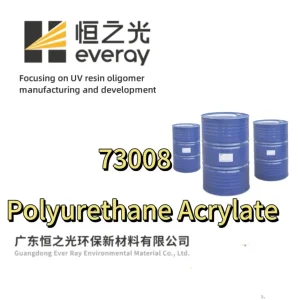
| Dual-Curing Polyurethane Acrylate | Photo-Induced Free Radical + Thermal Moisture/Isocyanate | 5 Sec UV / 15 Min Thermal | Shore D 70 - 80 | Low (< 2.0%) | 3D Printing Footwear, Deep Shadow Bonding |
A persistent technical hurdle in fast-drying free-radical epoxy acrylate systems is atmospheric oxygen inhibition. Free radicals generated by photoinitiators (such as TPO or 184) are rapidly scavenged by ground-state triplet oxygen ($O_2$), forming unreactive peroxyl radicals. This manifests as surface tackiness or incomplete curing under low-intensity UV exposure.
To overcome this without resorting to expensive nitrogen inerting blankets, EVER RAY engineers incorporate amine synergists (active amines) and amino-modified acrylates directly into the resin matrix. The active amino hydrogens participate in a chain-transfer reaction that regenerates active alkyl radicals, rapidly depleting oxygen at the coating-air interface and facilitating instantaneous, bone-dry surface cure even under low-energy LED UV lamps (365nm / 395nm).
Evaluating supplier capability beyond cost-per-kilogram: regulatory safety, lead-time resilience, and batch consistency.
International regulatory compliance is non-negotiable. Leading tier-1 chemical factories guarantee zero heavy metals, zero halogenated solvents, and full SVHC alignment, facilitating smooth customs clearance into EU and North American markets.
Viscosity directly governs application behavior. Formulators can request custom-tailored viscosities—from low-viscosity sprayable resins (< 500 mPa.s at 25°C) to high-thixotropy screen printing gels (> 50,000 mPa.s)—ensuring seamless integration without extensive line recalibration.
Industrial liquid chemicals demand secure, light-shielded, and moisture-proof packaging. High-volume orders are shipped in UN-certified 200kg steel drums or 1,000kg IBC totes featuring anti-static liners to maintain thermal stability during transoceanic transit.
The global specialty chemical landscape has evolved beyond mere scale. Modern chemical production hubs in Guangdong, China, leverage advanced DCS (Distributed Control Systems) and automated feeding infrastructure to achieve unparalleled precision in esterification, acrylation, and polymer blending.
At EVER RAY’s Yunfu manufacturing facility—spanning over 40,000 square meters—over ten automated production lines operate in a continuous closed-loop environment. Raw materials such as bisphenol-A diglycidyl ether (BADGE), acrylic acid, and aliphatic diisocyanates undergo real-time viscometric and refractometric inline monitoring. This eliminates human error during exothermic reaction stages, keeping acid values ($\le 1.0 \text{ mg KOH/g}$) and color indexes ($\le 1 \text{ Gardner}$) strictly within customer tolerance thresholds.
Demand for wholesale fast-drying epoxy resins varies dynamically across key international economic corridors:
Driven by strict VOC compliance regulations (EPA Clean Air Act), North American converters are migrating from solvent-borne coatings toward 100% solid UV epoxy acrylate systems. High demand centers on fast-curing overprint varnishes for commercial packaging and flexible food packaging adhesives.
European buyers prioritize energy-efficient UV-LED curing equipment (365nm-395nm wavelength) to lower electricity consumption in industrial finishing lines. Modified epoxy acrylates engineered for high surface reactivity under LED light sources dominate procurement inquiries in Germany, Italy, and France.
As the world's primary hub for consumer electronics assembly and furniture manufacturing, APAC requires large-capacity, cost-competitive epoxy acrylate shipments. Fast curing speeds ($> 30 \text{ meters/minute}$) on automated roller coating lines are required for SPC flooring, cabinet doors, and smartphone housings.
Tailored chemical performance engineered for demanding substrates and specialized industrial processing machinery.
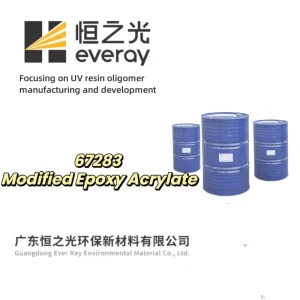
High hardness modified epoxy acrylates (such as Grade 6271) provide scratch resistance (> 4H pencil hardness), anti-fingerprint properties, and robust cross-hatch adhesion (5B) on polycarbonate (PC), ABS, and vacuum metallized plastics.
Fast-cure epoxy acrylates act as superior sanding sealers and topcoats for natural wood, MDF, and SPC vinyl tiles. High reactivity enables line speeds up to 40 m/min while maintaining high gloss retention and impact resistance.
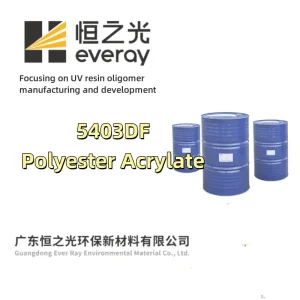
Modified polyester and epoxy acrylate solutions provide optimal pigment wetting, excellent ink-water balance, and immediate drying under UV lamps without misting or creeping during press runs.
In-depth technical answers addressing resin modification, storage handling, and custom synthesis options.
Explore our full line of functional oligomers for 3D printing photopolymers, electronic potting, and high-flexibility coatings.
As a global B2B procurement team or chemical formulator, partnering with a primary chemical manufacturer eliminates intermediary markups, ensures technical transparency, and delivers reliable supply chain execution. **Guangdong Ever Ray Environmental Material Co., Ltd.** combines nearly two decades of synthetic polymer experience with scalable Industry 4.0 production bases.
Whether you require drum-scale trial lots for custom formulation tests or full container load (FCL) monthly shipments for international production facilities, our application engineering team stands ready to assist with starting formulation advice, technical data packages, and custom resin synthesis.