High-purity, factory-direct oligomer grades synthesized for ultra-fast light curing, high chemical resistance, zero-VOC formulations, and superior surface adhesion across complex substrates.
The global market for chemical resin synthesis is experiencing a profound paradigm shift. As regulatory bodies across North America, the European Union, and Asia-Pacific tighten restrictions on Volatile Organic Compounds (VOCs) and Hazardous Air Pollutants (HAPs), industrial formulators are rapidly phasing out traditional solvent-based thermal cure systems. In their place, 100% solid content UV-curable resin systems—anchored by Bisphenol A epoxy acrylates, aliphatic/aromatic polyurethane acrylates, and specialty modified polyester acrylates—have emerged as the definitive benchmark for sustainable manufacturing.
As a leading synthesis specialist, Guangdong Ever Ray Environmental Material Co., Ltd. (EVER RAY) operates at the nexus of polymer chemistry and precision engineering. Modern manufacturing lines demand UV-curable resins that combine millisecond crosslinking speeds under low-energy LED-UV lamps (365nm to 395nm wavelengths) with exceptional mechanical robustness. The current evolution of wholesale epoxy resins spans several transformative vectors:
How Tier-1 industrial buyers mitigate raw material price volatility, enforce batch-to-batch consistency, and streamline custom chemical synthesis directly from primary manufacturers.
Every drum shipped undergo multi-stage Quality Assurance via Gel Permeation Chromatography (GPC), Rotational Viscometry, and Colorimetry (Gardner Scale). Variations in viscosity are kept strictly within ±5%, guaranteeing predictable fluid dynamics on your automated processing lines.
Eliminating middle-man markups through factory-direct procurement lowers total cost of ownership by 15% to 30%. Operating out of Yunfu and Jiangmen, Guangdong, our chemical logistics infrastructure guarantees rapid container displacement via major maritime ports (Shenzhen/Guangzhou/Hong Kong).
Off-the-shelf resins often fail niche production parameters. Our R&D lab customizes molecular weight distribution, acrylation degrees, refractive index, and dilution ratios using specialty acrylate monomers (THFA, IBOA, TMPTA, TPGDA) to match exact production environments.
Modern industrial applications demand tailored crosslinking networks. By selecting specific backbone chemistries—ranging from standard Bisphenol A diglycidyl ether diacrylate to aliphatic polyurethane acrylate oligomers—formulators can engineer exact physical parameters:
| Application Field | Recommended Oligomer System | Primary Technical Requirement | Performance Benchmark |
|---|---|---|---|
| Consumer Electronics & 3C | Aliphatic Polyurethane Acrylate / Modified Epoxy Acrylate | Scratch resistance, optical transparency, non-yellowing | Pencil Hardness ≥ 4H; Steel Wool 1000 cycles ΔE < 0.5 |
| Industrial Wood & SPC Flooring | Standard Bisphenol A Epoxy Acrylate (e.g., 9105A-80) | High mechanical modulus, fast cure, abrasion resistance | Taber Abraser < 0.02g loss; Rapid line speed (>40m/min) |
| Flexographic & Offset Inks | Polyester Acrylate (e.g., 5403DF, 5502B) | Low viscosity, high pigment wetting, low odor | Viscosity 1500-3000 mPa.s/25°C; High color strength |
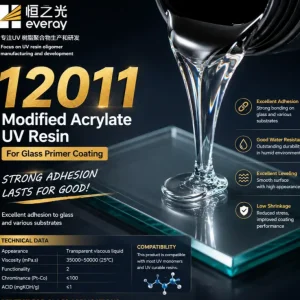
| Glass & Ceramic Primers | Special Modified Acrylate (e.g., 17730A-2, 12011) | Interfacial adhesion, boiling water resistance | Cross-cut Tape Test 100% adhesion after 2hr boiling water |
| 3D Photopolymer Resins | Low Shrinkage Polyurethane Acrylate (e.g., 7200F, 7913) | Dimensional stability, low volumetric shrinkage, toughness | Volumetric Shrinkage < 1.5%; Tensile Strength > 45 MPa |
In high-speed paperboard and plastic packaging, surface gloss and cure efficiency dictate throughput. Bisphenol A epoxy acrylates like 9105M-80 provide an unmatched balance of reactivity and surface brilliance. However, traditional epoxy acrylates can suffer from brittleness. By co-formulating with low-viscosity polyester acrylates or modified mono-functional monomers, formulators eliminate film cracking during post-print die-cutting and embossing.
Glass substrates present inorganic hydrophilic surfaces that naturally resist organic polymer bonding. Specialized resins such as 12011 Modified Acrylate UV Resin incorporate silane coupling functionality directly into the polymer chain. Upon UV irradiation, free-radical polymerization creates a dense crosslinked matrix while silanol groups form covalent siloxane bonds with the glass matrix, establishing permanent water and chemical resistance.
Navigating global chemical control laws requires transparent documentation, environmental compliance, and localized technical field support.
All EVER RAY products comply strictly with EU REACH registration requirements, SVHC candidate list screenings, RoHS 3.0 directives, and US TSCA inventories. Full Safety Data Sheets (GHS SDS) are provided in over 20 languages.
Synthesized under ISO 9001:2015 and ISO 14001:2015 certified standards, our manufacturing facilities utilize closed-loop reactors, automated raw material dosing systems, and comprehensive effluent treatment facilities.
Our global technical team provides technical guidance on viscosity adjustment, photoinitiator package optimization, oxygen inhibition mitigation, and lamp energy calibration directly to your R&D laboratory.
As the radiation curing industry advances toward higher sustainability and functional specialization, EVER RAY's R&D division is pioneering several strategic chemical synthesis roadmaps designed for implementation over the next decade:
Traditional 100% solids UV systems can present high application viscosity, requiring active diluent monomers that may increase skin irritation (primary irritation index). Our next-generation waterborne UV polyurethane acrylate dispersions utilize water as the primary viscosity reducer. After water flash-off, UV exposure yields a dense, non-tacky film with minimal residual monomer content, making it ideal for luxury cosmetic packaging and wood furniture finishes.
Complex 3D geometries, electronic encapsulation, and opaque automotive components often contain shadowed areas inaccessible to UV light photons. EVER RAY is expanding its oligomer architecture to incorporate dual-cure capabilities—combining UV free-radical curing for instant surface fixture with secondary thermal or ambient moisture curing mechanisms to ensure complete conversion deep within shadowed crevices.
Hyperbranched polymers feature a unique globular molecular architecture containing numerous terminal functional acrylate groups paired with a compact hydrodynamic volume. This design provides exceptionally low resin viscosity alongside ultra-high crosslinking functionality. Formulators can achieve 6H+ pencil hardness and chemical stain resistance without relying on high-viscosity six-functional aliphatic urethane acrylates.
Clear, authoritative answers to critical technical questions encountered during UV coating formulation and high-volume raw material procurement.
Explore our specialized portfolio of high-reactivity oligomers, anti-fouling polyurethane acrylates, high-gloss ink varnishes, and durable adhesive resins.