Factory-direct industrial supplies formulated for extreme durability, ultra-fast photocuring reactivity, and multi-substrate adhesion.
Navigating technological transitions, regulatory decarbonization pressure, and high-performance material engineering in global B2B chemical procurement.
The global synthetic resin and photopolymer market is undergoing a seismic paradigm shift. Driven by stringent global environmental mandates—such as the EU's REACH standards, zero-VOC workplace regulations, and global decarbonization targets—industrial manufacturing is rapidly replacing conventional solvent-borne thermal-cure resins with ultra-fast UV/EB (Ultraviolet/Electron Beam) curable resin systems. As a premier wholesale resin supplier and direct synthesis factory, our production ecosystem bridges chemical engineering innovation with mass-scale B2B supply chains.
Modern industrial applications require prepolymers and oligomers that do not merely meet baseline film-forming capabilities, but demonstrate tailored crosslinking kinetics, double-bond conversion rates exceeding 95%, precise viscosity profiles for automated dosing, and targeted mechanical compliance. From precision electronic encapsulation to high-speed flexographic/offset printing and heavy-duty industrial floor coatings, the reliance on high-purity acrylate oligomers has never been higher.
In-depth technical breakdown of backbone chemistry, crosslink density manipulation, and functional acrylic prepolymers.
Synthesized via the esterification of bisphenol-A diglycidyl ether (BADGE) with acrylic acid, epoxy acrylates form the cornerstone of high-speed industrial coatings. They offer exceptionally high reactivity, tensile strength, and surface hardness ($>3\text{H}$ Pencil Hardness).
Combining isocyanate chemistry with hydroxyl-functional acrylates, aliphatic PUAs deliver weatherable, non-yellowing, and impact-resistant coatings. Their segmented soft/hard molecular domains offer elongation values up to 200% without sacrificing film integrity.
An innovative eco-friendly hybrid class featuring self-emulsifying carboxylate or non-ionic groups within the polyurethane-acrylate backbone. Dispersed in water, these resins allow precise viscosity control without VOC-emitting active diluents.
Designed with dendritic molecular architectures, hyperbranched acrylates provide exceptionally high acrylic double-bond functionality ($n > 6$) at surprisingly low fluid viscosities, suppressing oxygen inhibition during air-curing processes.
| Resin Chemistry Class | Cure Speed (LED/Hg) | Film Hardness | Flexibility & Elongation | Yellowing Resistance | Primary Industrial Field |
|---|---|---|---|---|---|
| Bisphenol A Epoxy Acrylate | Ultra-Fast (< 0.5 sec) | High (2H – 4H) | Low (< 5%) | Moderate (Interior only) | Wood primers, Overprint Varnishes, Metal Inks |
| Aliphatic Urethane Acrylate | Medium - Fast | Medium (HB – 2H) | High (30% – 200%) | Excellent (5+ Year Outdoor) | 3C Consumer Electronics, Automotive Clearcoats |
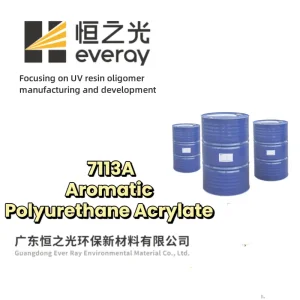
| Aromatic Urethane Acrylate | Fast | High (1H – 3H) | Medium (10% – 40%) | Fair (Slight Yellowing) | Industrial Flooring, Structural Adhesives |
| Polyester Acrylate | Ultra-Fast | Medium (F – H) | Balanced (15% – 50%) | Good | UV Lithographic & Screen Printing Inks |
| Waterborne PUA Dispersion | Fast (Post-water evap) | Tunable (HB – 3H) | High (50% – 150%) | Excellent | Eco Wood Finishing, Leather Coatings |
How our custom polymer formulations resolve specific manufacturing bottlenecks across consumer, automotive, and heavy industrial sectors.
Modern mobile devices, laptops, and smart wearables require extreme scratch resistance alongside optical clarity over substrates like polycarbonate (PC), ABS, polymethyl methacrylate (PMMA), and treated glass. Standard resins suffer from shrinkage stress leading to substrate warping or delamination during crosslinking.
Our Solution: Formulations incorporating low-shrinkage modified epoxy acrylates (such as Grade 6203F) combined with aliphatic urethane oligomers provide excellent inter-coat adhesion, passing 5B cross-hatch tape test and 1000-cycle steel wool abrasion tests while maintaining $100\%$ optical transparency.
In high-throughput printing lines operating at speeds exceeding $300\text{ meters/min}$, ink formulators face dual challenges: high pigment wetting performance to achieve high color density without rheological sagging, and rapid surface curing under energy-efficient 395nm LED-UV lamps.
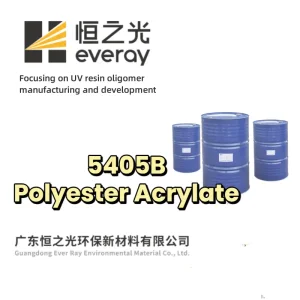
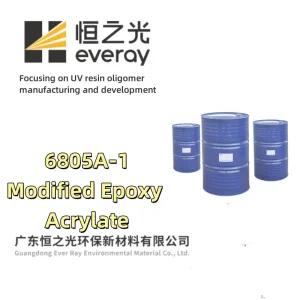
Our Solution: Polyester acrylates and hyperbranched amine-modified oligomers (such as Grade 6805A-1 and 5405B) optimize pigment dispersion while acting as internal photo-synergists, neutralizing atmospheric oxygen inhibition and enabling instant stackability without offset transfer.
Industrial assembly of glass-to-metal, glass-to-glass, and optical lenses demands ultra-clear anaerobic or photocurable liquid adhesives with zero shrinkage stress and refractive index matching ($n_D \approx 1.49 – 1.52$).
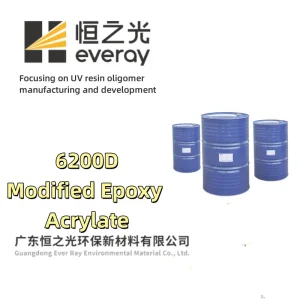
Our Solution: Grade 6200D and 72021E resins utilize modified polyurethane acrylates engineered for glass bonding. They offer controlled cure kinetics, preventing internal stress fractures during thermal shock cycling ($-40^\circ\text{C}$ to $+120^\circ\text{C}$).
In stereolithography (SLA) and Digital Light Processing (DLP) 3D printing, resin viscosity must remain below $500\text{ cP}$ at room temperature for rapid vat recoating, while maintaining high green-strength post-exposure to prevent dimensional slumping.
Our Solution: Waterborne and low-viscosity acrylate oligomers (such as Grade 70251) allow high filler loading (e.g., nano-silica, ceramic powders) for structural 3D printing, dental prosthetics, and elastic footwear midsoles.
Rigorous quality management systems guaranteeing batch-to-batch repeatability, global chemical compliance, and end-to-end technical support.
All bulk resins synthesized in our facilities fully comply with major regional regulatory frameworks including EU REACH registration, RoHS 3.0, TSCA (USA), IEC 62321 (Halogen-Free), and SVHC Candidate List restrictions. We supply comprehensive Safety Data Sheets (SDS) in accordance with GHS standards in over 20 languages.
Every manufacturing batch undergoes stringent Analytical Quality Control prior to release. Our lab utilizes Fourier-Transform Infrared Spectroscopy (FTIR) for double-bond conversion kinetics, rotational viscometry (Brookfield), Gel Permeation Chromatography (GPC) for molecular weight distribution, and spectrophotometric color testing (Gardner Scale < 1).
Recognizing that off-the-shelf oligomers do not always meet specialized application windows, our R&D technical division provides custom resin modification. We adjust backbone molecular weights, functionality numbers, photo-reactivity levels, and target viscosities based on client technical requirement sheets.
Pioneering the next century of chemical synthesis: sustainable monomers, bio-based prepolymers, and LED-UV hyper-sensitivity.
As the global coating and adhesive industries enter an era of advanced sustainability and digital manufacturing, our research facilities are focusing on four key chemical technology breakthroughs:
Replacing petroleum-derived polyols with plant-based succinic acid, modified soybean oil, and cardanol derivatives to create photopolymers containing up to 60% Renewable Carbon Content without losing thermal resistance.
Combining UV photocuring with secondary moisture, thermal, or anaerobic curing mechanisms. This solves the fundamental challenge of "shadowed areas" in complex 3D assembly and automotive electronic encapsulation.
Optimized for long-wavelength UV-A LED lamps (365nm, 385nm, 395nm, 405nm), offering extreme energy efficiency, lower substrate thermal load, and eliminate toxic ozone emission during industrial curing.
Integrating dynamic reversible chemical bonds and nano-zirconia dispersions directly into the urethane-acrylate backbone, providing self-repairing scratch resistance for premium automotive and electronic surfaces.
Expert clarification on resin selection, viscosity management, shipping regulations, and technical parameters.
Explore high-reactivity, anti-fouling, waterborne, and aromatic PA resin solutions tailored for demanding industrial manufacturing lines.