Engineered for immediate integration into high-speed UV/LED coating lines, industrial printing inks, electronics encapsulation, and advanced adhesive formulations.
Evaluating macroeconomic drivers, environmental regulations, and the paradigm shift from traditional thermal-cured solvent coatings to zero-VOC radiation-curable chemistry.
The global industrial chemical sector is experiencing an unprecedented structural transition. Drive by stringent environmental mandates—such as the European Union’s REACH guidelines, China’s "VOC Zero-Emission" industrial initiatives, and the US EPA’s Clean Air Act—formulators across coatings, graphic arts, electronics, and structural adhesives are rapidly phasing out solvent-borne polymers. Within this macroeconomic shift, UV Curable Epoxy Resins (Epoxy Acrylates) stand as the foundational pillar of modern photopolymer technology.
As a specialized supplier operating since 2006, Guangdong Ever Ray Environmental Material Co., Ltd. (EVER RAY) has observed that procurement standards have evolved. Modern tier-1 buyers no longer simply request a standard epoxy acrylate oligomer. They demand hyper-tailored chemical properties: specific double-bond reactivity, precise molecular weight distribution ($M_w/M_n$), low residual acrylic acid levels (<0.2%), and consistent color metrics (<1.0 Gardner). This technical whitepaper establishes the engineering benchmarks necessary to evaluate and source industrial-grade wholesale UV epoxy resins.
Understanding the molecular reaction pathways, functional crosslinking dynamics, and structural modification techniques of epoxy acrylate prepolymers.
Synthesized via the ring-opening esterification of Bisphenol-A Diglycidyl Ether (BADGE) with acrylic acid. Characterized by rapid free-radical polymerization kinetics, exceptionally high glass transition temperature ($T_g > 65^\circ\text{C}$), superior chemical resistance, and high gloss output.
By incorporating tertiary amines or aliphatic polyester chains into the backbone, modified epoxy acrylates effectively combat atmospheric oxygen inhibition during surface curing. This modification drastically increases surface slip, reduces cure energy requirements, and enhances flexibility.
Direct modification with inorganic-organic hybrid functional groups (such as phosphoric acid esters or alkoxysilane coupling linkages) grants direct chemical chelation to difficult substrates like unprimed glass, aluminum, stainless steel, and vacuum metallized films.
| Resin Chemistry Class | Cure Speed (m/min @ 120W/cm) | Pencil Hardness | Shrinkage Rate (%) | Adhesion (Cross-Hatch ASTM D3359) | Primary Industrial Use |
|---|---|---|---|---|---|
| Standard Epoxy Acrylate (e.g. EVER RAY 6803A) | 35 – 55 | 4H – 5H | 4.5% – 6.0% | 3B – 4B (Plastics, Wood) | Paper Varnishes, Wood Coatings, UV Inks |
| Fatty Acid Modified Epoxy Acrylate | 25 – 40 | 2H – 3H | 2.5% – 3.8% | 4B – 5B (Metals, ABS) | Flexo Inks, Metal Packaging Coatings |
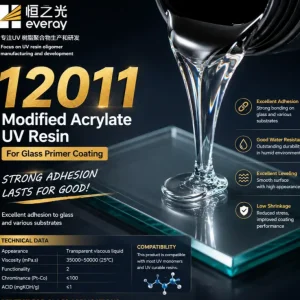
| Silane/Adhesion Promoted (e.g. EVER RAY 12011) | 20 – 35 | 3H – 4H | 1.8% – 2.8% | 5B (Glass, Aluminum, PET) | Glass Primers, Water-Transfer Coatings |
| Hyperbranched Epoxy Acrylate Hybrids | 50 – 80 | 5H – 6H | 1.2% – 2.0% | 5B (3C Electronic Housing) | High-Precision 3D Printing, Hardcoats |
Exploring the technological roadmap from 2025 to 2030: LED-UV transition, bio-based monomer integration, and zero-VOC waterborne UV dispersions.
Traditional medium-pressure mercury lamps are rapidly being decommissioned globally due to mercury elimination regulations (Minamata Convention) and high energy consumption. Modern UV epoxy resins must be engineered with photoinitiator absorption spectrum alignment (365nm, 385nm, 395nm, 405nm LED light sources). Resins like Polyester Acrylate 5501 feature targeted backbones that eliminate surface tackiness even under low-energy LED irradiation.
Driven by corporate ESG commitments and scope-3 carbon footprint reductions, oligomer manufacturers are replacing fossil-derived epoxides with bio-based polyols derived from soybean oil, cashew nut shell liquid (CNSL), and bio-succinic acid. Next-generation wholesale UV resins achieve bio-carbon contents ranging from 25% to 65% while maintaining strict industrial performance specs.
For applications where reactive diluent monomers (such as TPGDA, TMPTA) present odor, toxicity, or skin irritation risks (such as cosmetics packaging, nail gels, and interior wood), Waterborne UV Resins (e.g., Waterborne 70251) deliver zero-VOC performance. Water acts as the primary viscosity reducer before thermal evaporation and subsequent UV crosslinking.
How customized UV epoxy resin systems overcome rigorous manufacturing constraints across diverse end-use verticals.
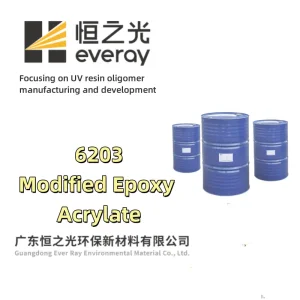
In the manufacture of mobile phones, laptops, and automotive interior panels, substrates such as Polycarbonate (PC), ABS, and PMMA require protective coatings that combine extreme scratch resistance with crystal optical clarity. Furthermore, substrates subjected to physical vapor deposition (PVD) / vacuum plating require basecoats that provide zero outgassing and high heat resistance. Products like 7230E Polyurethane Acrylate and 6803A Modified Epoxy Acrylate are specifically formulated to survive thermal cycling (-40°C to +85°C) and resist sweat, cosmetic oils, and abrasive wear.
Glass decoration—including cosmetic containers, architectural glass, and touch screens—presents unique adhesion challenges due to the inorganic, polar nature of silica surfaces. Standard resins undergo delamination upon exposure to moisture or boiling water tests. EVER RAY’s 12011 Modified Acrylate UV Resin integrates custom silane coupling groups directly into the oligomer backbone. This guarantees 100% adhesion retention even after 2-hour boiling water immersion tests, rendering it the benchmark choice for international glass coating factories.
High-speed sheet-fed and web offset printing presses demand inks with zero ink misting, rapid pigment wetting, and immediate through-cure under high line speeds (>150 m/min). Oligomers like 5320 Polyester Acrylate and 17701 Low Shrinkage Modified Acrylate optimize the rheological yield stress and water-ink balance, preventing emulsification in lithographic offset printing while delivering intense color saturation and high gloss overprint varnishing (OPV).
How Guangdong Ever Ray Environmental Material Co., Ltd. ensures continuous batch-to-batch consistency and technical compliance for global chemical distributors.
Our 40,000+ m² production base in Yunfu, Guangdong operates over 10 automated reactor vessels featuring precise DCS temperature control (±0.5°C) and closed-loop esterification monitoring to eliminate batch-to-batch viscosity variances.
Every lot manufactured undergoes rigorous testing: Gel Permeation Chromatography (GPC) for molecular weight distribution, FTIR spectroscopy for double-bond conversion verification, Brookfield viscometry, and colorimetric Gardner analysis.
We provide full technical support documentation including Technical Data Sheets (TDS), Safety Data Sheets (SDS compliant with GHS Revision 8), Certificate of Analysis (COA) per batch, and REACH registration support for EU importers.
Expert responses to procurement, chemical formulation, and international shipping inquiries.
Explore our full range of specialty low-odor, low-shrinkage, waterborne, and high-adhesion resin solutions.