The Australian industrial landscape is currently undergoing a decisive transition toward high-efficiency, sustainable manufacturing. Across Greater Melbourne—spanning key industrial precincts from Dandenong South and Campbellfield to Altona and Port Melbourne—manufacturers are under intensifying pressure to eliminate volatile organic compounds (VOCs), accelerate line throughput, and boost physical coating durability. At the epicenter of this technical revolution is Epoxy Acrylate Oligomer chemistry, the definitive workhorse of ultraviolet (UV) and electron beam (EB) radiation-curing formulations.
Global demand for UV curable resins has expanded beyond traditional overprint varnishes (OPVs) into high-tier applications including automotive OEM components, architectural wood flooring, electronics encapsulation, and flexible food packaging. For chemical formulators, coating compounders, and industrial end-users operating in Victoria, securing a dependable supply of high-purity, batch-consistent Bisphenol A and Bisphenol F epoxy acrylates is critical to maintaining a competitive edge.
Epoxy Acrylate Oligomers are synthesized primarily through the nucleophilic ring-opening reaction of acrylic acid with epoxy resins—most commonly Bisphenol A Diglycidyl Ether (DGEBA) or Bisphenol F Diglycidyl Ether (DGFBA) in the presence of custom catalyst complexes. The resulting molecule contains terminal acrylate double bonds capable of free-radical polymerization under UV light (200 nm to 400 nm) or electron beam exposure.
The intrinsic rigid aromatic backbone of Bisphenol A confers extraordinary mechanical performance upon photopolymerization. The cured matrix exhibits high Glass Transition Temperatures ($T_g$ ranging from $35^\circ\text{C}$ up to $95^\circ\text{C}$), dense crosslinking, unmatched tensile strength, and exceptional resistance to aggressive chemicals, acidic/alkaline media, and solvent rubbing (MEK double rubs > 200 cycles).
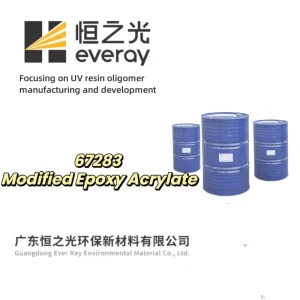
Standard epoxy acrylates can exhibit high viscosity (50,000 to 150,000 mPa·s at $25^\circ\text{C}$) and modest polymerization shrinkage (typically 4% to 7%). Our advanced modified series—such as 6160M-3 and 67283—utilize internal fatty acid modifications or specialized monomer cut ratios (TPGDA, TMPTA, or DPHA) to achieve superior wetting, reduced volume shrinkage, and minimized oxygen inhibition during surface cure under UV-LED curing systems (365nm / 395nm wavelength).
| Oligomer Grade | Chemistry / Modification | Viscosity ($mPa\cdot s @ 25^\circ C$) | Functionality | $T_g$ ($^\circ C$) | Primary Industrial Application |
|---|---|---|---|---|---|
| 6160M-3 | Fast Curing Modified Epoxy Acrylate | 25,000 - 45,000 | 2.2 | 65 | High-Speed Wood Coatings & OPV |
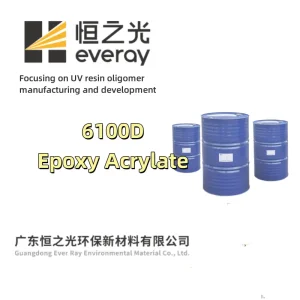
| 6100D-85 | Standard Bisphenol A (85% monomer cut) | 15,000 - 30,000 | 2.0 | 75 | Adhesion Primer on Timber & Plastics |
| 6231 | Fatty-Acid Modified Epoxy Acrylate | 10,000 - 20,000 | 2.0 | 42 | Flexible Packaging & High Leveling Finishes |
| 9105A-80 | High-Hardness Bisphenol A Resin | 30,000 - 50,000 | 2.5 | 88 | Heavy Industrial Metallic & Floor Finishes |
| 67283 | Non-Yellowing Modified Epoxy Acrylate | 8,000 - 18,000 | 2.0 | 58 | Clear Coats & Architectural Surfaces |
Utilized extensively in Geelong and Port Melbourne component manufacturing. High double-bond conversion ensures extreme scratch, chemical, and fuel resistance on rigid automotive exterior and interior trim components.
Melbourne’s commercial building sector demands durable finishes for native Victorian hardwoods (e.g., Victorian Ash, Jarrah). Our low-shrinkage epoxy acrylates prevent micro-cracking during seasonal thermal fluctuations.
High-speed lithographic and flexographic printing presses in Dandenong South require rapid curing resins. Modified epoxy acrylates provide optimal pigment wetting and high gloss values (> 90 GU at 60°).
In Clayton's research corridors, high-functionality epoxy acrylate blends form the backbone of SLA/DLP photopolymer resins, delivering high dimensional stability and superior modulus for functional prototypes.
Delivering exceptional adhesion to aluminum and tinplate substrates with superior pasteurization and boil-water resistance for beverage packaging facilities across Victoria.
Formulating thick-film concrete sealers and factory floor coatings in Sunshine industrial parks with high mechanical impact resistance and chemical resistance against oils and solvents.
Importing industrial raw materials into Australia demands total adherence to national regulatory oversight. All Epoxy Acrylate Oligomer products supplied into the Melbourne market strictly comply with the Australian Inventory of Industrial Chemicals (AICIS) regulations managed by the Department of Health and Aged Care.
Furthermore, our material packaging adheres to Safe Work Australia standards and GHS (Globally Harmonized System) classification requirements. Safety Data Sheets (SDS) are provided according to Australian national guidelines, complete with Australian emergency contact details and local transport documentation (ADG Code).
Streamlined maritime shipping routes straight into the Port of Melbourne with local safety stocks maintained in regional Victorian warehouses to protect against supply disruptions.
Every batch undergoes stringent quality control testing for viscosity, acid value, color scale (Gardner < 1), monomer ratio, and reactivity parameters before shipment dispatch.
Direct access to senior synthesis engineers and application technical staff to assist local compounders with monomer choice, photoinitiator selection, and troubleshooting line speeds.
As the global chemical industry converges on carbon neutrality and circular economy principles, the development of Epoxy Acrylate Oligomers is entering an era of rapid technical evolution. Chemical engineers are shifting away from 100% petrochemical feedstocks toward renewable bio-based epoxy building blocks, including epoxidized soybean oil (ESO), cashew nut shell liquid (CNSL) derivatives, and bio-derived acrylic acid.
Concurrently, the worldwide transition from traditional mercury vapor lamps to energy-efficient UV-LED curing systems (emitting narrow spectra centered at 365nm, 385nm, 395nm, or 405nm) necessitates oligomers with tailored photo-response capabilities. Our R&D facilities are actively optimizing double-bond functional density and hydrogen-bonding motifs to maximize surface cure performance without reliance on migrating amine synergists or excess photoinitiators.
Partner with a trusted global manufacturer. Get direct access to technical data sheets, local SDS documentation, and sample kits delivered to your Melbourne laboratory.
Send Inquiry Now