Glass substrates present one of the most chemically challenging environments for radiation-curable systems. As global industries shift away from solvent-borne thermosetting systems to meet strict volatile organic compound (VOC) directives, energy-curable UV/EB acrylate chemistry has emerged as the global standard.
In modern high-throughput manufacturing—spanning consumer electronics (3C cover glasses), architectural spandrels, automotive displays, and solar photovoltaic panels—traditional thermal coatings create unacceptable cycle time bottlenecks. Modified acrylates engineered specifically for glass provide instantaneous UV crosslinking, ultra-high surface hardness, and superior optical clarity while eliminating energy-intensive baking ovens.
Unmodified acrylic resins suffer from severe delamination when exposed to moisture due to the hydrophilic nature of inorganic silicate surfaces. Silanol groups ($Si-OH$) on glass adsorb a permanent nanometer-thin layer of water molecules.
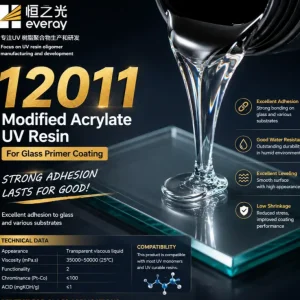
By incorporating chemically synthesized organic-inorganic hybrid functional monomers, phosphate esters, and silane-coupling acrylate oligomers (such as EVER RAY 12011), formulators achieve direct chemical covalent bonding ($Si-O-Si$) across the interface. This completely overcomes hydrolytic degradation, enabling UV primers and clear coats to survive rigorous boiling water immersion tests and extreme thermal shock environments.
To select the optimal modified acrylate oligomer, chemical formulators must evaluate the balance between polymerization shrinkage stress, crosslink density, and interfacial bonding functionality. Below is a comprehensive engineering comparison of modified acrylates utilized in high-grade glass protective primers and topcoats.
| Resin Technology Grade | Primary Functional Modification | Viscosity (mPa.s @ 25°C) | Refractive Index | Glass Adhesion Mechanism | Key Performance Attribute |
|---|---|---|---|---|---|
| EVER RAY 12011 | Silane-Organic Hybrid Acrylate | 2,500 - 4,500 | 1.498 | Covalent Si-O-Si Condensation | Boiling water resistance (>2h @ 100°C), zero delamination |
| Modified Epoxy Acrylate (6851A) | Aromatic Ring Epoxy Modification | 15,000 - 25,000 | 1.542 | Polar Hydrogen Bonding & Ring Opening | Ultra-high pencil hardness (4H-5H), chemical splash barrier |
| Aliphatic Urethane Acrylate (7200-1) | Isocyanurate / Polyether Backbone | 8,000 - 14,000 | 1.485 | Flexibility / Stress Relaxation | Non-yellowing, weatherability, impact shock energy absorption |
| Polycarbonate Acrylate (72203A) | Polycarbonate Diol Modification | 12,000 - 18,000 | 1.505 | Cohesive Energy & Soft-Touch Matrix | Hydrolytic stability, soft-touch feel, scratch resistance |
Organosilane modifications within the modified acrylate polymer structure contain hydrolyzable alkoxy groups. Upon contact with trace moisture on the glass surface, these groups form reactive silanol moieties ($R-Si-OH$). These react with inorganic glass silanols via condensation to produce strong siloxane bonds ($Si-O-Si$), converting the organic coating and inorganic glass into a single integrated chemical system.
Standard adhesive coatings break down rapidly when immersed in hot water as water molecules migrate into the polar interface and displace physical bonds. Modified acrylates formulated with hydrophobic backbones and dense covalent siloxane crosslinks prevent water ingress, ensuring pristine optical clarity and zero blister formation even under prolonged steam or boiling conditions.
Applied as optical primers, anti-shatter backing coatings, and decorative silkscreen inks for smartphone cover plates, smartwatches, and automotive cockpit displays. Modified acrylates deliver high optical transparency (>92%), anti-fingerprint compatibility, and flawless adhesion to aluminosilicate toughened glass (Gorilla Glass).
Used in UV screen inks, ceramic glass primers, and frosted glass decorative coatings. These formulations withstand heavy wash cycles, condensation, ambient UV radiation, and environmental weathering without yellowing, chalking, or delaminating from indoor or outdoor building facades.
Protective hardcoats applied over glass wind-deflectors, panoramic sunroof borders, and exterior glass lighting modules. Provides outstanding resistance to stone-chip abrasion, road salts, acidic rain, and intense temperature fluctuations (-40°C to +120°C).
Used as hydrophobic anti-soiling coatings and anti-reflective primer binders on solar panels. The ultra-low surface energy variants prevent dirt accumulation and maximize photon transmittance, ensuring long-term power generation efficiency in harsh outdoor desert installations.
As a recognized leader in UV monomer and oligomer manufacturing, Guangdong Ever Ray Environmental Material Co., Ltd. enforces strict raw material screening and standardized production protocols across a 40,000+ m² facility equipped with over 10 automated synthesis lines.
Every batch of modified acrylate oligomer undergoes stringent Analytical Quality Control (AQC) including Gel Permeation Chromatography (GPC) molecular weight profiling, gas chromatography residual monomer tracking, Brookfield viscosity checks, and colorimetry verification.
We recognize that coating application lines vary significantly in UV curing equipment (High-Pressure Mercury Lamps vs. 365nm/395nm LED UV sources), line speeds, coating thickness, and substrate surface pre-treatment (corona, flame, silane washing).
Our senior application engineering team provides customized resin synthesis, viscosity adjustment, photoinitiator matching, and pilot testing guidance directly to overseas chemical formulators and direct buyers worldwide.
Consult an Application EngineerTransitioning from mercury vapor lamps to energy-efficient 365nm/395nm LED curing systems requires modified acrylates with tailored absorption spectra and surface cure responses to eliminate oxygen inhibition without sacrificing cure speed.
Developing sustainable modified acrylates derived from plant-based polyols and renewable feedstocks, lowering carbon footprints while maintaining equivalent adhesion, hardness, and thermal resistance profiles on industrial glass.
Combining UV radical curing with moisture-cure silane condensation or thermal epoxy crosslinking to ensure total cure in shadowed, opaque glass areas and printed black matrix ink borders.
Partner with EVER RAY for direct factory pricing, batch-to-batch consistency, and custom modified acrylate resin synthesis tailored to your exact glass coating process parameters.
