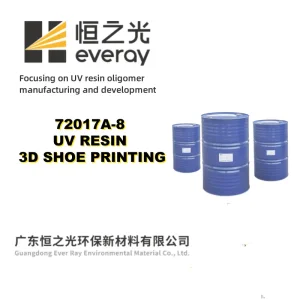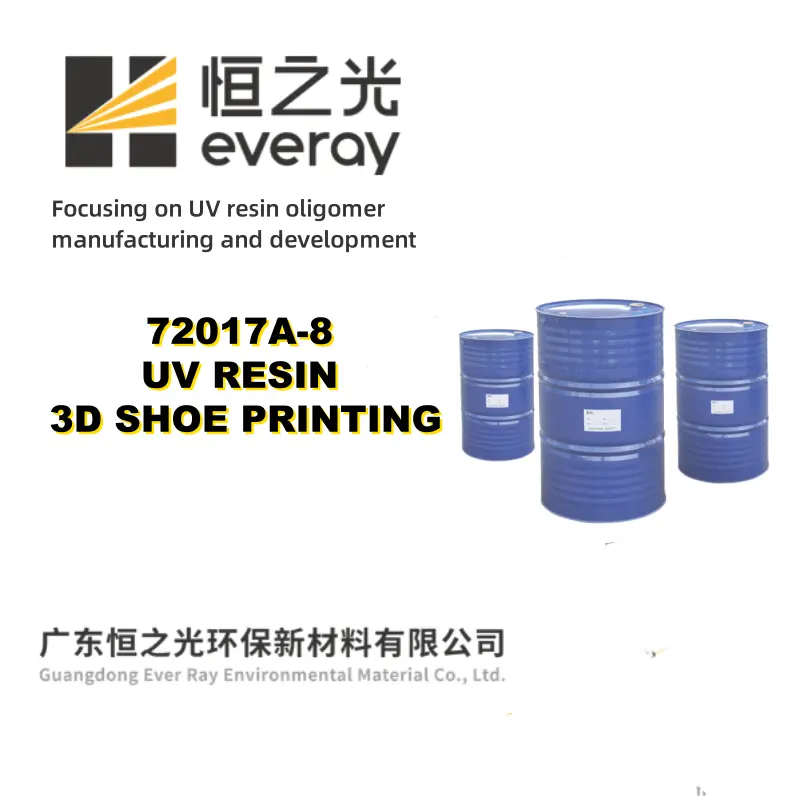
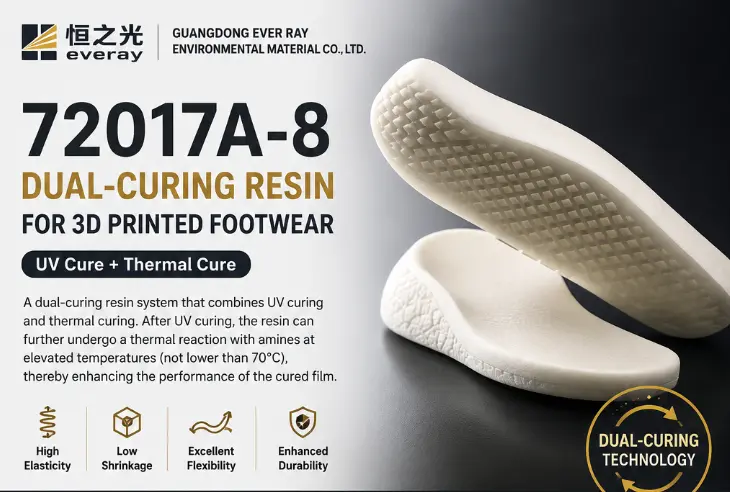
Wholesale 72017A-8 Dual-Curing UV Resin for 3D Printed Footwear | High Elasticity & Low Shrinkage Resin Manufacturer, Product

72017A-8 is a high-performance dual-curing resin system combining UV curing and thermal curing technologies. Designed for 3D printed footwear applications, it offers excellent flexibility, low curing shrinkage, superior elasticity, and enhanced durability after thermal post-curing. Ideal for shoe midsoles, customized insoles, lattice structures, UV adhesives, and other advanced UV-curable systems.

Product Description

72017A-8 Dual-Curing UV Resin for 3D Printed Footwear

72017A-8 is an innovative dual-curing resin system developed for demanding UV-curable applications requiring both flexibility and mechanical durability.

Unlike conventional UV resins, 72017A-8 combines rapid UV curing with a secondary thermal curing mechanism. After UV exposure, the resin can further react with amine components at elevated temperatures (≥70°C), forming an enhanced crosslinked network that significantly improves the final mechanical properties.

This dual-curing approach provides an excellent balance between printing precision, elasticity, dimensional stability, and long-term durability.

Key Features
Dual-Curing Technology
  • Fast UV curing for high-speed manufacturing
  • Secondary thermal curing for enhanced performance
  • Improved crosslink density after post-curing
Excellent Elasticity
  • High flexibility
  • Excellent rebound performance
  • Suitable for wearable applications
Low Curing Shrinkage
  • Reduced internal stress
  • Improved dimensional accuracy
  • Better print stability
Enhanced Mechanical Properties

After thermal post-curing:

  • Increased toughness
  • Improved fatigue resistance
  • Higher durability
  • Better long-term performance
Excellent Printability
  • High printing precision
  • Good layer adhesion
  • Suitable for complex lattice structures
  • Consistent processing performance
Typical Applications
Footwear Industry
  • 3D Printed Shoe Midsoles
  • Customized Insoles
  • Sports Footwear Components
  • Performance Footwear Structures
Functional 3D Printing
  • Flexible Lattice Structures
  • Energy Absorption Components
  • Wearable Products
  • Functional Prototypes
UV-Curable Systems
  • UV Adhesives
  • Flexible UV Coatings
  • Specialty UV Formulations
Advantages of Dual-Curing Technology

Compared with traditional UV-curable resins, 72017A-8 provides:
Higher elasticity
Better durability
Improved fatigue resistance
Enhanced dimensional stability
Lower curing shrinkage
Stronger final mechanical properties
Excellent suitability for footwear applications
Recommended Processing
1
UV cure to achieve rapid shape formation.
2
Thermal post-cure at temperatures above 70°C.
3
Amine crosslinking reaction further enhances the mechanical performance of the cured material.
Target Markets
  • Footwear Manufacturers
  • 3D Printing Service Providers
  • Additive Manufacturing Companies
  • Sports Equipment Manufacturers
  • UV Adhesive Producers
  • Advanced Material Developers
For technical support and formulation assistance, please contact Guangdong Ever Ray Environmental Material Co., Ltd.
Frequently Asked Questions (FAQ)
What is 72017A-8 dual-curing UV resin?
72017A-8 is an advanced dual-curing resin designed specifically for 3D printed footwear and functional applications, combining fast UV curing with thermal post-curing for superior mechanical strength and elasticity.
How does the dual-curing process work for this material?
The resin first undergoes rapid UV light exposure for high-precision shape formation during 3D printing. It is then thermal post-cured at temperatures above 70°C, triggering an amine reaction to create a densely crosslinked network.
What are the key advantages of using 72017A-8 over standard UV resins?
Unlike standard single-cure resins, 72017A-8 offers improved elasticity, enhanced fatigue resistance, lower curing shrinkage, greater dimensional stability, and significantly higher final mechanical durability.
What applications are best suited for 72017A-8 UV resin?
It is ideal for 3D printed shoe midsoles, customized insoles, sports footwear parts, flexible lattice structures, energy absorption components, wearable items, and specialized UV formulations.
What temperature is required for thermal post-curing?
The secondary thermal curing step requires elevated temperatures of 70°C or higher (≥70°C) to fully react the amine components and complete the crosslinking process.
Who can I contact for technical support and custom formulations?
You can reach out to Guangdong Ever Ray Environmental Material Co., Ltd. for comprehensive technical support, application guidance, and custom formulation assistance.

Related Products