Explore our industrial-grade UV-curable resin portfolio, optimized for exceptional hardness, chemical stability, low volumetric shrinkage, and superior substrate adhesion.
The global industrial landscape for high-performance polymers is undergoing a fundamental structural transition driven by stringent environmental regulations, energy-efficiency imperatives, and ultra-fast manufacturing throughput requirements. Polyurethane epoxy and polyurethane acrylate (PUA) oligomers represent the nexus of modern radiation curing (UV/EB) technology. By synthesizing the elastomeric toughness and scratch-resistant nature of polyurethanes with the exceptional chemical resistance, substrate adhesion, and tensile strength of bisphenol A or novolac epoxy backbones, chemical synthesis engineers have created a versatile class of high-gain materials.
Historically, industrial procurement teams were forced to compromise between **cure speed** and **film flexibility**. Standard bisphenol A epoxy acrylates provided unmatched surface hardness (often reaching 3H–4H pencil hardness) and extremely fast free-radical polymerization rates, yet exhibited inherent brittleness and elevated volumetric shrinkage (up to 6%–8%). Conversely, conventional aliphatic polyurethane acrylates delivered superlative non-yellowing weatherability, high elongation at break (>150%), and impact resistance, but suffered from slower surface cure rates and premium raw material costs.
Today, advanced synthesis techniques—such as modified epoxy acrylate hybridization, polycarbonate-modified polyurethanes, hyperbranched architectures, and photo-thermal dual-curing mechanisms—have effectively dismantled these technological trade-offs. B2B chemical buyers across Europe, North America, Southeast Asia, and the Asia-Pacific region actively seek validated **Polyurethane Epoxy Suppliers** capable of offering consistent batch-to-batch polymer quality, fully documented Technical Data Sheets (TDS), Safety Data Sheets (SDS), and bespoke formulation adaptability.
To systematically navigate the diverse polymer spectrum, polyurethane epoxy and acrylate oligomers are engineered through distinct structural pathways. Understanding these core chemical routes enables formulators to precise-match raw materials with end-use application criteria:
Synthesized using aliphatic diisocyanates (such as IPDI or HDI) paired with polyester, polyether, or polycarbonate polyols. APUAs exhibit zero yellowing under intense UV exposure, exceptional weatherability, and elastic recovery. Essential for 3C clear coats, automotive interiors, and outdoor PSA tapes.
Utilizes aromatic diisocyanates (TDI or MDI). These resins deliver remarkable tensile strength, high modulus, and rapid surface cure speeds at an economical cost. Ideal for interior floor coatings, industrial wood primers, and rigid plastic finishes where non-yellowing is not the primary requirement.
Formulated by reacting acrylic acid with epoxy resins (Bisphenol A or Novolac) followed by polyurethane or fatty acid modification. This chemical modification significantly reduces resin viscosity, improves film flexibility, lowers internal stress, and enhances adhesion to difficult metal and density-board substrates.
The matrix below summarizes empirical testing data conducted under standardized laboratory conditions (25°C, 60% RH, cured via 395nm LED UV lamp at 800 mJ/cm²):
| Resin Chemistry Category | Viscosity Range (mPa.s / 25°C) | Cure Speed (m/min) | Pencil Hardness | Elongation at Break (%) | Yellowing Resistance (ΔE) | Primary Substrate Compatibility |
|---|---|---|---|---|---|---|
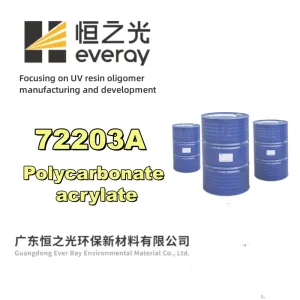
| Aliphatic PUA (e.g., 72203A) | 1,500 – 6,000 | 15 – 30 | HB – 2H | 80% – 220% | < 0.5 (Ultra-Low) | PC, ABS, PMMA, TPU, Leather |
| Modified Epoxy Acrylate (e.g., 6271) | 3,000 – 12,000 | 35 – 60 | 3H – 5H | 5% – 25% | 1.8 – 3.5 (Moderate) | Metals, Glass, Wood, MDF, PVC |
| Bisphenol A Epoxy Acrylate (e.g., 9104) | 15,000 – 45,000 | 40 – 75 | 4H – 6H | 2% – 8% | > 4.0 (High Yellowing) | Paper OPV, PCB Mask, Metal Packaging |
| Polyester Acrylate (e.g., 5335F) | 500 – 3,500 | 25 – 45 | H – 3H | 15% – 50% | 1.2 – 2.5 (Fair) | Printing Inks, Paper, Plastics |
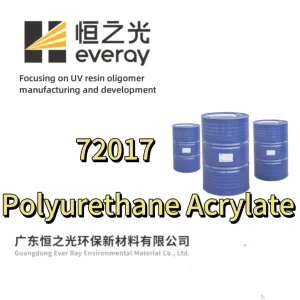
| Dual-Cure PUA Oligomer (e.g., 72017) | 2,000 – 8,000 | Dual Mechanism | 2H – 4H | 30% – 90% | < 1.0 (Low) | 3D Photopolymers, Deep Cavities |
Modern UV technology requires highly tailored oligomer solutions. Guangdong Ever Ray Environmental Material Co., Ltd. provides specialized polyurethane epoxy and acrylate resins formulated for challenging operational environments:
Smartphones, laptops, wearable devices, and automotive center consoles demand tactile luxury combined with rugged mechanical resistance. Incorporating **Polycarbonate Acrylate 72203A** or hyperbranched polyurethanes delivers a velvet-like "soft-touch" feel while maintaining outstanding MEK solvent resistance (>200 double rubs), artificial sweat resistance, and scratch recovery.
3D photopolymer resins often struggle with warping, brittleness, and incomplete curing in shadowed geometries. **Photo-Thermal Dual-Curing Polyurethane Resin 72017** solves shadow-cure challenges by combining light-initiated polymerization with secondary thermal post-curing. This dual route ensures complete conversion, low volumetric shrinkage (<0.8%), high impact strength, and dimensional fidelity for functional prototyping and dental models.
Commercial offset, flexographic, and gravure printing presses operate at line speeds exceeding 150 meters per minute. Formulations utilizing **Polyester Acrylate 5335F** or **Low Shrinkage Modified Acrylate Oligomer 17701** offer superior pigment wetting, fast surface cure, low misting on high-speed rollers, and flawless water-ink balance required for premium packaging.
Medium-density fiberboard (MDF) and porous wood substrates suffer from resin absorption and edge-cracking. Utilizing **1200A UV Resin** as a specialized primer resin creates a deep-penetrating barrier coat that anchors into wood fibers, offering exceptional sealing capabilities, sandability, and intercoat adhesion for high-gloss topcoats.
The polyurethane epoxy and UV-curable material sector is entering a transformative decade defined by eco-design, decarbonization, and digital manufacturing integration. Forward-looking chemical manufacturers must align R&D with three principal technology pillars:
Transitioning from pure petrochemical building blocks to renewable carbon sources (e.g., bio-succinic acid, cardanol-derived epoxy acrylates, soybean oil polyols). Next-generation polyurethane acrylates target renewable carbon contents between 30% and 65% without compromising glass transition temperature ($T_g$) or chemical resistance.
Phasing out high-pressure mercury lamps in favor of energy-efficient LED-UV curing systems. This transition requires oligomers with reduced oxygen inhibition sensitivity, optimized tertiary amine synergists, and tailored photoinitiator reactivity curves that cure tack-free under long-wavelength UV light.
Merging the zero-VOC compliance of water-based coatings with the instantaneous cure speeds of UV radiation. Waterborne polyurethane acrylate dispersions allow zero reactive diluent usage, resulting in ultrathin film build, exceptional clarity, and safety compliance for food-contact packaging and leather finishing.
Explore our specialized range of modified epoxy acrylates, polyester acrylates, and high-reactivity resins engineered for specific industrial production lines.
Established in 2006, **Guangdong Ever Ray Environmental Material Co., Ltd.** operates as a premier manufacturer of UV-curable resins and specialty acrylate oligomers. Headquartered in Jiangmen, Guangdong, with an expansive modern synthesis production base in Dawan Industrial Park, Yunfu City, our facilities span over **40,000 square meters** equipped with more than **10 continuous automated production lines**.
Our commitment to quality, professional expertise, and technical transparency is reflected in every stage of our supply chain:
Every batch of diisocyanates, epoxy resins, acrylic acid, and specialty polyols undergoes stringent incoming quality control (IQC) utilizing Fourier-Transform Infrared Spectroscopy (FTIR) and Gas Chromatography-Mass Spectrometry (GC-MS) to guarantee chemical purity and zero moisture contamination.
During resin synthesis, reactor temperature, viscosity kinetics, and free-monomer conversion are tracked in real-time. This eliminates batch-to-batch viscosity drift and ensures consistent chromaticity (Gardner color scale <1.0 for clear grades).
Backed by over 10 national invention and utility patents, our dedicated R&D team collaborates directly with global customer formulators to modify resin viscosity, functional group density, surface tackiness, and curing kinetics.
All shipment drums are accompanied by batch-specific Certificates of Analysis (COA), fully compliant REACH/GHS Safety Data Sheets (SDS), and Technical Data Sheets (TDS). Fast global delivery is backed by standardized ocean and air dangerous-goods (DG) packaging approvals.