Explore our factory-direct, highly specialized modified epoxy acrylates, polyurethane acrylates, and pure acrylate oligomers engineered for stringent coating, ink, and adhesive formulations.
Navigating modern chemical procurement requires deep architectural understanding of synthetic resin chemistry, total cost of ownership (TCO), supply chain resiliency, and rigorous quality metrics.
The global demand for synthetic urethane and polyurethane materials has transitioned from legacy solvent-based formulations toward high-solids, energy-curable, and waterborne resin systems. Driven by stringent global environmental mandates and continuous performance requirements in electronics, automotive, packaging, and additive manufacturing, industrial procurement directors must evaluate manufacturers not merely by price per kilogram, but by molecular design consistency, raw material purity, and technical agility.
When procurement managers buy polyurethane oligomers or modified epoxy acrylates, they are securing the foundation of their end-product's mechanical, thermal, and optical properties. A micro-variance in double-bond conversion efficiency or unreacted isocyanate content ($NCO\%$) can result in batch failures, adhesion loss on difficult substrates (such as polycarbonate or treated PET), or premature yellowing under atmospheric UV exposure.
| Resin Chemistry Class | Cure Speed & Reactivity | Flexibility vs. Hardness | Substrate Adhesion | Weatherability (QUV) | Primary Industrial Applications |
|---|---|---|---|---|---|
| Aliphatic Polyurethane Acrylate | Medium to High | Tailored High Toughness & Elasticity | Excellent (PC, ABS, Metal, Glass) | Outstanding (Non-yellowing) | 3C Electronics, Automotive Clear Coats, Outdoor Plastics |
| Aromatic Polyurethane Acrylate | High | High Hardness & Scratch Resistance | Good (Wood, PVC, SPC Flooring) | Moderate (Interior Grade) | Parquet Flooring, Industrial Wood Primers, Paper OPV |
| Bisphenol-A Epoxy Acrylate | Very High | High Hardness, Rigid (Low Flexibility) | Moderate to High (Metal, Wood) | Fair (Yellowing prone) | Overprint Varnishes (OPV), High-Speed Offset Inks, Wood Fillers |
| Polyester Acrylate Oligomer | High | Balanced Hardness & Flexibility | Superior Pigment Wetting | Good | UV Printing Inks (Flexo/Litho), Screen Inks, Pigmented Coatings |
| Waterborne Polyurethane Acrylate (UV-PUD) | Fast Post-Drying | High Elasticity, Low Shrinkage | Excellent (Leather, Plastics, Film) | Excellent | Eco-Friendly Wood Coatings, Flexible Packaging, Leather Finishing |
Our polyurethane and acrylate polymer systems are synthesized to address critical engineering bottlenecks in rapid UV line curing, substrate wetting, thermal shock resistance, and micro-scratch self-healing.
In consumer electronic housings (smartphones, laptops, wearables), coatings face harsh chemical exposure (sweat, cosmetics) and drop impacts. Formulations utilizing aliphatic urethane acrylates provide exceptional crosslinking density and non-yellowing clear coats with Pencil Hardness rating up to 3H-4H on PC/ABS substrates without micro-cracking.
Modern automated flooring lines run at speeds exceeding 30-50 m/min. Low-viscosity modified epoxy acrylates and aromatic urethane acrylate primers penetrate deep into wood fibers, providing moisture barrier resistance, rapid curing under Mercury/LED lamps, and superior Taber abrasion resistance for heavy commercial foot traffic.
High-speed lithographic and flexographic printing inks require resin binders with superior pigment wetting properties, low odor, and minimal migration. Polyester acrylates and amino-functional acrylate oligomers mitigate oxygen inhibition, ensuring tack-free surface curing even under low-energy LED irradiation.
Precision optical clear adhesives (LOCA) and structural metal/glass bonding resins demand sub-1% volume shrinkage during photopolymerization. Pure acrylate oligomers and flexible urethane acrylate backbones absorb internal thermal stress, preventing bond line failure under thermal cycling (-40°C to +125°C).
Stereolithography (SLA/DLP/LCD) resins demand low viscosity, high tensile strength, and impact toughness. ABS-like engineering resins formulated with specialized urethane acrylate oligomers deliver high deflection temperatures (HDT) and mechanical ductility for functional prototyping and end-use industrial parts.
From soft-touch tactile coatings on automotive dashboards to anti-fingerprint optical films, custom functional acrylate monomers and hyperbranched oligomers allow formulators to engineer surface energy, slip coefficient, hydrophobic angle, and chemical spot resistance.
The photopolymer industry is undergoing paradigm shifts towards eco-conscious synthesis, long-wave LED efficiency, bio-content integration, and dual-cure chemistry.
Traditional medium-pressure mercury lamps emit broad UV spectrum light but generate excessive heat and ozone. The shift to LED-UV curing systems requires oligomers tailored for deep-coat absorption at 365nm, 385nm, and 395nm wavelengths. Breakthrough research focuses on hyperbranched polyols and amino acrylates that overcome surface tackiness caused by radical scavenging in ambient oxygen.
Aligning with global carbon-neutral goals, next-generation polyurethane acrylates integrate up to 40%-70% renewable bio-based polyols derived from castor oil, soybean oil, and lignin derivatives. These bio-oligomers maintain structural mechanical toughness while drastically lowering the Net Carbon Footprint ($\text{g CO}_2\text{e/kg}$) across the supply chain.
Complex 3D geometries, thick electronic encapsulants, and automotive assemblies feature shadowed areas where UV radiation cannot penetrate directly. Dual-cure polyurethane formulations incorporate secondary chemical curing mechanisms—such as residual blocked isocyanate moieties or silane moisture-crosslinking—ensuring complete 100% polymer conversion in shadow zones.
Combining the environmentally benign nature of water diluents with the instantaneous curing speed of radiation chemistry, Waterborne Polyurethane Acrylate (UV-PUD) technology eliminates hazardous organic solvents (Toluene, MEK). This represents the ultimate solution for interior architectural coatings, automotive leather, and food packaging applications.
Chemical procurement across North America, Europe, and Asia Pacific requires rigorous compliance with international safety protocols, chemical control inventories, and secure logistics.
European markets enforce strict registration under EU REACH regulations. Formulations avoid Substances of Very High Concern (SVHC), hazardous photoinitiator residues, and restricted monomers like trimethylolpropane triacrylate (TMPTA) where lower-toxicity ethoxylated or propoxylated alternatives are mandated.
Products exported to North American markets strictly adhere to the United States Toxic Substances Control Act (TSCA) chemical substance inventory. Furthermore, heavy metal content, phthalate plasticizers, and halogenated flame retardants are routinely tested under EU RoHS 3 and California Proposition 65 guidelines.
To maintain polymer stability and avoid premature thermal polymerization during ocean transit, oligomers are packaged in light-proof, fluorinated HDPE drums, steel barrels (200kg net), or 1000kg IBC totes with controlled dissolved oxygen levels and stabilized temperature monitoring.
Discover high-reactivity polyester acrylates, waterborne UV resins, modified adhesion-promoting oligomers, and specialty dual-cure products.
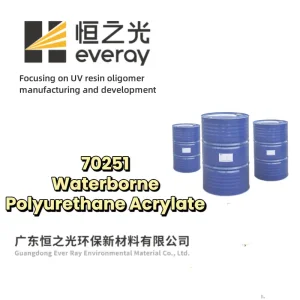
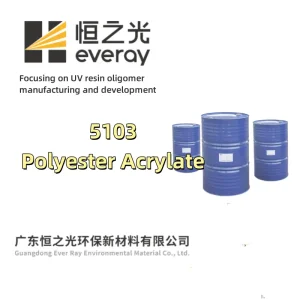
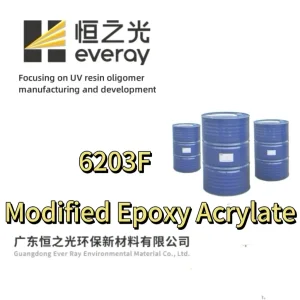
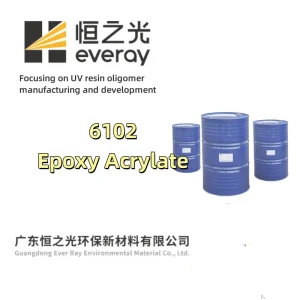
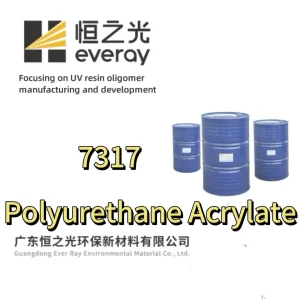
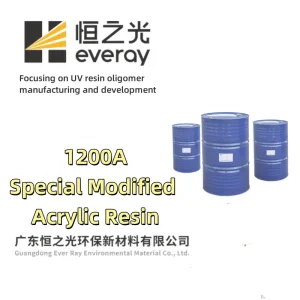
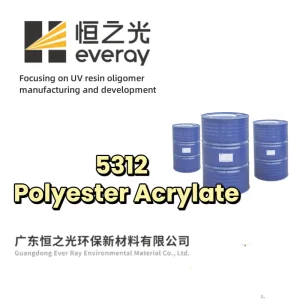
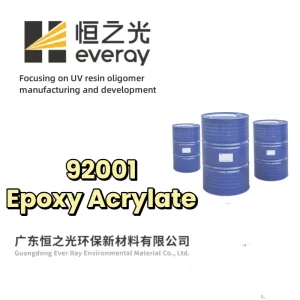
Guangdong Ever Ray Environmental Material Co., Ltd. combines advanced chemical reactor design, rigorous raw material qualification, and application testing labs to serve global formulators.
Operating from our modern 40,000+ square meter manufacturing base in Yunfu, Guangdong, equipped with over 10 automated synthesis reaction lines, EVER RAY delivers end-to-end resin manufacturing capability. Backed by more than 10 invention and utility patents, our R&D center in Jiangmen continuously pushes the boundary of radical photopolymerization technology.
Whether you require standard Bisphenol-A epoxy acrylates for high-volume paper overprint varnishes, highly flexible non-yellowing aliphatic urethane acrylates for automotive interior displays, or low-VOC waterborne polyurethane dispersions for eco-friendly wood finishes, our team provides custom viscosity matching, targeted refractive index tuning, and dedicated batch certificate of analysis (COA) verification prior to dispatch.
Deep-dive technical answers compiled by senior UV formulation experts to address common chemical selection, curing, and substrate adhesion challenges.
Partner directly with a premier Chinese UV curable resin manufacturer. Request custom technical samples, detailed TDS/SDS documentation, or factory-direct pricing quotes.
