Explore our primary factory-direct UV-curable oligomers engineered for dimensional accuracy, rapid cure response, low polymerization shrinkage, and superior mechanical performance.
The global additive manufacturing ecosystem is undergoing an unprecedented paradigm shift. Transitioning from decorative rapid prototyping toward functional end-use component production, enterprise procurement teams face stringent demands regarding batch-to-batch polymer consistency, thermal stability, Izod impact resistance, and chemical durability. Modern photopolymer synthesis requires deep integration between resin chemists, raw material suppliers, and end-use application engineers.
Established in 2006, EVER RAY operates state-of-the-art resin synthesis lines spanning over 40,000 m² in Yunfu, Guangdong, with sales headquarters in Jiangmen. Our R&D engineering teams hold over 10 invention and utility patents, delivering chemically standardized epoxy acrylates, polyurethane acrylates (PUA), polyester acrylates, amino acrylates, and specialty reactive monomers tailored for UV/EB radiation curing and 3D printing photo-formulations worldwide.
Photopolymers engineered for Stereolithography (SLA), Digital Light Processing (DLP), Masked Stereolithography (LCD/MSLA), and Material Jetting demand meticulous control over prepolymer molecular weight distribution, double bond conversion efficiency (DBC%), and photo-rheological behavior. The selection of base oligomers determines the ultimate glass transition temperature ($T_g$), tensile modulus, and volumetric shrinkage stress of the printed geometry.
Precision-tailored prepolymer viscosity ranges (from 100 cP to 50,000 cP at 25°C) allow formulators to optimize resin vat leveling speed, pixel resolution, and continuous printing cycles without compromising crosslinking density.
Optimized double-bond functionality and reactive monomer ratios ensure rapid photon conversion under 365nm, 385nm, and 405nm LED light engines while mitigating surface sticky layers caused by atmospheric oxygen inhibition.
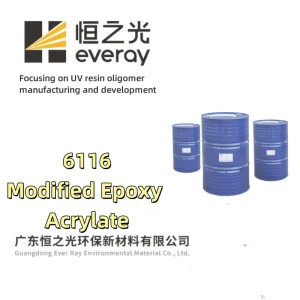
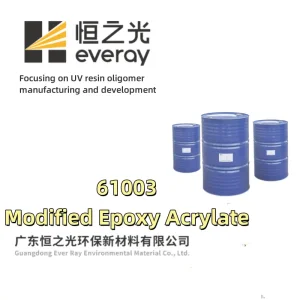
Incorporating specialized modified epoxy acrylates (such as 6203F) minimizes internal stress during photopolymerization, guaranteeing strict dimensional tolerances and warp-free execution in complex technical parts.
Strategic supply chain dynamics, quality metrics, and cost optimization for global enterprise formulators and OEM/ODM additive manufacturing entities.
As tier-1 industrial manufacturers scale up additive manufacturing production lines across North America, Europe, and the Asia-Pacific, strategic raw material sourcing has shifted from spot-market purchasing to direct contract partnerships with chemical synthesis factories. Enterprise procurement directors prioritize three key material pillars: chemical lot-to-lot consistency, regulatory compliance (REACH/RoHS), and total cost of ownership (TCO) optimization.
Uncontrolled variation in prepolymer viscosity or color index leads to printer recalibration downtime and failed build jobs. EVER RAY enforces strict Gel Permeation Chromatography (GPC), Fourier-Transform Infrared Spectroscopy (FTIR), and viscosity index monitoring for every production batch, ensuring less than ±3% variance across multi-ton shipments.
Export packaging complies with international dangerous goods transport protocols (where applicable), offering UV-barrier steel drums (200kg), IBC totes (1000kg), and customized sample pails. Direct factory export eliminates intermediary markups, reducing raw material procurement costs by 15% to 30%.
How targeted acrylate oligomers and resin chemistries resolve critical performance bottlenecks across major industrial sectors.
Under-the-hood jigs, air intake manifolds, and exterior prototypes require exceptional heat deflection temperatures (HDT > 120°C) and resistance to hydrocarbon solvents. Utilizing high-functionality aliphatic urethane acrylates and rigid modified epoxy resins ensures long-term thermal mechanical stability.
SLA/DLP dental surgical guides, clear aligner thermoforming models, and custom prosthetics demand biocompatibility, minimal moisture absorption, and precise dimensional retention. Non-yellowing aliphatic polyurethanes (e.g., 7200-1) provide ultra-clear aesthetics and skin-contact safety performance.
Consumer electronics housings, connectors, and optical display bonding demand scratch-resistant, anti-yellowing clear coats and flame-retardant potting polymers. Hyperbranched and multifunctional acrylate prepolymers deliver fast LED surface cure and pencil hardness exceeding 3H-5H.
Lattice midsoles and flexible damping structures require elastomeric photopolymers with high tensile elongation (>250%), excellent fatigue tear strength, and resilience under cyclic loading. Specialized flexible polyurethane acrylates (such as 7317) provide high reactivity and rubber-like rebound.
Short-run injection molding inserts produced via 3D printing eliminate expensive CNC steel tooling costs. Formulations combining bisphenol A epoxy acrylates with active monomer diluents deliver compressive strength capable of withstanding molten thermoplastic injection pressures.
Beyond 3D resin vats, our oligomers power high-performance UV offset inks, snowflake/wrinkle tactile coatings, density board primers (e.g., 1200A), and gel polishes requiring intense chemical resistance and substrate adhesion.
Empirical performance benchmarks across standard UV-curable oligomer classes to guide formulation engineers in material selection.
| Oligomer Chemistry Type | Viscosity (cP @ 25°C) | Tensile Strength (MPa) | Elongation at Break (%) | Cure Speed / Reactivity | Primary Performance Advantage |
|---|---|---|---|---|---|
| Modified Epoxy Acrylate (e.g., 61163, 6203F) | 1,500 – 8,000 | 45 – 70 | 2% – 6% | Very Fast | High hardness, fast cure, low shrinkage, superior cost efficiency |
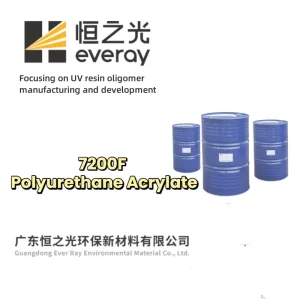
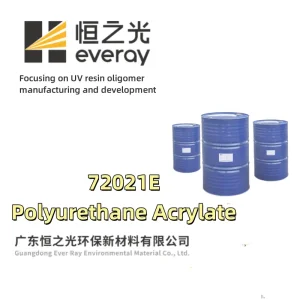
| Aliphatic Urethane Acrylate (e.g., 7200-1, 7200F) | 5,000 – 35,000 | 25 – 50 | 15% – 120% | Moderate / Fast | Non-yellowing, weatherability, exceptional flexibility & toughness |
| Aromatic Urethane Acrylate (e.g., 7402, 7600) | 10,000 – 55,000 | 35 – 65 | 5% – 35% | Fast | High tensile strength, scratch resistance, cost-effective toughness |
| Polyester Acrylate (e.g., 5103, 5403 series) | 500 – 3,500 | 15 – 35 | 10% – 50% | Fast | Low viscosity, excellent pigment wetting, smooth film leveling |
| Pure Acrylate / Specialty (e.g., 1100, 1200A) | 800 – 5,000 | 20 – 40 | 8% – 40% | Moderate | Outstanding direct adhesion to metals, glass, PC, PET & density board |
Key evolutionary directions in resin synthesis driving the next generation of high-speed additive manufacturing.
Combining primary UV radical polymerization with secondary thermal or moisture cure mechanisms eliminates light-penetration depth constraints. Dual-cure formulations enable shadow-zone curing in complex lattice topologies and thick cross-section industrial components.
Synthesizing oligomers from renewable bio-based polyols and plant-derived fatty acids reduces carbon footprints without sacrificing mechanical modulus. Future-proof formulators are aggressively integrating 30% to 60% bio-content resins into commercial supply chains.
Dispersing nano-silica, zirconia, or carbon nanotubes into ultra-low viscosity prepolymers yields ceramic-filled composite resins for extreme heat environments (>300°C) and high-voltage dielectric electrical insulation applications.
Ensuring seamless compliance with international chemical safety standards and global supply chain reliability.
Navigating environmental regulations is essential for enterprise chemical purchasing. EVER RAY supplies comprehensive compliance documentation package for every material grade:
Formulation challenges often require tailor-made prepolymer modifications rather than off-the-shelf products. Our Guangdong R&D team works directly with formulators to optimize:
Discover our complete range of specialized oligomers, flexible polyurethane acrylates, high-adhesion monomers, and LED-curable resins.
Technical answers addressing prepolymer behavior, photoinitiator compatibility, viscosity adjustment, and commercial purchasing protocols.
