Explore our primary chemical architectures designed for formulators requiring precise viscosity control, rapid cure kinetics, superior yellowing resistance, and substrate adhesion.
The worldwide demand for polyester polyurethane coatings has transitioned from basic corrosion protection into high-precision, multi-functional polymer networks capable of enduring extreme UV exposure, chemical immersion, and physical wear.
Polyester polyurethane coatings represent the pinnacle of step-growth polymerization synergy. By reacting hydroxyl-terminated polyester polyols ($R-OH$) with aliphatic or aromatic polyisocyanates ($R'-NCO$), formulators achieve an interpenetrating network with high hydrogen bonding density. This imparts exceptional toughness, flexibility, and solvent resistance across metals, engineered plastics, and composite substrates.
Global environmental directives—including the European REACH framework, US EPA Rule 1113/1151, and China’s national GB38508-2020 standards—have forced a rapid transition away from high-solvent 2K polyurethane systems. The market now favors 100% solid UV-curable polyester acrylates, high-solid 2K polyurethane polyols, and 1K/2K waterborne polyurethane dispersions (PUDs).
Industrial procurement specifiers in tier-one automotive OEMs, consumer electronics, and heavy marine protective coatings now mandate zero-defect coating reliability. High-density polyester polyurethane resins fulfill these specifications by preventing micro-cracking under severe thermal shock ($-40^\circ\text{C}$ to $+120^\circ\text{C}$) and resisting hydrolysis under humid environmental stress.
Understanding the relationship between ester backbone flexibility, urethane linkage density, and acrylic functionalization is key to engineering custom polyurethane coatings for demanding end-use environments.
| Resin Technology Class | Polymer Backbone Structure | Cure Mechanism | Pencil Hardness | Flexibility (Impact Resistance) | QUV-A Weathering (2000 hrs) | Key Target Application |
|---|---|---|---|---|---|---|
| Branched Polyester Polyurethane (2K Aliphatic) | Dicarboxylic Acids + Polyols + HDI Trimer | Isocyanate Addition ($\text{NCO} + \text{OH}$) | 2H - 4H | High ($> 50 \text{ kg}\cdot\text{cm}$) | $\Delta E < 1.5$ (No Chalking) | Automotive Clearcoats, Aerospace, Coil Coating |
| Urethane Modified Polyester Acrylate | Polyester Oligomer + Acrylate Functional Ends | Free Radical UV / EB Irradiation | 3H - 6H | Medium ($25 - 40 \text{ kg}\cdot\text{cm}$) | $\Delta E < 2.0$ (High Gloss Retention) | 3C Consumer Electronics, UV OPV Inks, Optical Plastics |
| Waterborne Polyurethane Dispersion (PUD) | Anionic/Non-ionic Polyester PUD Matrix | Coalescence + Physical/Isocyanate Crosslinking | H - 3H | Very High ($> 60 \text{ kg}\cdot\text{cm}$) | $\Delta E < 2.5$ | Flexible Leather Finish, Eco Wood Coatings, Architectural |
| Aromatic Epoxy-Modified Polyurethane | Bisphenol A Epoxy + Aromatic Isocyanate | Thermal Polyaddition / UV Hybrid | 4H - 7H | Low ($10 - 20 \text{ kg}\cdot\text{cm}$) | Yellows ($\Delta E > 8.0$) | Heavy-Duty Industrial Floor, Marine Primers, Subsea Pipe |
As environmental mandates tighten and performance expectations rise, four critical technological shifts are transforming the synthesis and application of polyester polyurethane coatings globally.
Replacing petroleum-derived phthalic anhydride and glycol monomer blocks with bio-succinic acid, dimer fatty acids, and castor oil-derived polyols. Modern bio-content polyester polyurethane resins achieve up to 65% renewable carbon content without compromising mechanical strength or chemical resistance.
Utilizing specialized polyester acrylate oligomers in conjunction with 172nm excimer laser radiation. This technique creates micro-folding on the coating surface during pre-cure, yielding ultra-matte finishes (Gloss < 2 at 60°) with exceptional anti-fingerprint properties and soft-touch tactile response without matting agents.
Combining free-radical photo-polymerization (UV curing for instant surface handling) with moisture-cure or thermal hydroxyl-isocyanate addition (2K polyurethane for shadow area crosslinking). Essential for complex 3D automotive interior parts, geometry-shielded components, and footwear assemblies.
Incorporating dynamic reversible chemical bonds (such as disulfide linkages or hydrogen-bonded supramolecular networks) within the polyester polyurethane skeleton. Scratches on clear coats self-heal upon exposure to mild heat ($60^\circ\text{C}$) or direct sunlight, maintaining pristine aesthetic clarity.
Every industrial sector presents unique chemical stress vectors. Here is how specialized polyester polyurethane coatings are formulated to address distinct operational demands.
Substrate: Electrocoated Steel, Aluminum Alloys, Thermoplastic Polyolefins (TPO).
Technical Challenge: High stone-chip resistance, acid rain durability, anti-yellowing, and high gloss retention ($>90$ units at 20°).
Solution Strategy: Low-viscosity branched polyester polyols crosslinked with aliphatic HDI trimers, fortified with hindered amine light stabilizers (HALS) and UV absorbers.
Substrate: Polycarbonate (PC), ABS, PMMA, Glass Fiber Composites.
Technical Challenge: Velvet-like tactile sensation, severe sweat/sebum resistance, and cosmetics alcohol immersion testing.
Solution Strategy: Soft aliphatic polyester polyurethane acrylates cured via UV LED, modified with micro-fine silica particles for consistent haptic feedback and zero stain adhesion.
Substrate: Hot-dip Galvanized Steel, Aluminum Sheet Coil.
Technical Challenge: 20+ year outdoor durability, post-coating T-bend flexibility ($0\text{T}-2\text{T}$ without cracking), and dirt pickup resistance.
Solution Strategy: High-molecular-weight linear polyester resins crosslinked with blocked polyisocyanates, providing high elasticity during metal fabrication and bending.
Substrate: Natural Solid Wood, Engineered Hardwood, SPC Flooring.
Technical Challenge: Taber abrasion resistance ($>1000$ cycles under CS-10 wheel), coin scratch resistance, and moisture seal.
Solution Strategy: High-functionality polyester acrylate UV resin systems paired with modified epoxy acrylate primers to ensure deep pore penetration and mechanical interlocking.
Substrate: Sandblasted Structural Carbon Steel (Sa 2.5).
Technical Challenge: Salt spray resistance ($>5000$ hours per ISO 9227), C5-M marine anti-corrosion rating, and chemical splash endurance.
Solution Strategy: High-solids, acrylic-modified polyester polyurethane topcoats applied over zinc-rich epoxy primers, ensuring structural integrity in offshore wind and chemical storage environments.
Substrate: Photopolymerized Layer-by-Layer SLA/DLP Assemblies.
Technical Challenge: Ultra-low volumetric shrinkage (<1.5%), high tensile strength (>50 MPa), and elastomeric recovery.
Solution Strategy: Specialty dual-curing polyurethane acrylate oligomers engineered for footwear midsoles, tough engineering prototypes, and high-precision industrial tooling.
Achieving optimal coating performance requires balancing the hydroxyl equivalent weight (HEW) of the polyester resin with the isocyanate index ($\text{NCO}:\text{OH}$ ratio), diluent viscosity, and catalyst loading.
For standard high-durability 2K polyurethane topcoats, an $\text{NCO}:\text{OH}$ ratio of 1.05 to 1.15 is recommended. This slight excess of isocyanate compensates for trace moisture scavenged from solvents or pigments, ensuring full crosslinking density, maximum chemical resistance, and zero residual unreacted hydroxyl groups.
Organotin catalysts (such as Dibutyltin Dilaurate - DBTDL) or eco-friendly tin-free alternatives (Bismuth/Zirconium carboxylates) are incorporated at concentrations of 0.005% to 0.05% based on total resin solids. Precise dosing regulates pot-life while ensuring rapid dust-free cure times under ambient conditions.
In 100% solid UV polyester acrylate systems, selecting low-viscosity mono- or di-functional acrylate monomers (such as TPGDA, HDDA, or IBOA) controls viscosity down to application windows ($200 - 800 \text{ mPa}\cdot\text{s}$ at $25^\circ\text{C}$), ensuring self-leveling and film wetting without VOC emission.
| Formulation Component | High-Solid 2K Polyurethane Topcoat (%) | UV-Curable Soft-Touch Coating (%) | Waterborne Polyurethane PUD Topcoat (%) |
|---|---|---|---|
| Primary Polyester Polyol / Acrylate Oligomer | 45.0 - 55.0 % | 35.0 - 50.0 % | 60.0 - 75.0 % (PUD Dispersion) |
| Isocyanate Curing Agent / Crosslinker | 25.0 - 35.0 % (HDI Trimer) | — | 2.0 - 5.0 % (Water-dispersible HDI) |
| Reactive Diluent / Solvents | 15.0 - 20.0 % (Butyl Acetate/PMA) | 35.0 - 45.0 % (Monomer blend) | 15.0 - 25.0 % (Deionized Water) |
| Photoinitiators / Catalysts | 0.02 - 0.1 % (DBTDL catalyst) | 3.0 - 5.0 % (TPO / Darocur 1173) | 0.1 - 0.5 % (Amine Neutralizer) |
| Additive Package (Flow, Leveling, UV) | 1.5 - 3.0 % | 2.0 - 4.0 % | 1.0 - 3.0 % |
Our R&D team remains at the forefront of polymer synthesis. Here is our technological development trajectory designed to help customer formulators stay ahead of upcoming regulatory and performance mandates.
Synthesizing dendritic polyester polyols featuring high hydroxyl functionality ($>8$ terminal OH groups per molecule) combined with spherical globular structures. This yields ultra-low solution viscosity at high molecular weights, facilitating coatings with $>80\%$ solid content without sacrificing mechanical strength.
Advancing Non-Isocyanate Polyurethane technology by reacting cyclic carbonates with bio-based aliphatic polyamines. NIPU systems eliminate health hazards associated with residual monomeric isocyanates ($\text{TDI}/\text{HDI}$ vapor), meeting strict EU REACH worker safety mandates while providing superior chemical hydrolytic stability.
Integrating fluoro-alkyl acrylate blocks and siloxane-modified polyester polyols into polyurethane backbones. The resulting films migrate to the air-coating interface during drying, creating superhydrophobic contact angles ($>110^\circ$) that exhibit natural self-cleaning and ice phobic properties for aerospace and renewable energy installations.
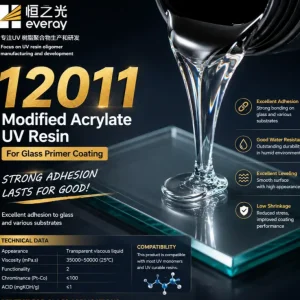
Browse our advanced functional oligomers designed for specialty glass primers, excimer laser applications, fast-curing offset inks, and soft-touch topcoats.
Comprehensive answers addressing chemical compatibility, resin selection criteria, formulation troubleshooting, and bulk procurement logistics.
