As global manufacturing imperatives pivot aggressively toward decarbonization, volatile organic compound (VOC) elimination, and high-throughput production efficiency, Polyurethane (PU) polymer technology is undergoing a transformative evolution. Modern industrial applications demand materials that combine chemical resilience with rapid processing cycles.
International environmental directives—including EU REACH, California CARB standards, and China's GB/T environmental codes—are forcing a global phase-out of traditional solvent-based polyurethane systems. Industrial formulators are migrating rapidly toward 100% solid UV-curable polyurethane acrylates (PUA) and zero-VOC waterborne polyurethane dispersions (PUDs).
These advanced polymer structures enable manufacturers to achieve instant crosslinking under UV/LED irradiation, drastically shortening line clearance times, reducing thermal energy footprints by up to 90%, and eliminating solvent recovery infrastructure overhead.
Modern engineering applications no longer tolerate trade-offs between flexibility and surface hardness. Next-generation polyurethane polymers are customized at the molecular backbone level to exhibit microphase separation—where hard segments provide mechanical abrasion and temperature resistance, while soft segments deliver elastomeric recovery and impact absorption.
From micro-electronics encapsulants exposed to thermal cycling (-40°C to +150°C) to additive manufacturing elastomeric resins for 3D printed footwear, synthesized polymers must maintain structural stability without phase degradation or hydrolytic cleavage.
The versatility of polyurethane polymers stems from the selective reaction of polyisocyanates with polyols. As a primary manufacturer, we control molecular weight distribution (MWD), acrylate functionality (ranging from mono-functional to hexafunctional), and backbone chemistry to deliver targeted performance characteristics.
| Polymer Category | Isocyanate / Backbone Base | Primary Technical Advantages | Key Industrial Applications |
|---|---|---|---|
| Aliphatic Urethane Acrylates (AUA) | Isophorone Diisocyanate (IPDI) / Hexamethylene Diisocyanate (HDI) | Exceptional non-yellowing, weatherability, UV stability, high elongation (up to 300%) | 3C Electronic coatings, outdoor automotive clearcoats, premium UV nail gels, optical films |
| Aromatic Urethane Acrylates (PUA) | Toluene Diisocyanate (TDI) / Methylene Diphenyl Diisocyanate (MDI) | Rapid cure speed, high tensile strength, excellent scratch resistance, cost efficiency | Industrial wood coatings, SPC resilient flooring sealers, flexographic printing inks, paper OPV |
| Waterborne Polyurethane Acrylates (WB-PUA) | Anionic / Non-ionic PUDs + Acrylate Functionalization | Zero-VOC dilution, low viscosity without active monomers, superior intercoat adhesion | Eco-friendly furniture sealers, synthetic leather finishing, waterborne UV 3D printing inks |
| Dual-Cure Polyurethane Resins | Isocyanate-functional acrylate prepolymers (UV + Moisture/Thermal) | Shadow-cure capability, deep-section crosslinking, zero unreacted residual monomers | Automotive camera/sensor encapsulation, 3D printed footwear midsoles, structural bonding |
| Hyperbranched Urethane Polymers | Dendritic multi-arm polyester/polyether polyols | Ultra-low viscosity, high reactivity, minimal cure shrinkage, high crosslink density | High-hardness anti-scratch hardcoats, barrier coatings, micro-molding formulations |
Selecting between aliphatic and aromatic structures is a critical total-cost-of-ownership decision. Aromatic PUAs leverage TDI/MDI rings to achieve high glass transition temperatures ($T_g$) at an economical cost point—ideal for interior substrates. Aliphatic AUAs utilize IPDI/HDI rings to eliminate chromophore formation, ensuring zero yellowing under solar radiation exposure over extended product lifespans.
Difunctional polyurethane acrylates impart flexibility and impact resistance due to low crosslink density. Conversely, hexafunctional oligomers yield dense, glass-like polymer networks providing surface pencil hardness up to 4H-5H, chemical resistance against methyl ethyl ketone (MEK) double rubs (>200 cycles), and superior stain barrier properties.
Formulators often face viscosity limitations. By controlling oligomer molecular weight and integrating modified acrylate monomers, we supply self-leveling polyurethane polymers that eliminate the need for excessive volatile thinners, maintaining 100% solid content without sacrificing coating flow or atomization performance in automated spray systems.
Operating out of our modern production base spanning over 40,000 m² in Yunfu, Guangdong, Guangdong Ever Ray Environmental Material Co., Ltd. embodies the synthesis of advanced chemical automation, raw material security, and strict quality control.
Our production facilities integrate automated Distributed Control Systems (DCS) and Programmable Logic Controllers (PLC) across 10+ synthesis lines. Every batch of polyurethane polymer undergoes real-time monitoring of exotherm curves, viscosity development, and free-isocyanate (-NCO) conversion rates via in-line FTIR spectrometry.
This automated rigor guarantees exceptional batch-to-batch consistency. Parameters such as color index (Gardner $\le 1$), acid value ($\le 2.0 \text{ mg KOH/g}$), and target viscosity profiles are tightly bounded, mitigating process variation for downstream formulators.
Situated in the Greater Bay Area chemical manufacturing corridor, we benefit from direct backward integration into primary raw materials including acrylic acid, polyols (PTMG, PPG, polyester polyols), and specialty diisocyanates. This proximity minimizes raw material supply chain disruptions and buffers global clients from severe pricing volatility.
With streamlined export logistics from Guangzhou and Shenzhen deep-water ports, we provide fully compliant dangerous goods (DG) containerized shipments, REACH pre-registrations, comprehensive SDS (GHS compliant), and certificates of analysis (COA) for international clearance.
Enterprise procurement managers and R&D directors evaluating global chemical suppliers require transparent total cost of ownership (TCO) models, absolute regulatory compliance, and scalable custom synthesis capabilities.
Relying on a single regional resin vendor exposes international manufacturers to supply chain choke points. By partnering with EVER RAY as a secondary or primary chemical supplier, global chemical blenders secure dual-sourcing resilience supported by large-scale warehouse reserves.
Off-the-shelf oligomers frequently fail specific customer test protocols. Our in-house synthesis laboratory offers custom molecular tuning—adjusting hydroxyl numbers, acrylate functionality, or monomer diluent blends to match specific curing lamp spectra (LED 365nm, 395nm, or Mercury lamps).
All polyurethane polymers are synthesized in compliance with modern environmental health and safety framework directives. We provide full documentation for RoHS, REACH SVHC compliance, Halogen-free verification, and low residual monomer certifications.
Polyurethane polymers serve as the structural backbone across diverse high-stress application environments. Below are technical breakdowns of how our targeted oligomer series solve distinct industrial engineering challenges.
Technical Requirement: High optical clarity, extreme scratch resistance (Pencil Hardness $\ge 3\text{H}$), superior thermal cycle resistance, and non-yellowing under intense sunlight.
Polymer Solution: Multi-functional Aliphatic Polyurethane Acrylates combined with Hyperbranched Acrylates. The aliphatic IPDI structure prevents light-induced yellowing ($\Delta YI < 0.5$ after 1000h QUV test), while high acrylate functionality creates a dense crosslinked barrier against artificial sweat, cosmetics, and daily friction.
Technical Requirement: Dual-curing mechanism, rapid green-state UV formation, high tensile rebound (>65%), ultra-low volumetric shrinkage (<1.5%), and fatigue endurance (>100,000 flex cycles).
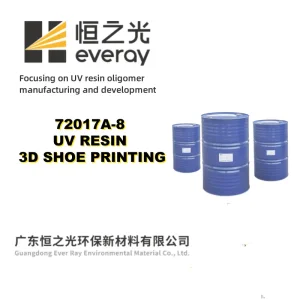
Polymer Solution: Specialized Dual-Curing Polyurethane Oligomers (such as Grade 72017A-8). These resins exhibit rapid photocuring under 405nm DLP/LCD light sources, followed by thermal or moisture secondary network completion to form tough, highly elastic polyurethanes ideal for midsoles, lattice structures, and industrial gaskets.
Technical Requirement: Extreme abrasion resistance (Taber Abrasion < 0.02g loss), stain resistance against household chemicals, stain barrier, and high coating speed applicability.
Polymer Solution: High-solids Aromatic & Modified Epoxy/Urethane Acrylate blends (e.g., Grade 1262B). Provides extreme surface toughness and rapid cure response under high-power mercury lamp lines running at speeds exceeding 40 m/min.
Technical Requirement: Low polymerization stress to prevent substrate warping, high lap shear strength (>12 MPa on metal/glass), optical transparency (>99%), and moisture resistance.
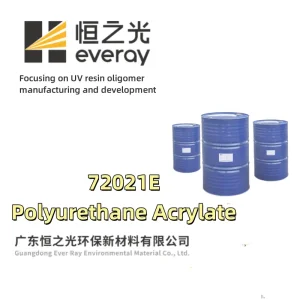
Polymer Solution: Pure Acrylate and Low-Shrinkage Polyurethane Acrylate Oligomers (such as Grade 72021E & 73008). Designed to maintain elastic energy absorption at the bond interface, preventing joint failure under mechanical vibration or thermal shock.
To satisfy technical due diligence for global chemical formulators, every drum of polyurethane polymer shipped from our Guangdong manufacturing plant undergoes comprehensive analytical verification against rigorous specification parameters.
Gel Permeation Chromatography (GPC) profiling ensures strict control over weight-average molecular weight ($M_w$), number-average molecular weight ($M_n$), and polydispersity index ($PDI$). Eliminating low-molecular-weight oligomer tails prevents surface tacky residues and guarantees consistent cure speeds.
Fourier-Transform Infrared Spectroscopy (FTIR) measures acrylic double bond density ($C=C$ conversion rate) and verifies the complete consumption of toxic free-isocyanate groups ($-NCO = 0\%$), protecting end-user safety and meeting strict cosmetic/packaging guidelines.
Cone-and-plate viscometry at controlled temperatures (25°C ± 0.1°C) determines shear response curves, confirming Newtonian or pseudoplastic flow behaviors required for automated roll coaters, spray nozzles, or 3D printer resin vats.
Direct technical answers for chemical engineers, R&D formulation specialists, and international procurement managers.
While Epoxy Acrylates provide high surface hardness, rapid cure kinetics, and low cost, they exhibit high brittleness, low elongation, and poor resistance to outdoor weathering/UV degradation. Polyurethane Acrylates incorporate urethane linkages ($-NH-COO-$) that yield high mechanical toughness, superior flexibility, impact absorption, and abrasion resistance. Furthermore, Aliphatic Polyurethane Acrylates provide complete non-yellowing weatherability, whereas Epoxy Acrylates yellow significantly under UV exposure.
Oxygen inhibition occurs when atmospheric oxygen quenches free radicals during surface photocuring, leading to surface tackiness. We mitigate this by synthesizing Amino Acrylate oligomers or active amine synergists into the polyurethane backbone. These tertiary amine groups react rapidly with peroxyl radicals to generate active alkylamino radicals, consuming dissolved oxygen and restoring sub-second surface cure velocity.
Yes. We routinely supply custom cut-grades tailored to client process specifications. Oligomers can be supplied as 100% pure polymers or pre-diluted in reactive monomers such as IBOA (Isobornyl Acrylate), TPGDA (Tripropylene Glycol Diacrylate), HDDA (1,6-Hexanediol Diacrylate), or TMPTA. Custom viscosity targets, glass transition temperatures ($T_g$), and color requirements are validated prior to bulk production.
We provide comprehensive technical dossiers for every evaluation request, including full Technical Data Sheets (TDS), safety documentation (GHS-compliant SDS), and batch-specific Certificates of Analysis (COA). Standard laboratory evaluation samples (100g to 1kg) are available for international air freight delivery upon technical review.
When stored in original sealed, light-proof containers at temperatures between 10°C and 30°C away from direct sunlight and heat sources, our polyurethane acrylate oligomers maintain a shelf life of 12 months. Resins should be kept away from peroxides, strong alkalis, and radical initiators to prevent premature polymerization.
Yes. Guangdong Ever Ray Environmental Material Co., Ltd. manufactures products in accordance with ISO 9001 and ISO 14001 standards. Our resins comply with EU REACH requirements, RoHS hazardous substance restrictions, contain no listed SVHCs (Substances of Very High Concern), and meet low-VOC/zero-halogen requirements for electronic applications.