Precision-synthesized acrylate oligomers and modified resins engineered to optimize crosslinking density, reduce volumetric shrinkage, and guarantee molecular adhesion across plastic, metal, density board, and paper substrates.
Understanding free-radical photopolymerization, resin surface energy optimization, and stress-mitigation mechanisms in modern UV curable primers.
Formulated with low-surface-tension modified acrylates (22–28 mN/m), ensuring complete thermodynamic wetting across low-energy plastic substrates like untreated PP, ABS, and PC without cratering or pinholes.
Utilizing hyperbranched polyester acrylates and ring-opening epoxy structures to suppress free-radical polymerization contraction from 12% down to <2.5%, preventing adhesion failure and micro-cracking.
Incorporating carboxyl, hydroxyl, and silane functional groups that establish covalent bonds with inorganic metals/glass and hydrogen bonds with organic polymer matrixes for superior cross-hatch adhesion (ASTM D3359 Class 5B).
| Resin Technology Class | Cure Speed (m/min) | Adhesion Strength | Yellowing Index (ΔYI) | Viscosity (mPa.s / 25°C) | Primary Substrate Focus |
|---|---|---|---|---|---|
| Bisphenol A Epoxy Acrylate | Fast (>40m/min) | High (Metal/Wood) | Medium (>3.5) | 15,000 – 45,000 | High-hardness wood primers, metal lacquers |
| Aliphatic Polyurethane Acrylate | Moderate (20-35m/min) | Extreme (PC/ABS/PET) | Ultra-Low (<0.5) | 2,000 – 12,000 | 3C Electronics, Automotive clearcoats, UV nail gel |
| Polyester Acrylate Oligomer | Ultra-Fast (>50m/min) | Moderate (Paper/Card) | Low (<1.8) | 500 – 3,500 | Flexographic inks, offset varnish, OPV paper primers |
| Special Functional Acrylate | Tailored (15-40m/min) | Covalent (Glass/Aluminum) | Low (<1.0) | 300 – 2,500 | Boiling water resistant glass, vacuum metallization |
How customized UV primers solve specific coating, line-speed, and durability bottlenecks across diverse global manufacturing ecosystems.
Modern vehicle cockpits demand high-scratch-resistant finishes over complex polyolefin alloys (TPO, PP-EPDM). Our low-temperature UV curing primers eliminate thermal deformation during IR flashing while providing pass-level performance for severe ISO 16750 climate thermal-shock cycling (-40°C to +105°C).
Smartphones, laptops, and wearable devices utilize PC+ABS blends and anodized aluminum frames. Applying aliphatic PUA primers like 7230E guarantees zero peel after 100 cycles of artificial sweat tests, RCA tape abrasion, and drop-impact stress testing without affecting delicate antenna cutouts.
Density board (MDF/HDF) porous surfaces adsorb conventional solvent coatings unevenly. High-solids UV primer resins (such as 1200A) offer rapid sealing, excellent sanding properties within seconds post-cure, and high build per roller coat, reducing production energy by up to 60%.
Cosmetic packaging and automotive trims rely on Physical Vapor Deposition (PVD). UV primers form an ultra-smooth, high-gloss base coat that levels micro-substrate defects. The cured primer resists thermal outgassing in vacuum chambers, ensuring pristine aluminum mirror deposition.
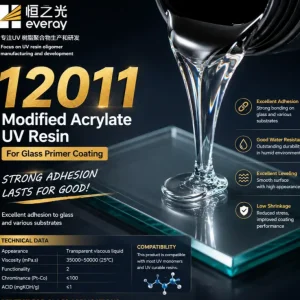
Hydrophilic glass surfaces typically cause standard UV coatings to strip under humid conditions. Utilizing silane-modified acrylate primers (such as 12011) provides direct bonding that survives 2-hour boiling water sterilization without blistering or gloss attenuation.
Flexible food packaging and paper board folding cartons require rapid inline curing on flexographic or offset presses operating at 300 m/min. Low-viscosity polyester acrylates provide near-instant free-radical conversions under 365nm/395nm LED-UV lamps with zero monomer odor migration.
Where photopolymer science is headed: Decarbonization, LED-UV wavelength tuning, bio-based feedstock integration, and waterborne UV dispersions.
Engineered oligomers optimized for monochromatic LED emission spectra. By incorporating built-in tertiary amine synergists and self-initiating acrylate backbones, surface oxygen inhibition is mitigated without relying on high-intensity mercury UVC lamps.
Integrating modified plant-oil polyols, modified rosin esters, and bio-succinic acid into polyurethane acrylate backbones, achieving bio-carbon fractions up to 45% while preserving extreme mechanical scratch resistance.
Combining the zero-VOC benefits of waterborne coatings with the instantaneous cure of photopolymerization. Ideal for heat-sensitive wood veneers, genuine leather finishing, and flexible plastic films.
How Guangdong Ever Ray leverages full chemical process integration to guarantee batch-to-batch consistency and competitive direct-factory pricing.
Unlike simple blending facilities, our Yunfu manufacturing base synthesizes base polyols, esterifies specialty acrylate monomers, and functionalizes polyisocyanates in-house. This vertical integration isolates global formulators from raw material price spikes while enabling precise structural design from the molecular level up.
Equipped with over 10 automated stainless-steel synthesis reactors ranging from 5 to 30 tons. Every production batch undergoes rigorous quality assurance checking using Gel Permeation Chromatography (GPC), Gas Chromatography-Mass Spectrometry (GC-MS), rotational viscometers, and differential scanning calorimetry (DSC) to ensure viscosity delta stays within ±5%.
Navigating international chemical regulations seamlessly with comprehensive documentation and localized technical engineering.
Fully pre-registered and registered under EU REACH regulations. Free from Substances of Very High Concern (SVHC) and hazardous photoinitiator remnants like TPO or Benzophenone.
All products conform to US EPA TSCA regulations. Globally Harmonized System (GHS) compliant Safety Data Sheets (SDS) provided in over 15 local languages.
Formulated specifically to meet electronic industry standards (IEC 61249-2-21), ensuring zero heavy metals or halogen compounds in sensitive circuit-board coatings.
Explore our targeted acrylate solutions formulated for specialized adhesion performance, wrinkle texturing, low-shrinkage nail gels, and high-temperature resistance.
Detailed technical answers to common engineering questions regarding UV primer selection, adhesion optimization, and curing troubleshooting.