Factory-direct liquid epoxy formulations engineered for superior double-bond conversion, structural adhesion, and extreme chemical durability across global manufacturing lines.
In the rapidly evolving landscape of advanced industrial chemistry, liquid epoxy resins and their acrylic-modified derivatives (epoxy acrylates) represent the foundation of modern protective coatings, structural adhesives, electronic encapsulants, and photo-curable imaging materials. As global industries pivot toward solvent-free formulations, ultra-fast radiation curing, and high-durability surfaces, sourcing high-purity liquid epoxy systems directly from specialized chemical manufacturers has become a strategic priority for commercial formulators and procurement directors worldwide.
At its fundamental molecular level, liquid epoxy resin—predominantly synthesized through the condensation reaction of Bisphenol A (or Bisphenol F) with Epichlorohydrin in the presence of a basic catalyst—possesses a dense network of oxirane (epoxide) rings. These three-membered cyclic ethers exhibit remarkable thermodynamic reactivity. When crosslinked with amine hardeners, acid anhydrides, or catalytic initiators, liquid epoxy transforms into a highly crosslinked, thermosetting polymer matrix characterized by exceptional tensile strength, chemical resistance, minimal shrinkage, and superior substrate adhesion.
Furthermore, through the esterification of liquid epoxy resins with acrylic acid, chemical engineers produce Epoxy Acrylate Oligomers. This hybrid synthesis bridges the structural rigidity, heat resistance, and adhesion of classic epoxy chemistry with the instantaneous free-radical polymerizability of acrylic esters under Ultraviolet (UV) or Electron Beam (EB) radiation. The result is a high-viscosity liquid oligomer capable of curing within fractions of a second upon exposure to specific UV wavelengths, forming ultratough, glossy, and scratch-resistant films.
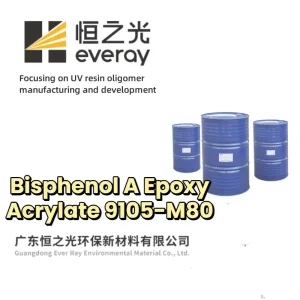
Formulators frequently face trade-offs between viscosity, flexibility, and chemical resistance. Standard Bisphenol A Liquid Epoxy Acrylate (such as Model 9105M-80) delivers maximum pencil hardness (up to 4H-5H) and solvent resistance due to its rigid aromatic backbone. However, its high natural viscosity requires reactive diluents. In contrast, Modified Epoxy Acrylates incorporate aliphatic chains or polyether linkages into the backbone, significantly lowering viscosity (e.g., Grade 6300), reducing ester polymerization shrinkage, and eliminating surface brittleness without compromising cure speed.
The global demand for liquid epoxy resin and UV-curable acrylate oligomers is undergoing a structural expansion driven by environmental mandates, industrial automation, and advanced electronics manufacturing. According to recent industrial chemical market analyses, the market for liquid epoxy resins is projected to exceed $12 Billion USD by 2030, while the radiation-curable resin sector maintains a compound annual growth rate (CAGR) exceeding 6.8%.
Accounting for over 55% of global liquid epoxy consumption, the APAC region—led by China's advanced chemical clusters—serves as both the primary manufacturing powerhouse and the largest consumer of industrial coatings, consumer electronics, and green energy infrastructure.
Rigid VOC regulations across Europe (REACH) and North America (EPA Clean Air Act) are accelerating the phase-out of traditional solvent-based epoxies in favor of 100% solids UV-curable liquid epoxies and waterborne polyurethane acrylates.
The rapid proliferation of 5G infrastructure, electric vehicles (EV battery potting, lightweight composites), and additive manufacturing (SLA/DLP 3D printing) requires highly specialized epoxy liquids with engineered dielectric properties and low shrinkage.
Next-generation synthetic routes designed to eliminate oxygen inhibition, enhance outdoor yellowing resistance, and establish sustainable bio-based monomer structures.
| Chemical Category | Core Structural Formula / Modification | Primary Technical Advantage | Key Industrial Applications |
|---|---|---|---|
| Bisphenol A Epoxy Acrylate | Standard Epoxy Backbone + Acrylic Acid Functionalization | Maximum hardness, fastest cure speed, superior gloss and chemical barrier | Overprint Varnishes (OPV), Wood Fillers, Metal Primers, PCB Solder Masks |
| Modified Epoxy Acrylate | Polyether / Polyol Flexible Chain Insertion | Reduced curing shrinkage, improved flexibility, lower viscosity without diluents | Flexible Packaging Inks, Paper Coatings, Electronics Potting Varnishes |
| Aliphatic Urethane Acrylate | Isophorone Diisocyanate (IPDI) / H12MDI Backbone | Zero yellowing, extreme outdoor weatherability, high elongation and impact toughness | 3C Electronics Topcoats, Automotive Interior Trim, Outdoor Protective Films |
| Aromatic Urethane Acrylate | TDI / MDI Isocyanate Derivative | Cost-effective toughness, excellent abrasion resistance, high tensile strength | Industrial Flooring Sealers, Wood Coatings, High-Wear Plastic Coatings |
| Hyperbranched Acrylate | 3D Dendritic Multi-Functional Structure | Ultra-low viscosity with high acrylamide functionality, rapid surface crosslinking | High-Speed UV Inkjet, Scratch-Resistant Clearcoats, 3D Resin Additives |
Our chemical R&D laboratories in Guangdong are currently pioneering three core technological breakthroughs within the epoxy liquid domain:
In major electronic manufacturing hubs (Dongguan, Shenzhen, Vietnam, Penang), high-purity liquid epoxy acrylates blended with aliphatic polyurethane acrylates are applied to polycarbonate (PC), ABS, and PMMA smartphone and laptop casings. These coatings provide stain resistance, sweat repellency, and drop protection.
In European and North American commercial packaging plants, low-viscosity polyester acrylates and modified epoxy oligomers (e.g., Models 5335F, 5377A) serve as vehicle resins for UV offset inks. They offer optimal pigment wetting, excellent water-ink balance, and rapid curing under LED-UV curing lamps.
For luxury vinyl tile (LVT), stone plastic composite (SPC) flooring, and solid wood furniture produced across Southeast Asia and the US, bisphenol A epoxy acrylate coatings form high-build sanding sealers and topcoats that resist hot coffee stains, shoe heel scuffs, and cleaning chemicals.
Industrial SLA, DLP, and LCD 3D printing equipment utilizes modified dual-cure epoxy acrylates and elastic oligomers (e.g., Model 72017A-8) to produce elastomeric footwear midsoles, snap-fit prototypes, and dental aligner models featuring dimensional precision and tear strength.
Cosmetic packaging and automotive lighting reflectors require bright chrome-like finishes. Specialized aromatic PA UV resins (e.g., Model 7113A) provide mirror-like leveling, inter-layer adhesion between plastic substrates and evaporated aluminum, and heat resistance during vacuum deposition.
Fast-curing yellowing-resistant epoxy acrylates (e.g., Model 61003A) are dispensed into LED drivers, automotive sensors, and relay switches, offering rapid gelation times, thermal shock isolation, and moisture resistance up to IP68 standards.
As global supply chains navigate raw material volatility and geopolitical shifts, our primary production facility in Yunfu, Guangdong—spanning over 40,000 square meters—demonstrates the competitive advantages of China's integrated chemical supply chain ecosystem. Direct access to upstream PetroChina and Sinopec basic raw materials (such as phenol, acetone, and acrylic acid) ensures uninterrupted bulk production and price stability for our international partners.
Equipped with 10+ stainless-steel automated synthesis lines with capacities ranging from 5 to 30 metric tons per batch, utilizing DCS computer-controlled temperature and pressure profiling to guarantee consistent molecular weight distribution.
Every batch undergoes testing via Gel Permeation Chromatography (GPC), Gas Chromatography-Mass Spectrometry (GC-MS), Brookfield viscometers, and colorimeters to enforce strict COA specifications prior to release.
Proximity to Nansha and Shekou deep-water ports enables rapid containerized shipping (200kg steel drums, 1000kg IBC totes, or ISO tanks) with full Dangerous Goods (DG) compliance documentation and international customs clearance support.
Navigating global regulatory frameworks is critical for industrial formulators introducing new resin grades. As a direct chemical manufacturer, Guangdong Ever Ray Environmental Material Co., Ltd. ensures that all liquid epoxies and acrylate oligomers satisfy stringent international safety and environmental directives.
Our export grades conform to EU REACH regulations, maintaining Substance of Very High Concern (SVHC) levels below 0.1% w/w, enabling seamless importation into European Union member states.
Formulations intended for consumer electronics and automotive PCB potting are certified free of heavy metals (Pb, Cd, Hg, Cr VI) and restricted halogenated flame retardants in compliance with RoHS Directive 2011/65/EU.
Our application engineering team collaborates directly with customer R&D personnel to tailor resin viscosity, refractive index, pigment wetting performance, and cure speeds to meet precise production parameters.
Explore our range of UV oligomers engineered for vacuum metallization, paper varnishes, 3D footwear photopolymers, and outdoor pressure-sensitive adhesives.
Expert insights addressing common engineering, formulation, and procurement questions regarding wholesale liquid epoxies and UV-curable oligomers.
Standard Bisphenol A Epoxy Acrylate (such as Grade 9105M-80) is synthesized by reacting liquid bisphenol A epoxy resin directly with acrylic acid. It delivers maximum surface hardness, scratch resistance, chemical barrier performance, and rapid UV response. However, its high natural viscosity requires significant reactive monomer dilution, and cured films can be brittle. Modified Epoxy Acrylates (such as Grade 6300 or 61003A) incorporate flexibilizing polyether or polyester chains into the backbone, lowering viscosity, reducing polymerization shrinkage stress, improving adhesion to difficult plastics, and maintaining impact toughness.
Atmospheric oxygen reacts rapidly with free radicals generated during UV irradiation, forming inactive peroxy radicals and leaving a tacky or uncured surface film. Formulators can resolve oxygen inhibition by: (1) Incorporating Amino Acrylate Oligomers or Active Amine Synergists, which undergo rapid hydrogen abstraction to consume oxygen; (2) Blending high-functionality Hyperbranched Acrylates to increase surface double-bond crosslinking density; (3) Curing under an inert Nitrogen ($N_2$) blanket; or (4) Using higher-intensity LED-UV lamps operating at 365nm / 395nm wavelengths.
For applications exposed to direct sunlight, UV weatherability is paramount. Standard epoxy acrylates and aromatic polyurethane acrylates contain benzene rings that absorb solar UV radiation, leading to photo-oxidation and yellowing over time. Formulators should specify Aliphatic Polyurethane Acrylates (such as Model 72027 or IPDI/H12MDI-based resins), which possess cycloaliphatic or linear aliphatic backbones completely free of aromatic structures, providing zero yellowing, thermal stability, and multi-year outdoor durability.
As an integrated manufacturer with extensive chemical synthesis capabilities, Ever Ray offers custom resin modifications including: adjusting oligomer molecular weight distributions to match viscosity targets (from 500 mPa.s to over 100,000 mPa.s at 25°C); tailoring acrylate functionality from mono-functional to hexafunctional structures; diluting high-viscosity resins in specific reactive monomers (TMPTA, TPGDA, HDDA, or IBOA); and modifying refractive indices or dielectric constants for electronic encapsulants.
All UV-curable liquid epoxy acrylates and oligomers are sensitive to ambient heat and actinic light. Products are packaged in dark lined steel drums (200kg) or opaque black HDPE IBC totes (1000kg). Storage must be maintained in a cool, dry, well-ventilated warehouse at temperatures between 10°C and 25°C, isolated from direct sunlight, open flames, and strong oxidizing agents. Under recommended storage conditions, unopened factory drums maintain a shelf life of 12 months from the manufacturing date.
Procurement directors and R&D managers can contact our global sales department directly via email or WhatsApp. We provide 1kg to 5kg lab evaluation samples packaged in light-shielded containers, accompanied by comprehensive Technical Data Sheets (TDS), Safety Data Sheets (SDS) in accordance with GHS standards, and batch-specific Certificates of Analysis (COA). Technical support engineers are available to assist with formulation guidelines and curing equipment optimization.
