A comprehensive examination of interface chemistry, hydrolytic stability, and polymer structure optimization for inorganic glass substrates.
Glass substrates present unique challenges due to their smooth, non-porous inorganic nature and hydrophilic surface silanol (Si-OH) group concentration. Formulating a reliable wholesale glass adhesion UV oligomer requires chemical architectures capable of forming dual covalent and hydrogen bonding networks across the resin-substrate threshold.
Traditional acrylate photo-polymerization exhibits volumetric shrinkage ranging from 5% to 15%. This creates severe internal shear stresses at the rigid glass boundary. Our specialized polyurethane acrylate (PUA) and modified epoxy acrylate oligomers incorporate flexible soft segments and hyperbranched structures that dramatically lower internal crosslinking stress.
Water molecule intrusion at the organic-inorganic interface is the leading cause of adhesion failure in glass coatings and adhesives. Advanced chemical modification with hydrophobic backbone segments ensures passing critical industrial testing, including 4-hour boiling water immersion and 500-hour damp-heat (60°C/90% RH) aging without delamination.
The global market for UV-curable glass coatings, inks, and structural adhesives is undergoing a rapid transition driven by modern industrial automation, stringent environmental mandates, and the miniaturization of electronic devices. As global formulators replace solvent-borne systems with high-speed UV radiation curing, the demand for primary oligomers engineered specifically for glass substrates has escalated significantly.
Global manufacturing lines are rapidly replacing traditional mercury lamps with energy-efficient LED-UV curing systems (365nm, 385nm, 395nm, 405nm). This shift demands UV oligomers with heightened photo-reactivity and lower oxygen inhibition sensitivities, enabling rapid surface and deep-layer curing under narrower spectral outputs.
Regulatory frameworks such as EU REACH, TSCA in the United States, and China's GB standards on volatile organic compounds (VOCs) are driving formulators toward waterborne UV polyurethane dispersions (PUDs) and solvent-free monomer formulations, particularly in architectural interior and consumer container glass applications.
The booming demand for touch panels, smart architectural glass, automotive HUD screens, and wearable displays requires Liquid Optical Clear Adhesives (LOCA) and screen-printing primers with high optical transparency (transmittance >99%), non-yellowing aliphatic backbones, and exceptional thermal shock resistance.
| Oligomer Chemical Class | Initial Adhesion (0B-5B) | Boiling Water Resistance | Yellowing Resistance | Tensile / Flexibility Balance | Primary Target Application |
|---|---|---|---|---|---|
| Aliphatic Polyurethane Acrylate (e.g., PUA 7291B) | 5B (Excellent) | Passes 4h @ 100°C | Grade 0-1 (Non-Yellowing) | High Toughness & Flexibility | Optical Displays, Screen Glass, Mobile 3C Housings |
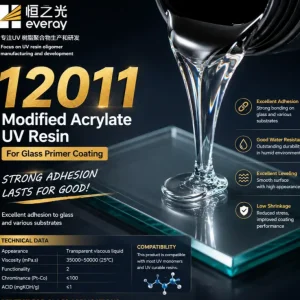
| Modified Epoxy Acrylate (e.g., Resin 12011) | 5B (Superior) | Passes 2h-4h Boiling Test | Grade 2 (Slight Yellowing) | High Hardness & Chemical Resistance | Glass Primer Coatings, Wine Bottle Decor, Mirrors |
| Bisphenol A Epoxy Acrylate (e.g., 9105M-80) | 4B - 5B | Moderate (Requires Silane) | Grade 3-4 (Standard) | High Rigidity & Gloss | Industrial Overprint Varnishes, Flat Glass Inks |
| Polyester Acrylate Solution (e.g., 5332F / 5501) | 3B - 4B | Standard | Grade 2-3 | Excellent Pigment Wetting | UV Glass Screen Printing & Offset Inks |
When procurement directors and senior R&D formulation chemists evaluate wholesale glass adhesion UV oligomers, the focus extends beyond simple cost per kilogram. B2B buyer intent prioritizes total formulation economics, processing window robustness, batch-to-batch chemical stability, and global regulatory compliance.
Rather than relying solely on post-addition liquid silane coupling agents—which can suffer from limited pot-life and hydrolytic degradation—our factory synthesizes custom oligomers with built-in alkoxy-silane functional moieties. This ensures permanent covalent anchoring to silica networks upon light activation.
Glass coating lines utilize automated spray coating, roller coating, or screen printing setups. B2B buyers require tailored viscosity profiles (ranging from 1,500 mPa.s for spraying to over 50,000 mPa.s for screen inks) that maintain Newtonian or thixotropic stability across changing ambient cleanroom temperatures.
A variation of ±5% in oligomer molecular weight distribution or double-bond conversion reactivity can disrupt industrial manufacturing lines. Comprehensive Quality Assurance (QA) protocols track acid value, free monomer residue, color index (APHA < 50), and gel times for every export batch.
As a premier China-based UV resin and acrylate oligomer manufacturing enterprise established in 2006, our modern production infrastructure integrates Industry 4.0 smart factory concepts to solve global chemical supply chain vulnerabilities. Operating a fully licensed chemical synthesis plant spanning over 40,000 square meters in Guangdong, China, we offer international formulators seamless raw material supply security.
Equipped with 10+ state-of-the-art Distributed Control System (DCS) automated synthesis reactors, our facility eliminates human batching errors. Precise automated control over temperature ramps, esterification feed rates, and vacuum stripping guarantees exceptional oligomer purity and narrow molecular weight distribution.
Located in the heart of South China's chemical cluster, our factory maintains direct strategic partnerships for core building blocks including acrylic acid, epoxy resins, isocyanates (IPDI, HDI, TDI), and polyols. This backward integration insulates international buyers from global raw material price volatility.
We provide full documentation suites including GHS-compliant Safety Data Sheets (SDS), Technical Data Sheets (TDS), Certificates of Analysis (COA), and REACH pre-registrations for Europe. Customized export packaging (200kg steel drums, 1000kg IBC totes) ensures safe transit across international shipping routes.
Used in high-speed optical assembly lines for mobile phones, tablets, and automotive touch panel displays. UV resins incorporating PUA 7291B deliver non-yellowing optical clarity, scratch resistance, and exceptional adhesion to Gorilla Glass® and PMMA/PC films.
High-end spirits, cosmetics, and perfume bottles demand vibrant, metallic, or matte screen-printed coatings. Formulations leveraging modified epoxy acrylates (12011) achieve rapid UV curing, alcohol resistance, and complete boiling water washability resistance during pasteurization.
Large-format glass backsplashes, mirror coatings, and laminated automotive glass panels require long-term thermal expansion tolerance. UV oligomers engineered with low volumetric shrinkage eliminate edge-flaking and long-term delamination under outdoor UV exposure.
Expert insights addressing key chemical, formulation, and procurement questions regarding glass adhesion UV curable resins.
Glass surfaces are highly hydrophilic and covered with surface silanol (Si-OH) groups that naturally adsorb atmospheric moisture. Standard acrylate resins rely only on weak van der Waals forces. When exposed to humidity or boiling water, moisture penetrates the organic-inorganic boundary, displacing the resin film. Specialized glass adhesion UV oligomers (such as Model 12011) utilize dual covalent coupling mechanisms and hydrophobic polymer backbones that resist hydrolytic cleavage.
During UV free-radical polymerization, liquid monomer molecules convert into dense covalent polymer chains, causing volumetric shrinkage (typically 5%–12%). Because rigid inorganic glass cannot deform to relieve this stress, high shear forces develop at the interface, causing spontaneous peeling or poor cross-hatch tape test results. We minimize shrinkage by synthesizing hyperbranched, high-molecular-weight polyurethane acrylates (e.g., PUA 7291B) and incorporating mono-functional or ring-opening reactive diluents.
Direct addition of small-molecule silanes (like gamma-glycidoxypropyltrimethoxysilane) into a UV formulation can improve initial adhesion, but often leads to poor pot-life, liquid phase separation, and inconsistent performance as the silane hydrolyzes in the liquid drum. A silane-modified UV oligomer features covalently pre-bound silane functionality integrated directly onto the polymer backbone, ensuring uniform dispersion, long storage stability, and consistent industrial performance.
Yes. All of our flagship glass adhesion oligomers—including PUA 7291B, 12011, and 67283—are optimized for high surface and depth reactivity under LED-UV curing wavelengths (365nm, 385nm, 395nm, 405nm) as well as traditional medium-pressure mercury vapor lamps.
We recommend a standard three-stage evaluation: 1) Cross-Hatch Adhesion (ASTM D3359) immediately after curing and after 24 hours of room-temperature relaxation. 2) Boiling Water Test involving continuous immersion in boiling water (100°C) for 2 to 4 hours, followed by immediate cross-hatch testing. 3) Chemical Resistance Test consisting of 100+ MEK or IPA double rubs under a 1kg force weight.
As a direct factory manufacturer, we offer flexible bulk packaging options including 20kg plastic drums, 200kg steel drums, and 1000kg IBC totes. We support worldwide LCL and FCL shipping with complete export regulatory compliance (REACH, TSCA, SDS, COA).