Engineered Industrial Oligomers, Technical Whitepaper Guidance, and Direct OEM Chemical Supply Chain Solutions for UV/EB Curable Systems.
Select from our laboratory-tested acrylate resins engineered for maximum ink wettability, substrate adhesion, low shrinkage, and high surface fullness.
In contemporary chemical manufacturing, polyester acrylates and unsaturated polyester resins (UPR) serve as foundational polymer backbones across global industrial markets. As industrial sectors transition rapidly away from high-VOC solvent-borne coatings toward energy-efficient, rapid-cure radiation polymerization (UV/EB), polyester acrylate oligomers have emerged as pivotal materials for high-throughput automated conversion lines.
The global market for UV-curable polyester acrylates is expanding at a Compound Annual Growth Rate (CAGR) exceeding 6.8% annually, driven by expanding demands in Asia-Pacific packaging hubs, North American automotive OEM refinishing, European eco-compliant wood furniture lines, and global electronics packaging. Unlike traditional saturated polyesters that rely on thermal solvent evaporation, radiation-curable polyester acrylate oligomers undergo near-instantaneous free-radical crosslinking upon exposure to ultraviolet light or electron beams. This transformation yields zero-VOC, solvent-free cured networks exhibiting exceptional chemical stability, scratch resistance, and optical clarity.
Enterprise chemical purchasers must distinguish between commodity unsaturated polyesters and ultra-pure, multi-functional polyester acrylate oligomers. Modern industrial applications demand precise control over molecular weight distribution ($M_w/M_n$), esterification degree, hydroxyl value, and double-bond conversion rates. From high-speed offset printing presses operating at 500 meters per minute to delicate consumer electronics coatings requiring anti-yellowing and thermal cycle stability, polyester acrylates provide the essential balance of wetting, viscosity adjustment, and mechanical flexibility.
Polyester acrylate oligomers are synthesized via the esterification of polyols (such as ethylene glycol, neopentyl glycol, or trimethylolpropane) with polybasic acids (such as phthalic anhydride, adipic acid, or isophthalic acid), followed by end-capping with acrylic acid. By modulating the monomer ratios and functionality (ranging from tetra-functional to hexa-functional polyesters), chemical formulators can tailor specific physical characteristics:
Polyester acrylates are recognized in offset and flexographic ink chemistry for their unmatched ester backbone polarity. This structure significantly reduces surface tension, enabling rapid dispersion of organic and inorganic pigments (e.g., Carbon Black, Phthalocyanine Blue) without requiring excessive polymeric dispersants.
| Oligomer Type | Cure Speed | Pigment Wetting | Tensile / Hardness | Flexibility & Elongation | Cost-Efficiency Ratio |
|---|---|---|---|---|---|
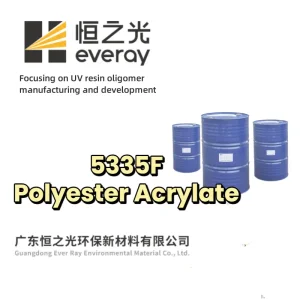
| Polyester Acrylate (e.g., 5320, 5335F) | High to Very High | Industry Leader (5/5) | Moderate to High | Balanced to High | Optimal / High Efficiency |
| Bisphenol A Epoxy Acrylate (e.g., 9104, 9105A) | Maximum | Moderate | Very High (Pencil 3H-5H) | Low / Rigid | Maximum Economy |
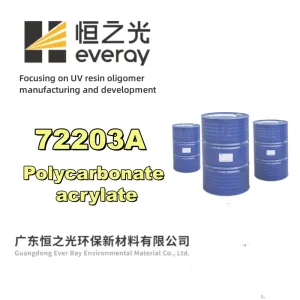
| Aliphatic Urethane Acrylate (e.g., 72203A) | Moderate to High | Good | High (Non-Yellowing) | Superior Elasticity | Premium Grade |
| Aromatic Urethane Acrylate (e.g., 7911) | High | Good | High Toughness | Good Impact Resistance | Balanced Industrial |
How direct OEM chemical manufacturing lowers procurement costs while enforcing stringent global ISO quality standards.
Situated in Guangdong's premier chemical industrial zone (Jiangmen R&D headquarters and Yunfu 40,000+ m² production base), EVER RAY leverages direct raw material integration (phthalic anhydride, acrylic acid, polyols). This eliminates multi-tier distribution markups and guarantees uninterrupted bulk supply.
Every production batch undergoes strict analytical verification: Gel Permeation Chromatography (GPC) for molecular weight control, Brookfield viscosity tolerance within ±5%, acid value verification (< 2 mg KOH/g), and color index matching ($ΔE < 0.2$), guaranteeing smooth transition between supply cycles.
Backbone modifications (hyperbranched polyesters, amine-modified acrylics, waterborne dispersions) are custom-engineered by our PhD chemical engineering team within 7 to 14 days, offering tailored viscosity, refractive index, or adhesion properties for specific application lines.
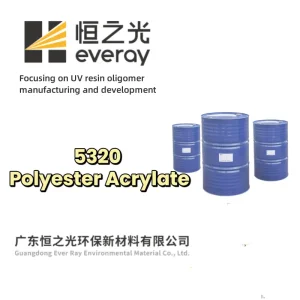
In paperboard packaging and commercial publishing, polyester acrylates such as 5320 and 5335F provide crucial pigment wetting. Their low viscosity reduction curve ensures high ink transfers without emulsification under intense fountain solution conditions.
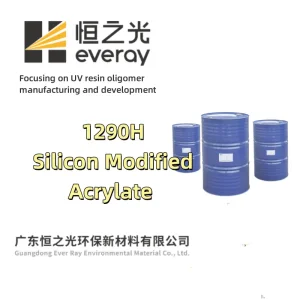
In luxury vinyl tile (LVT), SPC stone flooring, and solid wood coating lines, low-shrinkage oligomers like 1290H prevent micro-cracking and edge curl while providing surface hardness, abrasion resistance, and stain protection against household solvents.
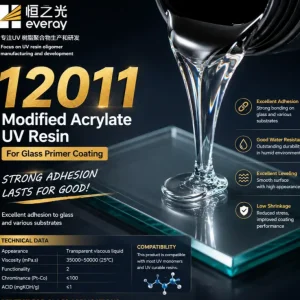
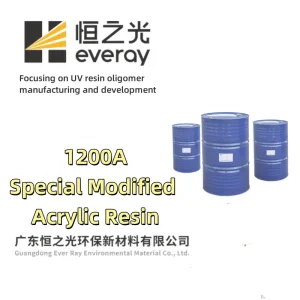
Non-porous inorganic substrates represent major adhesion challenges. Specialized resins like 12011 and 1200A integrate functional carboxylic or phosphate groups to bond directly with glass and aluminum, maintaining adhesion during boiling water immersion tests.
Consumer mobile devices, automotive interior trim, and wearable electronics utilize polycarbonate acrylates (e.g., 72203A) to create haptic soft-touch coatings that resist skin oils, cosmetic chemicals, and repeated abrasion cycles.
Engineering-grade 3D resins require low volumetric shrinkage, fast laser or LCD exposure response, and elevated heat deflection temperatures (HDT). Specialty grades like 71209A-1 provide ABS-like impact strength and dimensional tolerance.
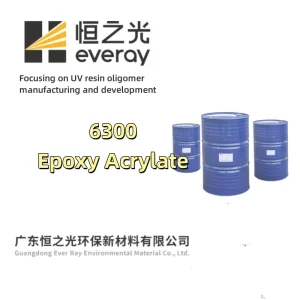
High-solids inline packaging varnishes utilize modified epoxy and polyester acrylates (e.g., 6300, 5650F) to deliver gloss values exceeding 90+ GU (at 60° angle), rapid yellowing-free UV cure, and low residual odor for folding cartons.
As international regulatory frameworks enforce stringent limits on volatile organic compounds, hazardous air pollutants (HAPs), and photoinitiator migration limits (such as Nestlé Guidance and EU food contact regulations), the UV curable resin industry is experiencing key technical shifts:
Synthesizing polyester backbones utilizing bio-based succinic acid, 1,3-propanediol, and plant-derived polyols to achieve carbon-neutral chemical footprints without sacrificing mechanical durability or cure speed.
Combining the low-viscosity application profiles of waterborne coatings with instantaneous UV crosslinking. These zero-VOC systems eliminate monomeric diluent skin irritation concerns for sensitive wood and leather finishing applications.
Engineering hyper-reactive oligomer chains optimized for monochromatic LED curing lamps. These resins overcome surface oxygen inhibition at lower light intensities, significantly lowering energy consumption across production lines.
When qualifying a new wholesale polyester acrylate supplier, global procurement directors and technical directors should follow a standardized four-stage evaluation methodology to ensure complete process compatibility:
Inspect Technical Data Sheets (TDS) for target viscosity (mPa.s at 25°C), functionality (acrylate groups per molecule), density, color (Gardner scale), and Tg (glass transition temperature).
Test 1kg evaluation samples for diluent solubility (HDDA, TPGDA, TMPTA), photoinitiator response (TPO, 184), shelf-life stability at 60°C for 14 days, and substrate wetting angle.
Conduct line trials assessing double-bond conversion, MEK rub resistance (> 200 cycles), cross-hatch tape adhesion (ASTM D3359 5B), surface hardness, and anti-yellowing index.
Obtain Safety Data Sheets (SDS per GHS format), REACH registration certificates, RoHS/RoHS3 compliance documentation, and drum packaging safety inspection reports.
Explore targeted resin formulations for high-heat anti-yellowing, electronic encapsulation, and specialized industrial coatings.