Explore our core industrial-grade modified epoxy acrylates, active diluents, and dual-curing oligomers engineered for extreme durability, fast radiation curing, and optical clarity.
The global market for high-clarity transparent epoxy resins and radiation-curable acrylate oligomers is experiencing an unprecedented structural shift. Driven by stringent international environmental mandates (such as EU REACH, US EPA Rule 1191, and Asia-Pacific Zero-VOC regulations) alongside technological leaps in high-speed manufacturing, formulators are rapidly transitioning away from conventional solvent-borne thermocuring systems to photocurable, 100% solid-content epoxy acrylates and modified polyurethane oligomers.
Transparent epoxy resins have evolved from simple two-component potting compounds into ultra-specialized, highly reactive molecular matrices. Modern industrial applications demand rapid photo-polymerization within milliseconds under UV-LED spectra (365nm to 395nm), minimal yellowing index ($\Delta E < 1.0$ post-QUV testing), high optical transparency (>92% visible light transmittance), and tuned crosslink density to balance pencil hardness ($3H - 6H$) with mechanical flexibility.
Global manufacturers are phasing out mercury vapor lamps in favor of energy-efficient UV-LED curing lines. This requires epoxy resins and acrylate oligomers engineered with enhanced surface-cure reactivity, mitigating oxygen inhibition without compromising thermal stability.
For electronic displays, optical clear adhesives (OCA), 3C housing finishes, and high-end wood coatings, yellowing under solar UV exposure is non-negotiable. Aliphatic modification of bisphenol-A structures and hydrogen-bonded urethane linkage engineering now guarantee pristine optical clarity.
SLA, DLP, and LCD 3D printing technologies require photopolymers with extremely low volume shrinkage (<1.5%), tailored viscosity (100–500 mPa.s), and dual-curing mechanics (free-radical + thermal/cationic) to deliver elastomeric footwear midsoles and rigid engineering prototypes.
Understanding the mechanical and optical trade-offs between standard bisphenol-A epoxy resins, modified epoxy acrylates, and aliphatic urethane acrylates is critical for enterprise R&D formulators:
| Resin Chemistry Class | Cure Mechanism | Pencil Hardness | Yellowing Resistance ($\Delta E$) | Substrate Adhesion | Primary Industrial Use Case |
|---|---|---|---|---|---|
| Bisphenol-A Epoxy Acrylate (e.g., Grade 9105A-80) | Free-Radical UV ($300-400 mJ/cm^2$) | 4H – 6H | Moderate ($\Delta E \approx 2.5 - 4.0$) | Metal, Glass, Rigid Plastics | Paper OPV, Wood Primers, High-Speed Inks |
| Modified Epoxy Acrylate (e.g., Grade 6805A-1 / 6106) | Fast-Cure Radical ($150-250 mJ/cm^2$) | 3H – 5H | High ($\Delta E < 1.5$) | PVC, ABS, PC, Treated PET | High-Gloss UV Varnish, Vacuum Plating Finishes |
| Aliphatic Urethane Acrylate (e.g., Grade 7296-1) | UV-LED / Electron Beam | 2H – 4H | Ultra-High ($\Delta E < 0.5$) | PMMA, Glass, TPU, Leather | 3C Consumer Electronics, Optical Adhesives, Automotive Coatings |
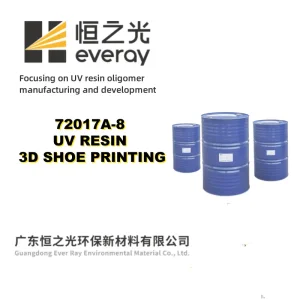
| Dual-Curing Functional System (e.g., Grade 72017A-8) | UV Light + Thermal / Moisture | Shore 60A – 85D | Excellent ($\Delta E < 1.0$) | Multi-Substrate Composite Bond | 3D Printed Footwear, Industrial Rubber Replacement, Micro-Electronics |
When global chemical distributors, paint manufacturers, and industrial OEMs source wholesale transparent epoxy resins and acrylate oligomers, procurement decisions extend far beyond basic pricing per kilogram. Quality control parameters must align with rigorous ASTM, ISO, and DIN international test standards to guarantee line efficiency and zero end-product field failures.
Lot-to-lot viscosity tolerance ($\pm 5\%$ Brookfield at $25^\circ C$) is essential for automated spray, roller, and flexographic printing equipment. Formulators require stable shear-thinning indices to avoid sag or uneven levelling.
High acrylate double-bond conversion (>88% via FT-IR spectroscopy) guarantees fast crosslinking, minimizing unreacted residual monomers that cause odor, skin irritation, or outgassing in electronic assemblies.
For optical clear varnishes, 3D resins, and clear coats, procurement specifications mandate APHA values below 30 or Gardner color index below 0.5 to prevent discoloration on white or transparent substrates.
Light-shielded, UN-certified HDPE drums or stainless-steel IBC totes stabilized with hydroquinone monomethyl ether (MEHQ) inhibitor prevent premature gelation, offering guaranteed 12-month shelf stability in global transit.
Guangdong Ever Ray Environmental Material Co., Ltd. represents the forefront of China's Industry 4.0 transformation in fine chemical manufacturing. Established in 2006, Ever Ray has built an integrated ecosystem spanning synthesis R&D in Jiangmen to massive chemical production in Yunfu, Guangdong.
Spanning over 40,000 square meters in Yunfu City, our state-of-the-art manufacturing base utilizes fully enclosed DCS automated reaction systems, ensuring precision control over temperature, vacuum, and monomer dosing during epoxy acrylate esterification.
Every batch undergoes rigorous quality validation including Gel Permeation Chromatography (GPC) for molecular weight distribution, FT-IR functional group verification, and rotational rheology testing before shipment.
Located in the Pearl River Delta industrial cluster, Ever Ray leverages direct port access (Guangzhou/Shenzhen/Hong Kong), providing full dangerous goods export clearance, reach compliance, and customized OEM packaging for international buyers.
Transparent epoxy resins and UV curable acrylate oligomers are deployed across highly diverse, demanding industrial verticals. Below are technical breakdowns of how specific resin series perform in key applications:
Primary Choice: Grade 1730 & 7162 Urethane/Epoxy Acrylates
Consumer electronic housings (smartphones, laptops, automotive interiors) demand high gloss, extreme scratch resistance (5H pencil hardness), and adhesion to PVD vacuum-metallized layers. Grade 1730 provides fast curing speed with zero inter-layer delamination during thermal cycling tests ($-40^\circ C \text{ to } +85^\circ C$).
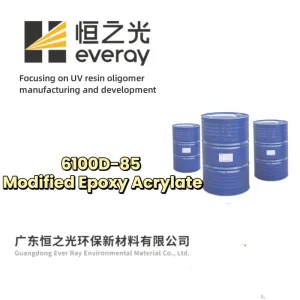
Primary Choice: Grade 1262B, 6100D-85 & 5501 Polyester Acrylates
High-traffic SPC and luxury vinyl tiles (LVT) require low-viscosity UV coatings that fill micro-pores while providing superior wear resistance. Grade 1262B delivers excellent chemical resistance to household solvents, non-yellowing characteristics, and low shrinkage upon rapid UV curing.
Primary Choice: Grade 5403-3F & 6805A-1 Modified Resins
Modern printing presses operate at line speeds exceeding 300 meters per minute. Grade 5403-3F polyester acrylate delivers superior pigment wetting, maintaining optimal water-ink balance in lithographic UV inks while preventing emulsion breakdown.
Primary Choice: Grade 72017A-8 & 6271 Low-Yellowing Oligomers
Additively manufactured footwear midsoles requires elastic recovery and high tear strength. Grade 72017A-8 offers dual-curing functionality, combining rapid UV green-state formation with post-thermal secondary crosslinking for maximum dynamic fatigue performance.
Complete product listings for substrate bonding, LED-UV wood finishes, vacuum plating primers, and high-water-balance ink oligomers.
In-depth responses from our senior polymer R&D team to assist procurement directors and technical formulators.
Request technical data sheets, safety data sheets, and free 500g sample kits for batch testing in your laboratory. Contact our application engineering team today.
